
Amazon Affiliate Cookie Duration: 24 Hours, With a Catch
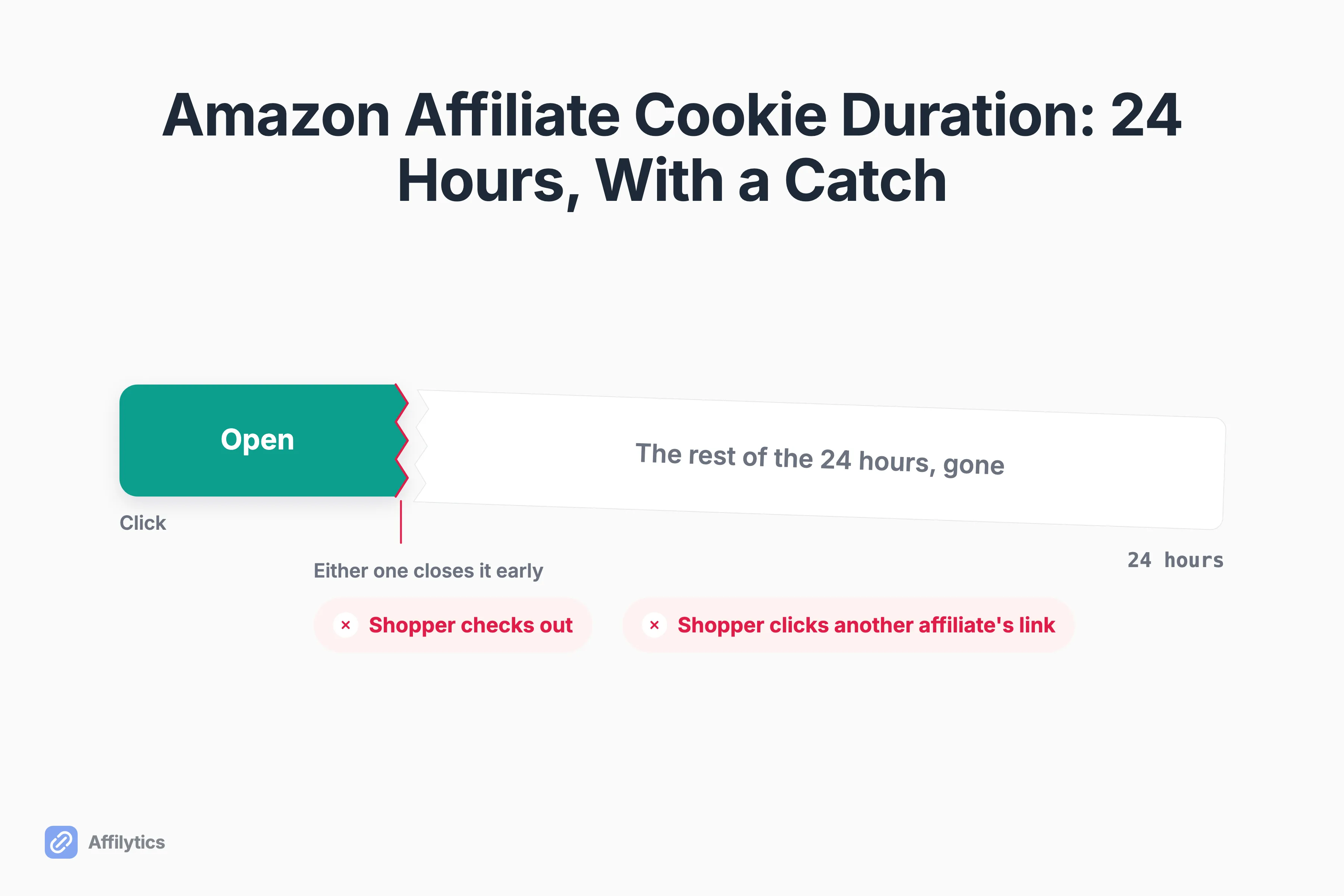
The Amazon affiliate cookie duration is 24 hours. That sounds simple until you learn that two perfectly ordinary things a shopper does can slam that window shut in four minutes.
We build Affilytics, which routes a creator’s affiliate clicks to the storefront where they can actually be credited, so we spend a lot of time inside the mechanics of what happens between a click and a commission.
That gap between the click and the payout is where affiliate income quietly disappears, and it is the same gap behind why commissions vanish between the click and the sale.
This post covers what the 24-hour window actually is, the two things that close it early, the 90-day rule everyone misnames, and why a click can miss the window before the clock even starts.
How Long the Amazon Affiliate Cookie Actually Lasts
Section titled “How Long the Amazon Affiliate Cookie Actually Lasts”Amazon’s own program documentation says you earn commission on any qualifying items placed in a customer’s Shopping Cart within 24 hours of that shopper arriving through your link. Here is the sentence in full:
“You earn commission income on any qualifying items placed in a customer’s Shopping Cart within 24 hours of their arrival at Amazon.com via your Associates link.”
Read it twice. Two things are hiding in there that nearly every summary of it drops:
- The clock starts on arrival, not on the click that generated the visit and not on the purchase at the end of it.
- It covers any qualifying items placed in the cart, not only the product you actually wrote about.
A tracking cookie here is just a small note the shopper’s browser holds saying “this person came from you.” Amazon’s note has a 24-hour shelf life. That’s the whole primer. If that window is what pushed you here, it is also worth knowing the alternatives worth adding and which of them publish a cookie window at all.
Now the part the search results skip. The link doesn’t expire. The attribution window does.
Those are two different failure modes with two different fixes, and creators mix them up constantly. In the r/Affiliatemarketing thread Google ranks for this exact question, the original poster had to step back in and clarify: “My question was about the links themselves, not the cookie data.” Half the answers underneath were solving the other problem.
So which one is actually broken when your clicks stop paying?
If the URL still loads a live product page, your problem is timing and attribution, and the rest of this post is about that. If it doesn’t load, you have link rot instead, and Amazon affiliate links do not expire, but they do rot covers that half.
The Two Things That Close Your 24-Hour Window Early
Section titled “The Two Things That Close Your 24-Hour Window Early”Most explanations treat the 24 hours as a countdown that ticks along peacefully while the shopper thinks it over. It doesn’t work that way. Amazon shuts the window early on two specific events, and every explainer ranking around Amazon’s own help page skips both.
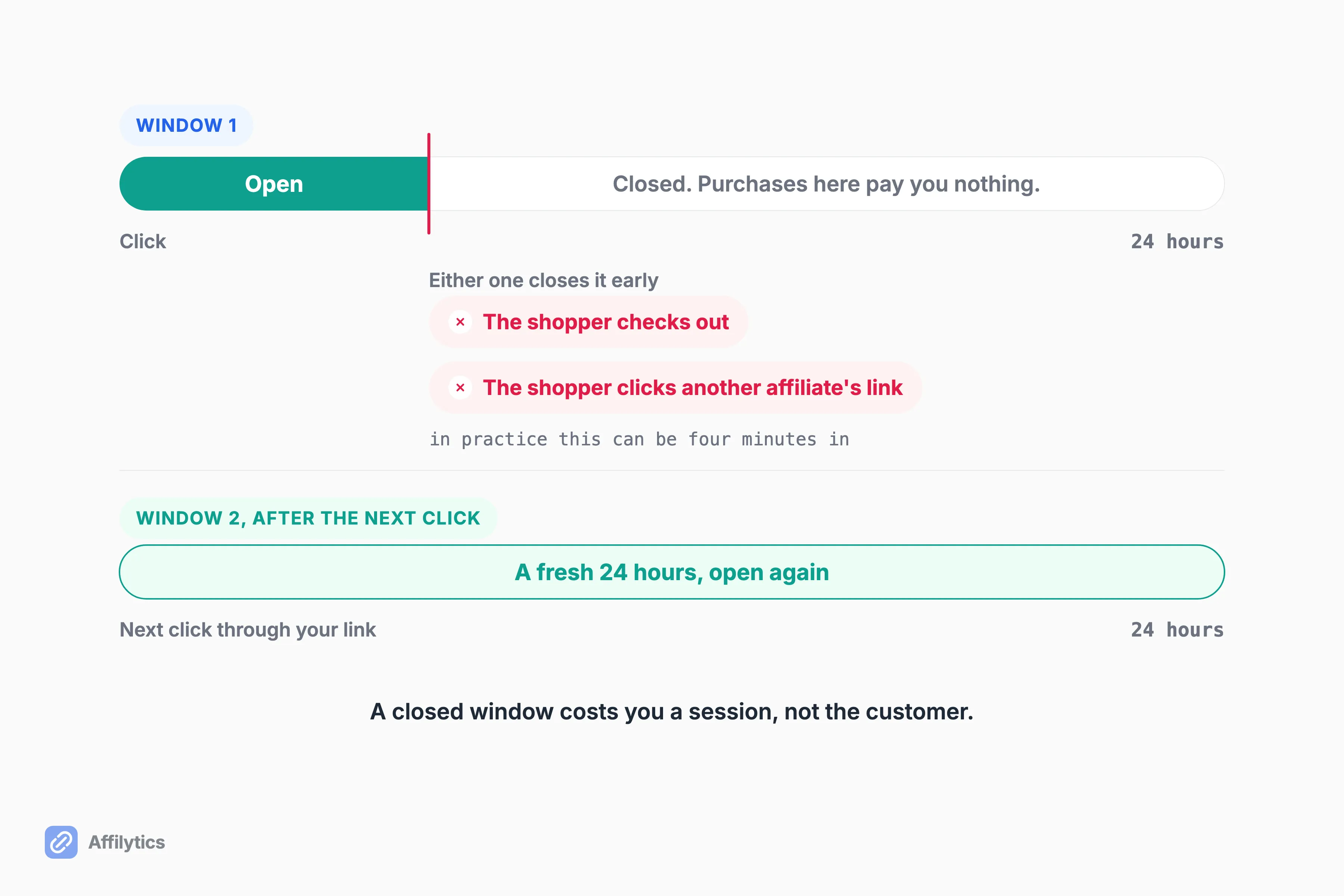
Amazon’s wording:
“However, this 24-hour window closes once the customer submits his order or reenters Amazon.com through another Associate’s link.”
- The shopper checks out. Someone who clicks your link and buys within four minutes has just closed your window. Whatever they buy that evening, in a second session, pays you nothing.
- The shopper clicks another affiliate’s link. A shopper who reads two or three reviews before buying has clicked two or three affiliate links, and only the last one counts. That is not an edge case. That is the normal path.
The first one catches creators off guard because it feels backwards. The reward for a fast, decisive buyer is a window that lasted four minutes instead of 24 hours. Speed backfires here.
So is a closed window a permanent loss on that shopper?
No, and this is the sentence worth remembering: “if the customer then returns to Amazon.com through one of your Associates links, this opens a new 24-hour window.” A closed window costs you a session, not a customer. Every new click through your link is a fresh 24 hours.
The 90-Day Rule Everyone Calls a Cookie
Section titled “The 90-Day Rule Everyone Calls a Cookie”Search the Amazon affiliate cookie duration and a good share of the results will tell you there is a 90-day version of it. There is not. There never was.
What Amazon actually says is this:
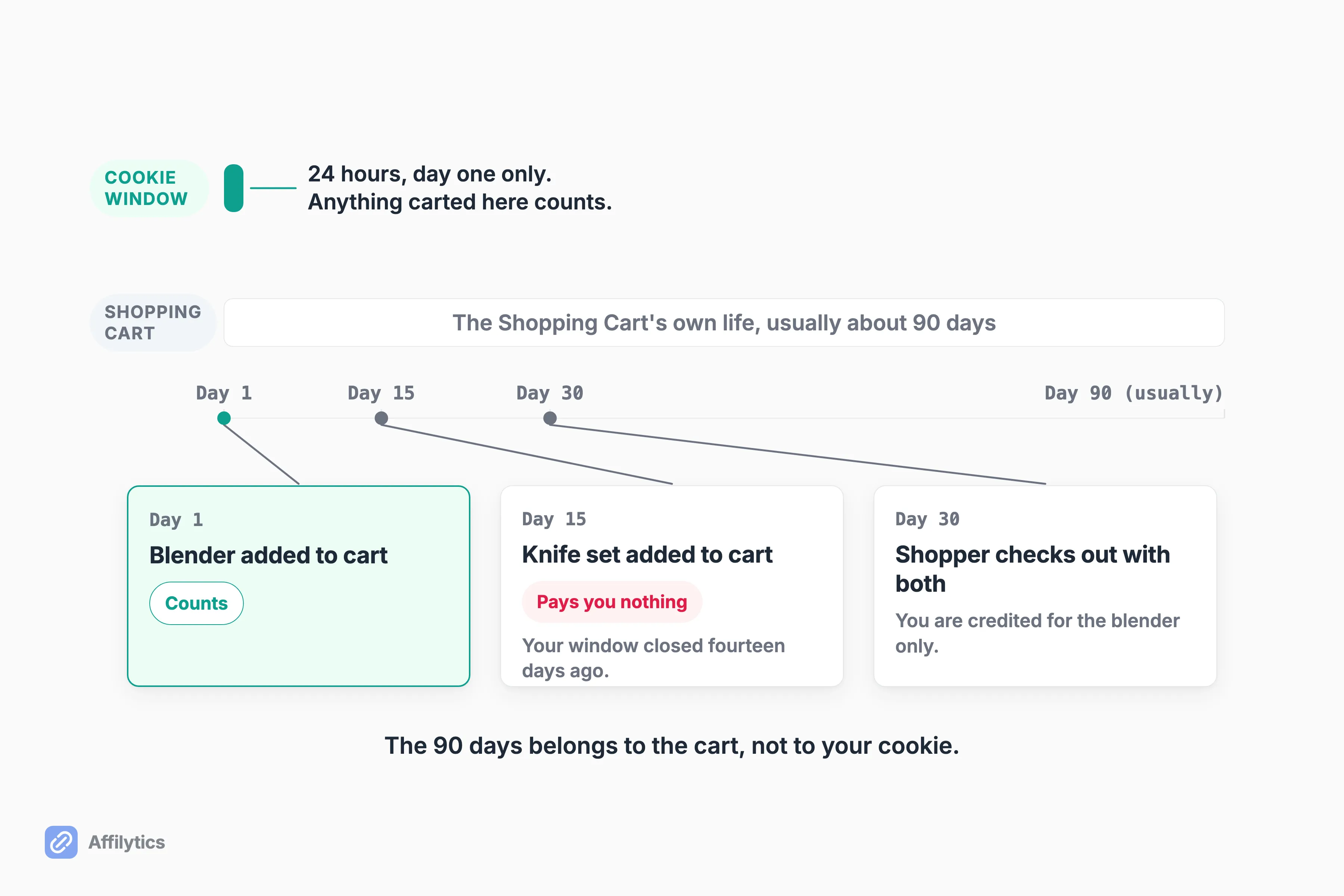
“As long as the item was added to the customer’s Shopping Cart during this 24-hour window, you will still earn a referral commission if the order is placed before the Shopping Cart expires (usually after 90 days).”
The 90 days belongs to the Shopping Cart, not to you. It only ever applies to items that were already carted inside your 24 hours. And Amazon’s hedge word is “usually”, which several ranking pages quietly upgrade into a fixed extension with its own arithmetic. Amazon never states that number, so I am not going to repeat it.
Here is the version you can actually follow:
- Day 1: the shopper clicks your link and drops a blender in the cart. Inside the window, so it counts.
- Day 15: they add a knife set to the same cart. Your window closed fourteen days ago. That one pays you nothing.
- Day 30: they check out with both. You get credited for the blender.
Why does the money show up so much later than the sale, then?
Because Amazon adds one more condition: the commission “will not be credited to your Associates account until the customer has purchased the item, accepted delivery, and remitted full payment to Amazon.com.” Carted on day 1, bought on day 30, delivered on day 33. The line item lands in your account well after you stopped thinking about that click.
What the Window Covers: The Whole Cart, Not Just Your Product
Section titled “What the Window Covers: The Whole Cart, Not Just Your Product”The phrase “any qualifying items” is doing real work, and it is the part creators under-use most. Say a reader clicks your $14 supplement link, lands on Amazon, and then adds a $340 espresso machine to the same cart before checking out. Both are qualifying items placed during your window. You get paid on both.
That’s genuinely good news, and it’s also the part of the mechanic that travels furthest in distorted form. A post with 159 likes on X puts it this way:
“Amazon is legally required to pay u a commission on every single product a customer buys within 24 hours of clicking ur link… not just the product u recommended. ANYTHING they buy. The entire cart. For 24 hours.”
Is any of that true?
The core of it, yes. Qualifying items really aren’t limited to the product you recommended, and that’s worth planning content around. But three things in there will cost you money if you believe them:
- “Legally required” is wrong. No statute sets this window. It is program policy, and the Associates Operating Agreement says Amazon can modify any of the terms and conditions at any time and in its sole discretion.
- It ignores both closing events. “For 24 hours” is only true if the shopper neither checks out nor clicks another affiliate’s link, and one of those two almost always happens.
- It collapses two separate rules. The 24-hour add-to-cart window and the cart’s own expiry are different clocks with different jobs.
Worth knowing too: shoppers understand this rule better than most creators assume, and a chunk of them dislike it. On r/InfluencerLounge, u/RoboticCommentator put it bluntly: “I hate how they get commission on things they aren’t even pushing. Just accidental or halo sales as it’s called. It’s so grimy.” That’s a fair thing to feel about a rule you didn’t agree to. It’s also the rule, exactly as Amazon writes it, and pretending everyone loves it doesn’t make anyone’s links track better.
Why Your Clicks Can Miss the Window Entirely
Section titled “Why Your Clicks Can Miss the Window Entirely”A 24-hour window is worth nothing if the click never opened one. This is the failure mode that hides best, because your click count looks completely healthy while your commission report does not. It is also one of the four leaks we priced out when working through what the 24-hour window costs you in real earnings.
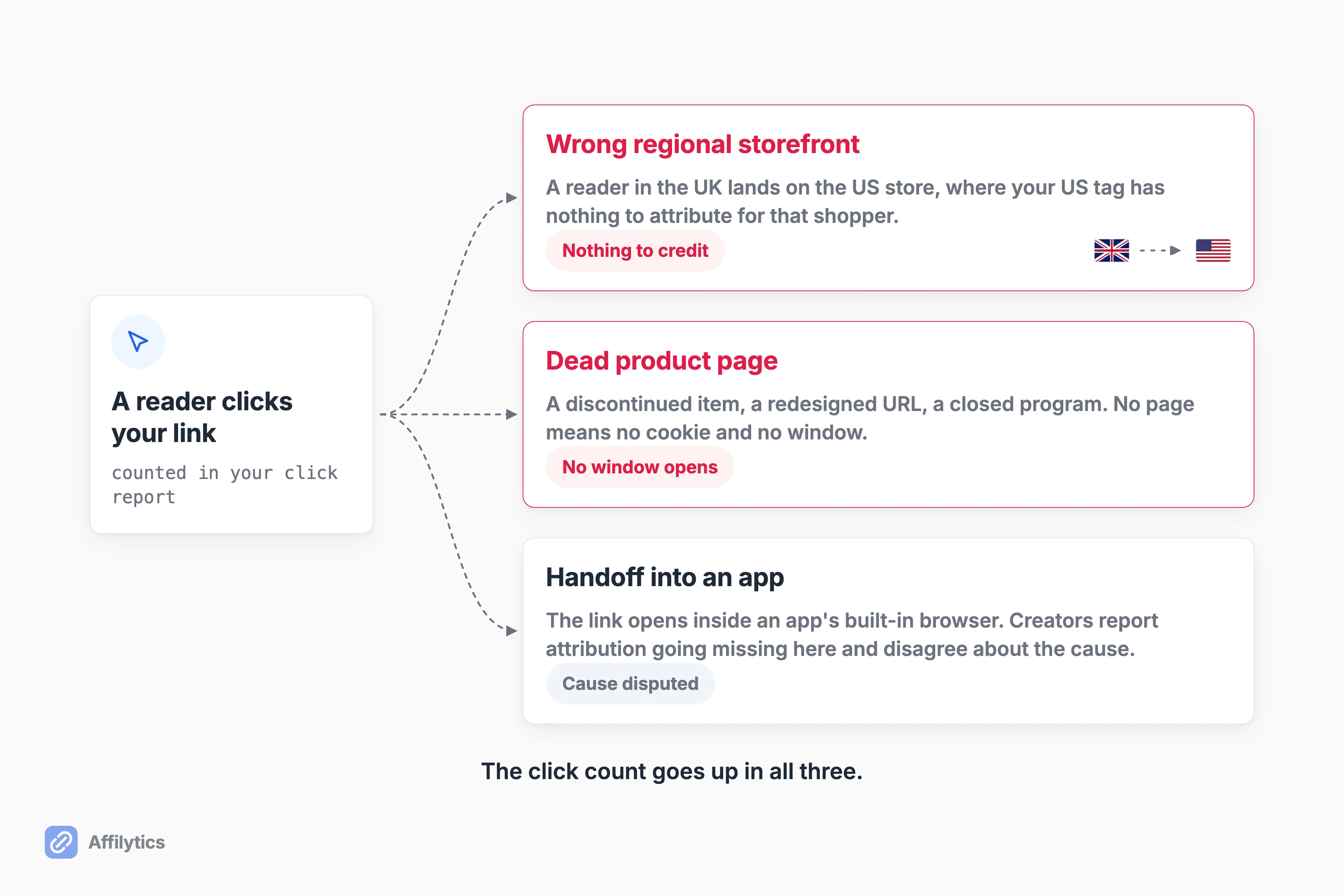
Three things go wrong before the clock ever starts:
- The click lands on a storefront where your tag does not work. A reader in the UK clicking an
amazon.comlink arrives on the US storefront, where a US tracking ID has nothing useful to attribute for that shopper. A window may technically open. It opened on a click that was never going to turn into credited income, which is why what an international click is actually worth is usually less than a creator assumes. An Affilytics smart link checks which country the click came from, sends it to that country’s Amazon storefront with the tag that works there, and falls back to a default destination when no country rule matches. The 24 hours then starts on a click that can actually be credited to you. - The link is dead. A discontinued product, a merchant URL redesign, a program that shut down. No product page means no cookie and no window, and the click still lands in your click count, which is exactly how an Amazon affiliate link that stops working stays invisible for months.
- The click hands off to an app. Creators regularly report losing attribution when a link opens inside a social app’s built-in browser or inside the Amazon app, and they openly disagree about the cause. In one r/Amazon_Influencer thread, the original poster (“I have hundreds of click throughs but not a single sale”) blamed the Amazon app for dropping the tag, the highest-scored reply flatly contradicted that explanation, and a second commenter offered a different mechanism entirely. Nobody in that thread produced a mechanism everyone accepted. That thread is an Influencer-program one, and both Amazon programs run on this same 24-hour window, which is why how the two Amazon programs compare turns on the click rather than the rate card.
So how do you tell which one is happening to you?
Look at what the click hits, not at what the click count says. Clicks with no sales and a live product page usually means the storefront or the tag. Clicks with no sales and a page that redirects somewhere strange usually means the link itself.
How to Get More Out of a 24-Hour Window
Section titled “How to Get More Out of a 24-Hour Window”You can’t negotiate the Amazon affiliate cookie duration. You can decide what a click meets on the other side of it, and that is most of what you actually control.
Where does that actually leave your content strategy? Roughly here:
- Publish where the click and the purchase sit close together. A 24-hour window rewards buy-now content over research content. A “which one should I get” post converts inside the window in a way a “what to look for in 2027” post rarely does.
- Make the click land right the first time. Right storefront, right tag, live product page. That’s the sentence that ties this whole post together, and how geo-routing sends each click to its own storefront walks through the redirect path behind it.
- Know which links are dead before your readers do. Affilytics can scan a YouTube channel or a site, find every affiliate link already published there, and monitor each one, with an alert the moment a check catches the change rather than at the end of the week. It finds and watches the links you already have; turning one into a smart link stays your call.
- Check other programs against their own terms. Twenty-four hours is short compared to a lot of the market. Awin, one of the larger affiliate networks, tells its own advertisers the industry standard is 30 days, but durations may vary by program. The comparison tables floating around are mostly copied from each other, so read the program’s own terms instead. Target’s partner FAQ, for one, publishes a 7-day last-click window, seven times Amazon’s.
Every Click Gets Exactly One Window
Section titled “Every Click Gets Exactly One Window”Twenty-four hours, one shot per click, and only one part of it is yours to control: where the click lands. Everything else is Amazon’s clock.
Two full weeks of Affilytics with everything unlocked, no credit card, is enough time to see which of your links open a window worth having and which ones are quietly opening nothing at all. Create your free account and point a real click at it.
How long does the Amazon affiliate cookie last?
Section titled “How long does the Amazon affiliate cookie last?”24 hours, counted from the moment the shopper arrives at Amazon through your Associates link. During that window, any qualifying items they place in their Shopping Cart can earn you commission, not just the product you linked to.
Is there a 90-day Amazon affiliate cookie?
Section titled “Is there a 90-day Amazon affiliate cookie?”No. The 90 days is roughly how long the Shopping Cart itself lasts, and it only applies to items already added during the 24-hour window. Amazon’s own wording is “usually after 90 days”, so it is not a fixed guarantee.
Do I earn commission on everything the customer buys?
Section titled “Do I earn commission on everything the customer buys?”On any qualifying items they put in the cart while your window is open, yes. But the window closes the moment they submit an order or re-enter Amazon through another Associate’s link, and purchases after that point pay you nothing.
Do Amazon affiliate links themselves expire?
Section titled “Do Amazon affiliate links themselves expire?”No, the URL keeps working. What expires is the attribution window. Separately, the product page behind the link can die, which is a different problem with a different fix.