
Amazon Influencer vs Affiliate: Which One Pays You More
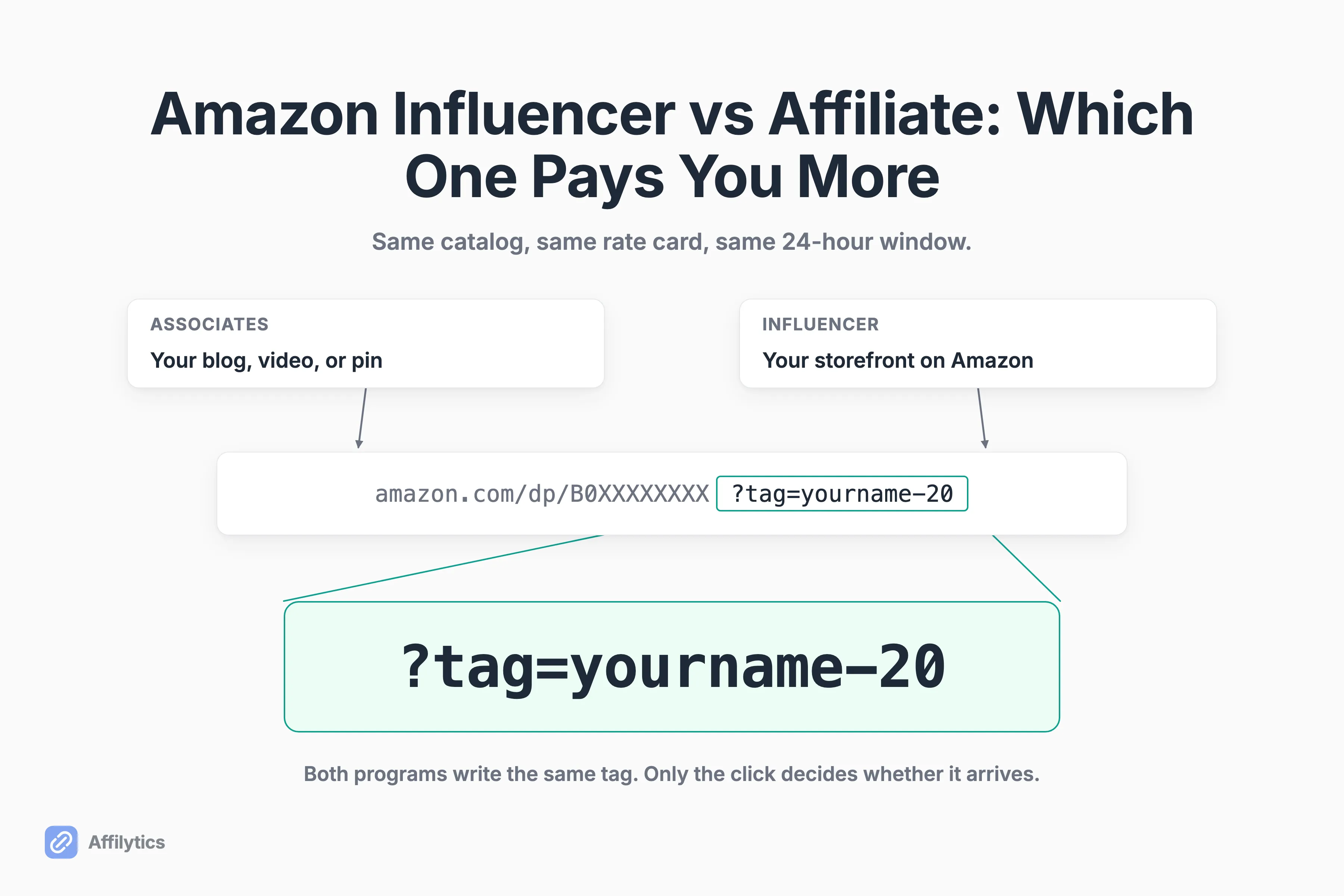
You got approved for the Amazon Influencer program and the Amazon affiliate program separately, and now you are staring at two dashboards trying to work out which one is actually worth your time. One creator in r/Amazon_Influencer put it plainly: “I had to apply to both separately and was approved separately.. but I don’t understand how they work cohesively.” Here is the honest answer. The Amazon Influencer vs affiliate choice matters far less than what happens to the click after someone taps your link.
We build the routing and link-health layer that sits underneath affiliate links, so we spend most of our time on the part of this question the comparison articles skip: what happens between the tap and the checkout.
Both programs are paid on the same terms, and both of them run on the same short clock, a 24-hour window that starts the moment somebody clicks and does not care which program sent them.
This guide covers what actually separates the two programs, what they share, the one asymmetry that should decide it for most creators, and how to run both without losing track of either.
The Short Answer: They Are Two Doors Into the Same Store
Section titled “The Short Answer: They Are Two Doors Into the Same Store”Neither program pays more than the other by design.
Both the Amazon Associates program and the Amazon Influencer program pay commission off the same rate card, and that rate card is set by product category. A kitchen gadget pays what a kitchen gadget pays, whichever door the shopper walked through. So “which one pays more” has no answer at the rate level. It only has an answer at the traffic level.
The cleanest description I have read came from a creator in r/Amazon_Influencer answering this exact question: “Associates is for off-Amazon traffic you send in. Influencer is for on-Amazon traffic where your videos convert shoppers already there. Same products, different commission paths.”
Here is the side by side.
| Amazon Associates | Amazon Influencer | |
|---|---|---|
| Where your content lives | Your blog, channel, newsletter, or social feed | Amazon itself, on your storefront and on product listings |
| Where the click starts | Off Amazon, on something you published | On Amazon, from a shopper who is already browsing |
| Who can join | Creators with an active audience on a qualifying platform | Same platforms, judged on the overall strength of the connected account |
| What you have to build | Content that earns traffic you then send to Amazon | Short review and demo videos, plus a curated storefront |
| How commission is set | Amazon’s category rate card | The same category rate card |
| International reach | A link is a URL, so it can be routed to the shopper’s own marketplace | Tied to the single marketplace the storefront sits in |
On who can join, Amazon’s own program information page is refreshingly blunt: “Currently you must have a YouTube, Instagram, Tiktok, Facebook or Pinterest account to qualify.” There is no separate audience you have to go and build first.
So should you pick one?
Probably not. The most upvoted answer I found to that question came down to this: “you can do both. You would be getting a lot of extra money for almost no more extra work.” That holds up, because the two programs are fed by different traffic.
Your storefront videos do not steal clicks from your blog, and your blog does not steal shoppers from the Amazon search results. Running both adds a second income path on top of a catalog you are already recommending from.
What Actually Differs: Where the Click Starts
Section titled “What Actually Differs: Where the Click Starts”There is exactly one structural difference between the two programs, and every other difference in this comparison is downstream of it: where the click starts.
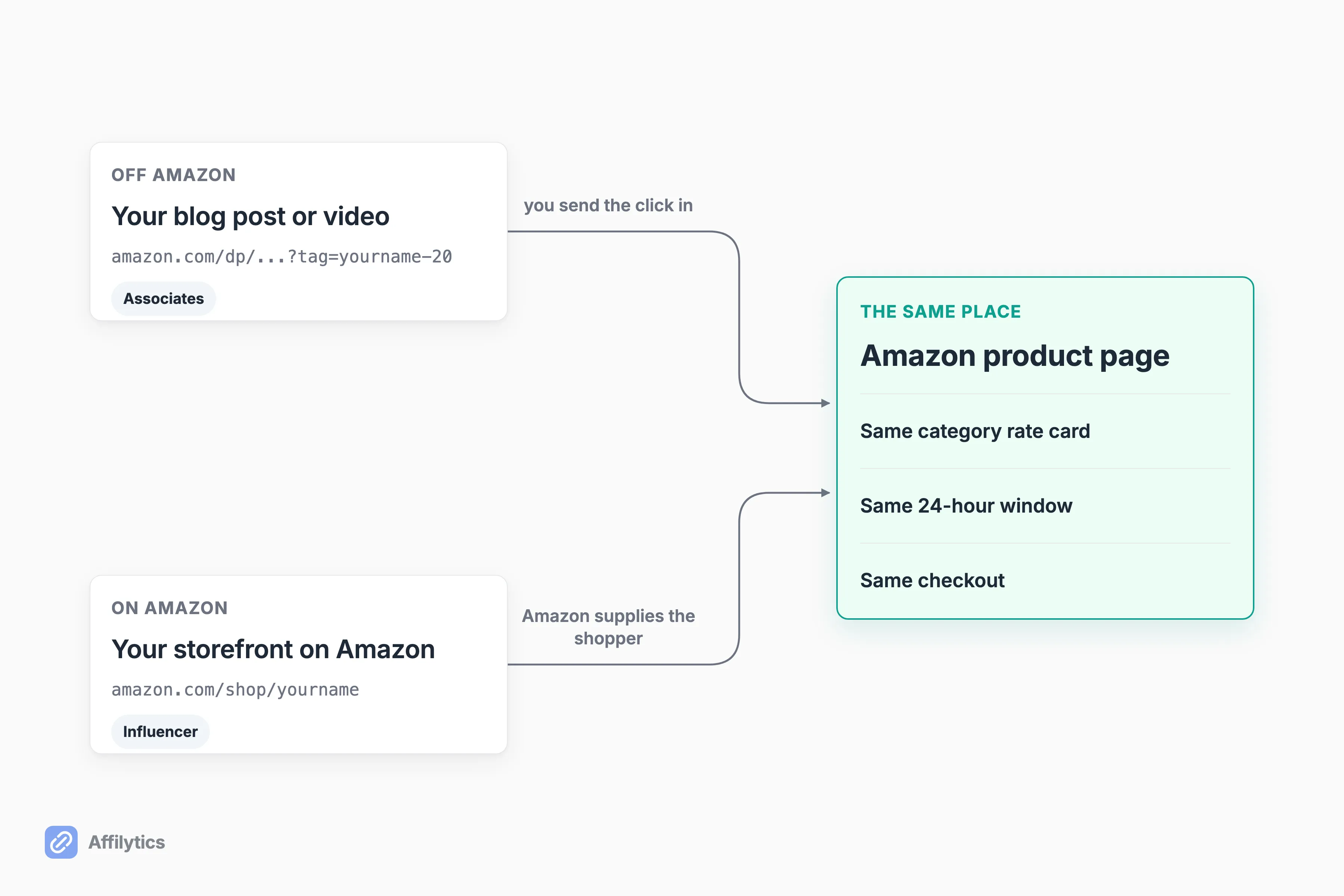
With Associates, the click starts on something you own. A blog post, a video description, a newsletter, a pin. You built the audience, you keep the audience, and Amazon rents you the catalog and the checkout at the end of it.
With Influencer, the click starts on Amazon. Your storefront is a page hosted on Amazon that collects the products you recommend, and your onsite review videos can appear on the product listings themselves, next to a shopper who is already mid-purchase. You are not bringing anyone in. You are converting people Amazon brought.
That flips who owns what. With Associates you own the audience and rent the catalog. With Influencer you rent both, and Amazon decides whether your video gets shown at all.
Is that a dealbreaker?
No, but it is a real cost, and creators name it. One put it this way: “My only issue with Amazon reviews is they rotate the videos, one day you’ll be watched to get the commission another day you’ll be swapped out.” You have no visibility into why a video that earned yesterday earns nothing today.
The offsite side has its own gate, and it catches people who came in through the storefront. A creator with dozens of onsite commissions and one offsite sale asked whether the whole account was at risk, and the answer was that the two tracks are judged separately: “If you have already been accepted in the influencer program and you are not trying [to] post link[s] outside of the Amazon site, you do not have to worry about it, but if you want to do any offsite sales then you do have to make 3 qualified sales on the associates side.” That gate is real and Amazon spells it out: once you apply, you have 180 days to refer a sale, and once you have referred three qualifying sales Amazon reviews your application and gives you a decision.
What Does Not Differ: The Rate Card and the 24-Hour Window
Section titled “What Does Not Differ: The Rate Card and the 24-Hour Window”Two things creators assume are the differentiator, and neither one is.
The first is the money itself. Amazon’s category rate card is what pays you on both sides, and a category pays what it pays regardless of whether the sale came from a storefront video or from a link in an old blog post. Picking a program will never move that number. Picking a category will.
The second is the clock, and this one deserves more attention than it gets. How the 24-hour window actually works is the single most expensive mechanic in either program: the click starts a 24-hour timer, everything the shopper adds to their cart inside it can be credited to you, and everything after it is somebody else’s commission.
So what does that actually mean for the content you already published?
It means your old work only pays through fresh clicks. A video from two years ago can earn today, but only because somebody watched it today and tapped through today. It also means the gap between “I got a lot of clicks” and “I got paid” is completely normal, and it is not evidence that you chose the wrong program.
Creators feel this and mostly find out the hard way. One asked flatly: “How do I tag the products on Pinterest if you click on them they start a 24 hour deadline?” That is the right instinct, and the answer is the same on both sides of the house:
- The window starts at the click, not at the view, so impressions are not the number to watch.
- A shopper who browses today and buys on payday next week earns you nothing.
- Nothing about being in the Influencer program extends it, and nothing about being an Associate shortens it.
The Asymmetry That Should Decide It: International Traffic
Section titled “The Asymmetry That Should Decide It: International Traffic”Here is the one place the two programs genuinely diverge on income, and it has nothing to do with commission rates.
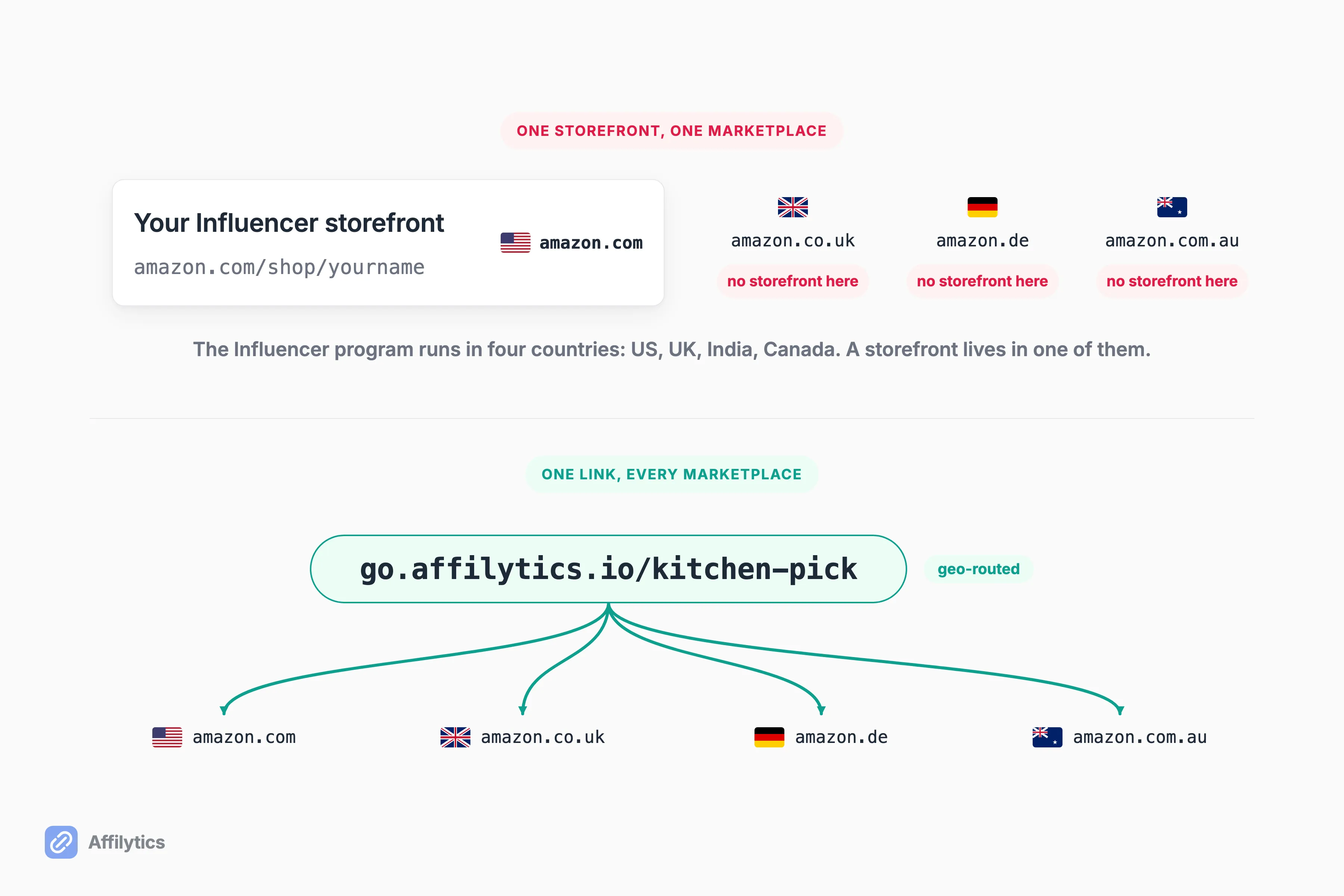
An Influencer storefront is tied to one Amazon marketplace, and the program itself only exists in a handful of them. Amazon runs a separate Influencer Program for the US, the UK, India, and Canada, which is the entire list. So a US storefront is a US page for US shoppers. A visitor browsing a German or Japanese Amazon is not looking at a different version of your storefront. There is no version of it waiting for them at all.
An affiliate link does not have that problem, because an affiliate link is just a URL. A URL can be rewritten, redirected, and pointed at whichever Amazon the visitor actually shops on. That is the whole reason Amazon built its own redirect tooling, and it is worth understanding both what OneLink does and where it stops before you rely on it, along with the newer setup that lets a single account earn from international traffic across several marketplaces. That is a program-level choice; once you have made it, what you actually publish comes down to how the two link formats differ once you have picked a program.
So how much of your audience is actually outside your own country?
Go and look before you answer. Most creators guess low, and the country breakdown in your platform analytics settles it in about thirty seconds. If a real share of your viewers is abroad, that share is structurally unreachable through your storefront and reachable through links. That is a far bigger swing than any eligibility rule or effort difference in the earlier sections.
This is the part of the problem we built for. An Affilytics smart link is a short URL on go.affilytics.io with country rules attached to it:
- The visitor’s country is resolved from their IP address.
- The first matching country rule wins and sends them to that marketplace.
- Anything unmatched falls back to a default URL, so nobody ever hits a dead end.
You create the link and swap it into your content yourself, the same way you would swap in any other link. The point is that your UK viewer stops landing on a page they cannot buy from.
The Failure Both Programs Share: The Click That Never Gets Credited
Section titled “The Failure Both Programs Share: The Click That Never Gets Credited”A tap is not a credited click.
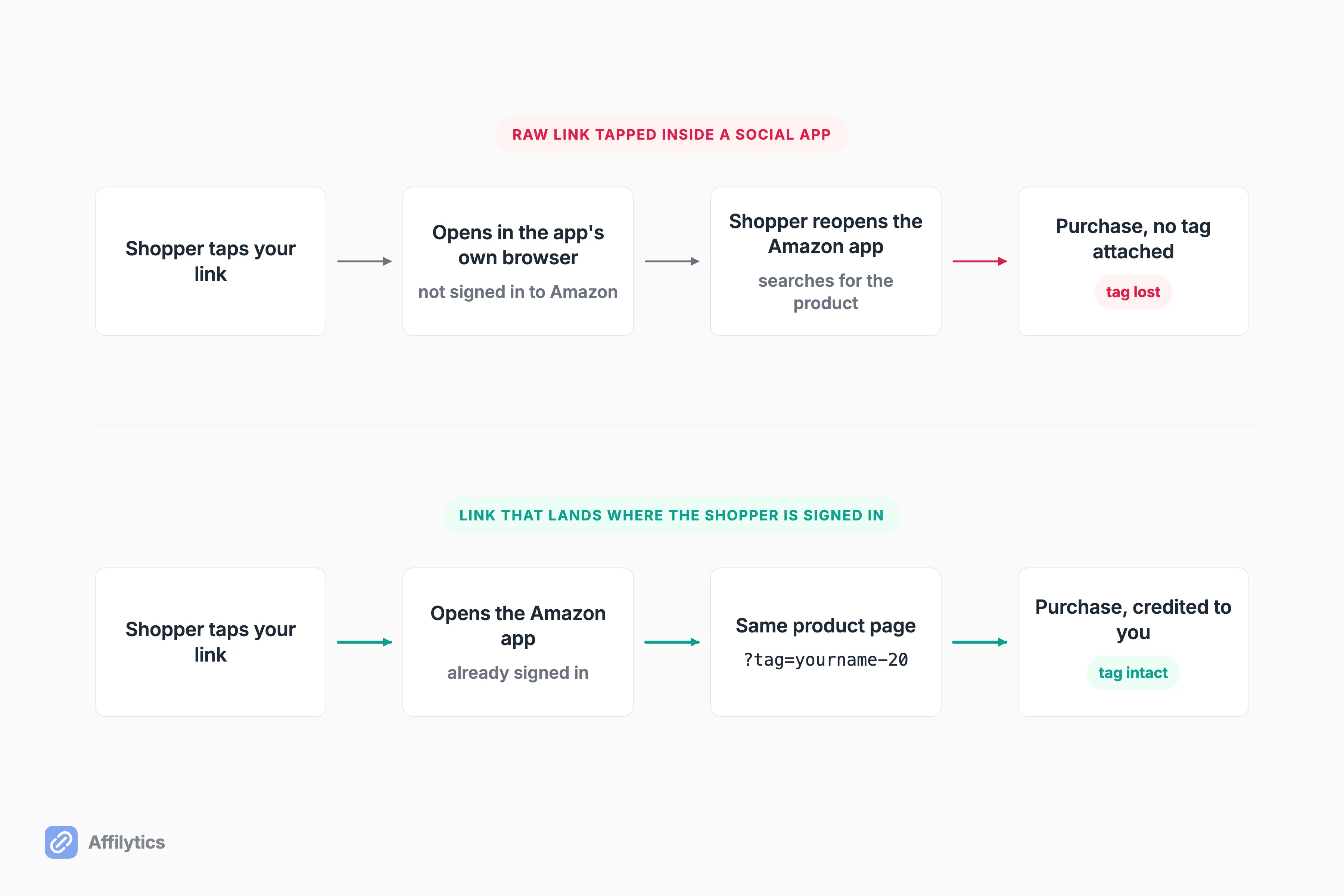
This is the failure mode the comparison articles ranking for this question skip, and it hits both programs equally. The window can be running perfectly and the tag can still be missing, which means the sale happens, the shopper is happy, and nothing lands in your dashboard.
The symptom is unmistakable once you have seen it. A creator described theirs like this: “On Pinterest, it shows that my posts are 100k+ views with hundreds of outbound clicks to my Amazon. However, recently on SiteStripe, it shows I only average about 2 site visits a day, and the products I am earning commission from are random products I never advertised.”
Hundreds of clicks on one side of the glass. Two visits a day on the other.
The mechanism creators keep converging on is not exotic. A raw link tapped inside a social app usually opens in that app’s own built-in browser, and almost nobody is signed in to Amazon there.
As one commenter explained it: “Using only the sitestripe link opens the browser within the app you’re using. So if you post on IG, it opens in the IG browser, which nobody logs in on… you lose it because they didn’t log into Amazon after clicking your link.” The shopper then goes and finds the product in the real Amazon app, buys it there, and that purchase was never connected to you. We walk through the full chain of why commissions vanish between click and checkout separately, because it is a longer story than this section can hold.
The community’s answer to this is deep linking, treated as folk knowledge rather than documentation: “Most folks including Amazon recommend deep linking your links. It’s utterly ridiculous we need to do that but here we are.”
So what do creators reach for?
Across two threads on this exact problem, five separate third-party tools got named to each other: LinkTwin, Joylink, PostTap, Geniuslink, and URLgenius. The commenters did not agree on which one preserves the tag. What that disagreement tells you is more useful than the names themselves: creators have already accepted that a raw link out of SiteStripe is not the finished product, no matter which of the two programs sent the click.
How to Choose, Based on What You Already Publish
Section titled “How to Choose, Based on What You Already Publish”The Amazon Influencer vs affiliate decision gets easier when you forget the feature lists. Frame it around what you are already producing every week.
- You publish long-form off Amazon (a blog, YouTube reviews, a newsletter, a real Pinterest presence). Associates is where your existing catalog earns. Every post you have already written is inventory, and you do not have to make anything new to start.
- You are willing to shoot short unboxing and demo clips. The Influencer program adds a second path, and it does not need an audience of your own, because Amazon supplies the shopper. What it needs is volume.
- You do both. Run both. They are fed by different traffic and they do not cannibalize each other.
Should you believe the income screenshots while you decide?
Be careful there. Public earnings posts about the Influencer program are loud, and they get contested in their own replies within hours.
One projection was answered with “No you don’t… Nice bait though.” Another creator posting his own earnings screenshots conceded further down the same thread that “The business is not profitable yet (spent over $7k, made less than that total so far).” Neither of those is proof the program is bad. They are proof that a headline number is not a plan.
The more useful signal in those threads is what scaling actually looks like. The same creator explained how he keeps the time cost down: “I’ve outsourced everything, so the time is pretty small for me. I’ve hired others to create the videos for me and VA uploads the videos.” That is a small operation with staff, not a side project. If you are choosing between the two programs on effort, price the Influencer side at what it takes to keep shipping video, not at what it takes to shoot the first one.
Running Both Without Losing Track of Either
Section titled “Running Both Without Losing Track of Either”Two commission paths means two places money can quietly stop arriving, and they fail in different ways.
The onsite side fails visibly. A video gets rotated out of the carousel and your earnings drop, and while that is frustrating, you can see it happen in the dashboard. The offsite side fails silently, because that is where the inventory accumulates. Every blog post, description and pin you have ever published is still out there serving links to products that have since moved, sold out, or lost their tag.
An old link stops paying in more ways than it stops loading:
- The product was discontinued or replaced, so the page still opens and there is nothing on it to buy.
- The item is out of stock in the marketplace the shopper actually landed on.
- The page loads perfectly and the tag is gone, which looks identical to a healthy link from the outside.
None of those look broken in a browser. That is exactly what makes them expensive.
How would you even know?
You mostly would not, which is why the creator earlier in this post was collecting commissions on products she had never promoted without ever finding out where they came from. Nobody sends you an alert when a two-year-old link stops working.
That is the job the second half of our product does. You paste a channel or site URL, Affilytics finds every affiliate link already published there, and each one gets checked on an ongoing basis, so a link that has gone broken, gone out of stock, or lost its tag surfaces when the check catches the change instead of whenever you next go looking.
Start With Where Your Clicks Actually Come From
Section titled “Start With Where Your Clicks Actually Come From”Whichever program you pick, the money lands or leaks at the link layer. So start there: pull up the country breakdown for your audience, look at how many of those people your current links can actually serve, and route the rest somewhere they can buy.
Create your free account and you get two full weeks with everything unlocked, no credit card, which is enough time to find out whether your offsite links are earning what you think they are.
Can you be in the Amazon Influencer program and Amazon Associates at the same time?
Section titled “Can you be in the Amazon Influencer program and Amazon Associates at the same time?”Yes. The Influencer program operates inside the wider Associates system, and most creators apply and get approved for each side separately, which is exactly why the two dashboards feel disconnected. They are fed by different traffic, one from your own content off Amazon and one from shoppers already browsing on Amazon, so they do not compete with each other. Running both is the default advice creators give each other, because the second path reuses work you have already done.
Does the Amazon Influencer program pay more than affiliate links?
Section titled “Does the Amazon Influencer program pay more than affiliate links?”No. Both programs are paid off the same commission rate card, which is set by product category, so the same product pays the same either way. What changes your income is where your traffic comes from and whether the click still carries your tag when the shopper checks out. Treat any claim that one program pays a better rate than the other with suspicion, because the rate is not the variable.
Do you need followers to join the Amazon Influencer program?
Section titled “Do you need followers to join the Amazon Influencer program?”You need an active account on one of the social platforms Amazon accepts, and Amazon evaluates the overall strength of that account rather than publishing a public follower minimum. Any specific threshold you have read in a comparison article is not an Amazon-published number, so do not treat it as a bar you have to clear. If your account is real and active, applying costs you nothing but the time.
Can an Amazon Influencer storefront earn from international shoppers?
Section titled “Can an Amazon Influencer storefront earn from international shoppers?”A storefront is registered in a single Amazon marketplace, so a shopper browsing a different country’s marketplace is outside it. That is the structural reason the offsite side matters for an international audience: an affiliate link is a URL, and a URL can be routed to the marketplace the visitor actually shops on, while a storefront cannot follow them there. If a real share of your audience is abroad, that share is reachable through links and not through your storefront.
Why do I get clicks but no Amazon commissions?
Section titled “Why do I get clicks but no Amazon commissions?”The two usual causes are the short attribution window and a tag that never survived the trip. The window is 24 hours from the click, so a shopper who browses today and buys next week earns you nothing. The tag problem is quieter: a raw link tapped inside a social app often opens in that app’s built-in browser, where the shopper is not signed in to Amazon, and the purchase they make later in the Amazon app is never connected back to you.