
Walmart Affiliate Program: What It Really Pays in 2026
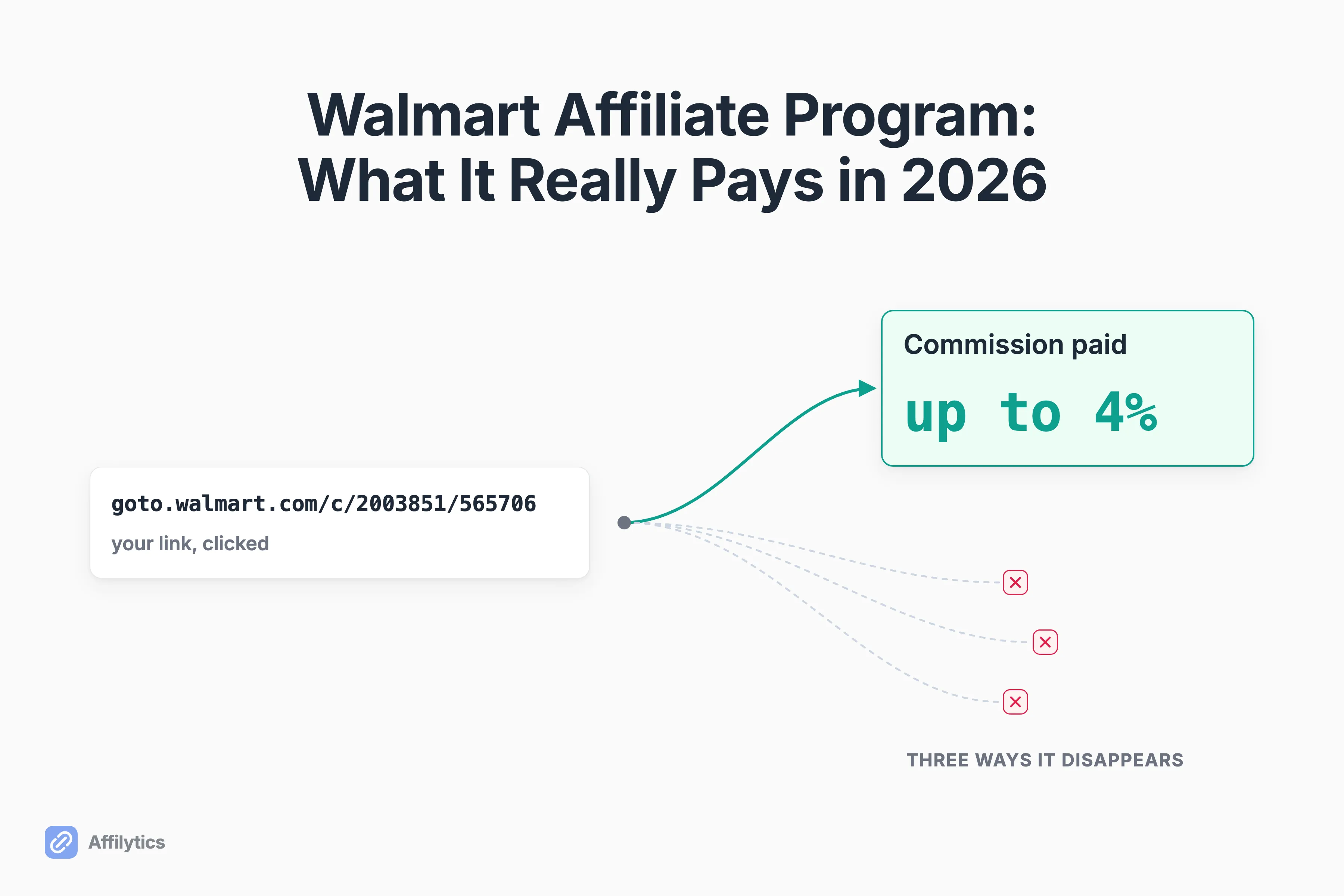
The Walmart affiliate program is one of the easiest programs to look up and one of the easiest to get wrong. The articles ranking for it hand you confident numbers: one prints a ceiling twice as high as anything on Walmart’s own site, and that same article turns a line about returns into a tracking cookie Walmart has never published.
I build Affilytics with my co-founder. It sends a click to the store in the reader’s own country and flags links that have quietly stopped paying, which is why I end up reading the parts of an affiliate agreement most people scroll past.
Most people land here from the same place, a look at programs that pay more than Amazon, and Walmart is usually the first name on that list.
This guide covers what the program actually pays, how it differs from Walmart Creator, what happens between a click and a payout, and how it stacks up against Amazon when you put both sets of terms side by side.
What the Walmart affiliate program actually is
Section titled “What the Walmart affiliate program actually is”The deal is simple. You link to products on Walmart.com, someone clicks and buys, and you get a percentage of the sale. Walmart’s FAQ is blunt about the cost of entry: “It is absolutely free to join the Walmart.com Affiliate Program”.
Here is the part almost every guide skips. You do not get a Walmart dashboard.
You get an Impact account. Impact, which Walmart’s pages still call Impact Radius, is a third-party affiliate platform that large retailers rent instead of building their own tracking software, and Walmart is one of them. Its FAQ names the arrangement directly: “Walmart.com uses Impact Radius as our Affiliate Service Provider. Impact Radius provides Walmart.com affiliates with one simple interface to track all their sales, impressions, click-throughs and commissions.”
So the practical shape of the program looks like this:
- Your links are Impact links, not links you generate inside some Walmart tool
- Your reporting lives in Impact, in the same dashboard as every other Impact program you join later
- Your commissions are paid on monthly net sales, which Walmart’s FAQ says “do not include returns, sales tax or shipping and handling”
Why does the network matter if you are only joining one program?
Because it decides where you go when something looks wrong. A Walmart link that stops paying is not a question you take to Walmart, at least not first. It is a row in an Impact report, sitting next to rows from every other advertiser you ever signed up with on that platform.
There is one more thing worth knowing before you start, because it catches people mid-signup. Creating the account is not the same as being accepted. Walmart’s affiliate agreement says that creating an account through the platform “does not guarantee your participation in the Program”.
Two doors, in other words. Impact lets you into the building. Walmart decides whether you get into the room.
Free to join is worth taking at face value, though, because it is one of the few things Walmart’s pages state without qualification. No application fee, no minimum spend, nothing to cancel if you decide it is not working. The cost of adding Walmart is not money. It is the second dashboard, and the second set of links sitting in your old content.
Walmart Affiliate Program vs Walmart Creator: two programs, one name
Section titled “Walmart Affiliate Program vs Walmart Creator: two programs, one name”Walmart runs two separate creator programs, and both of them produce something Walmart itself calls an affiliate link. That is the single most confused thing about this topic, and the confusion is not the reader’s fault.
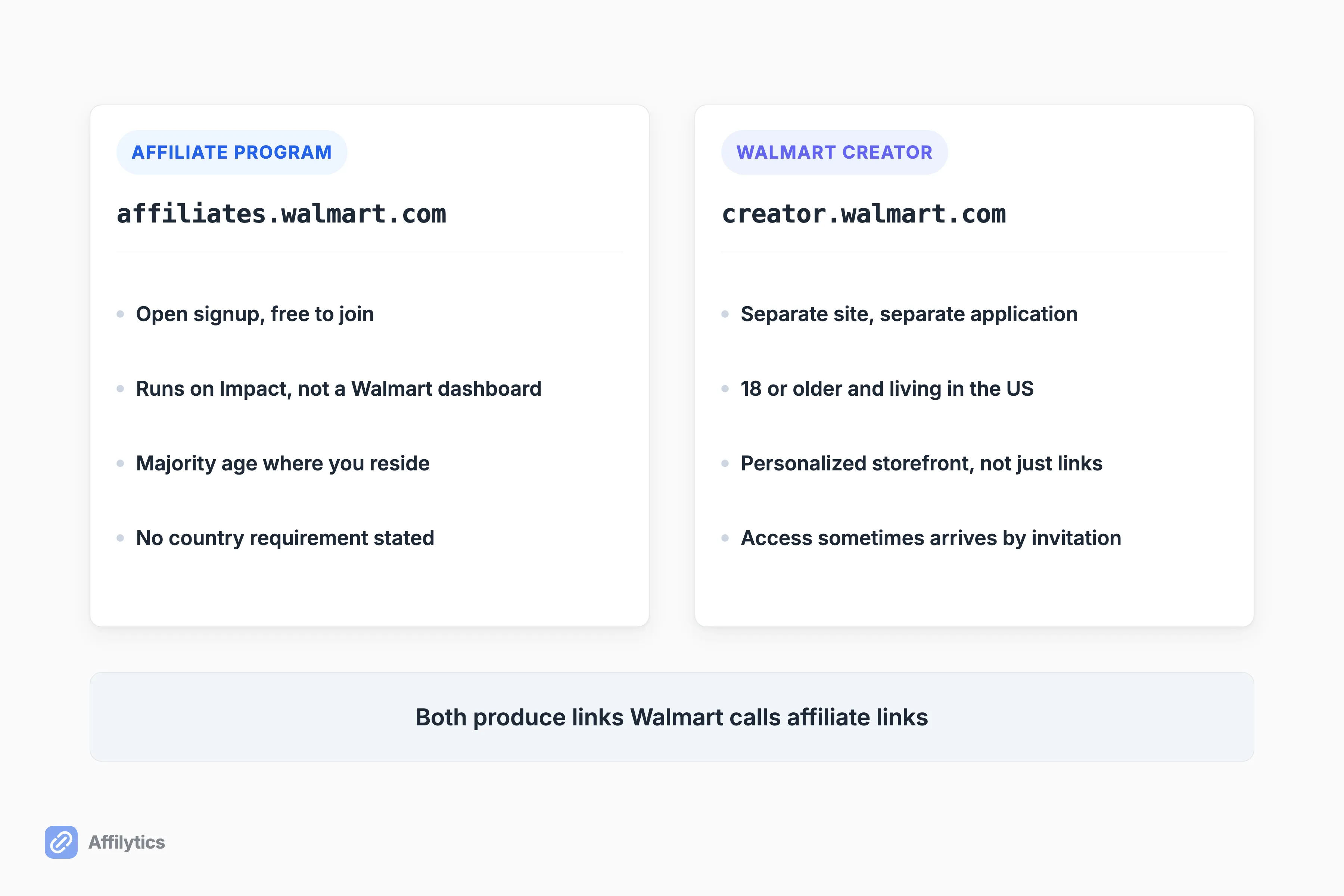
The affiliate program lives at affiliates.walmart.com. Open signup, free to join, runs on Impact.
Its public pages never say who is eligible. The affiliate agreement does, and it sets two conditions: you must “be of majority age in the jurisdiction you reside, which is at least 18 years or older in most states”, and you must not be a current Walmart employee. Notice what that list does not include: a country requirement.
Walmart Creator is a different site with different rules. Its front page states the gate plainly: you must be “18 years or older & live within the US to apply”. The mechanics are storefront-shaped rather than link-shaped: create affiliate links, build a personalized storefront, track your performance. And access does not always come from applying. One creator posted, “This morning we were invited to join the Walmart Creator Program!”
How do you tell which one you are actually in?
- If you applied at affiliates.walmart.com and log into Impact to see your numbers, you are in the affiliate program
- If you have a Walmart storefront page with your name on it, you are in Creator
- If Walmart invited you rather than approved your application, you are almost certainly in Creator
Walmart’s own Creator page labels its output “affiliate links”, which is the exact phrase the other program uses, so creators repeat the blur in good faith. One creator announcing acceptance wrote, “I’m now a Walmart creator! It’s an affiliate program like Amazon.” A poster in r/WalmartSellers described the two tangling inside a single account, saying they had “a link to a Creator’s Storefront but no storefront”, and that clicking through told them Walmart had denied them.
Sorting this out is not pedantry. The rate you should expect and whether you are eligible at all both hang on which program you are in. Walmart Creator has run an elevated promotional rate on at least one shopping event. The affiliate program publishes a flat ceiling and leaves it there. Mixing the two up is how a 4% program ends up described online as an 11% or 18% one.
What it pays, and why you will see three different numbers
Section titled “What it pays, and why you will see three different numbers”Walmart publishes two figures about its own commission, on two different pages, and they agree with each other.
The FAQ states the ceiling: “Affiliates can earn up to 4% on each eligible sale” when a customer links directly from a Walmart.com link on your site and completes a qualifying purchase. The benefits page states the structure: “A great commission structure (see chart below) that pays 1-4% with three return days.”
Read those together and you have the whole public record. Walmart’s own program page lists the structure as 1-4% with three return days, which is its attribution window. That is everything Walmart says about rate and window, in Walmart’s words, anywhere on its public pages.
Now notice what is missing. The benefits page says “see chart below” and then renders no chart. Walmart does not publish a per-category rate table on its public benefits page, so if you want to know what a television pays versus a toaster, those pages will not tell you.
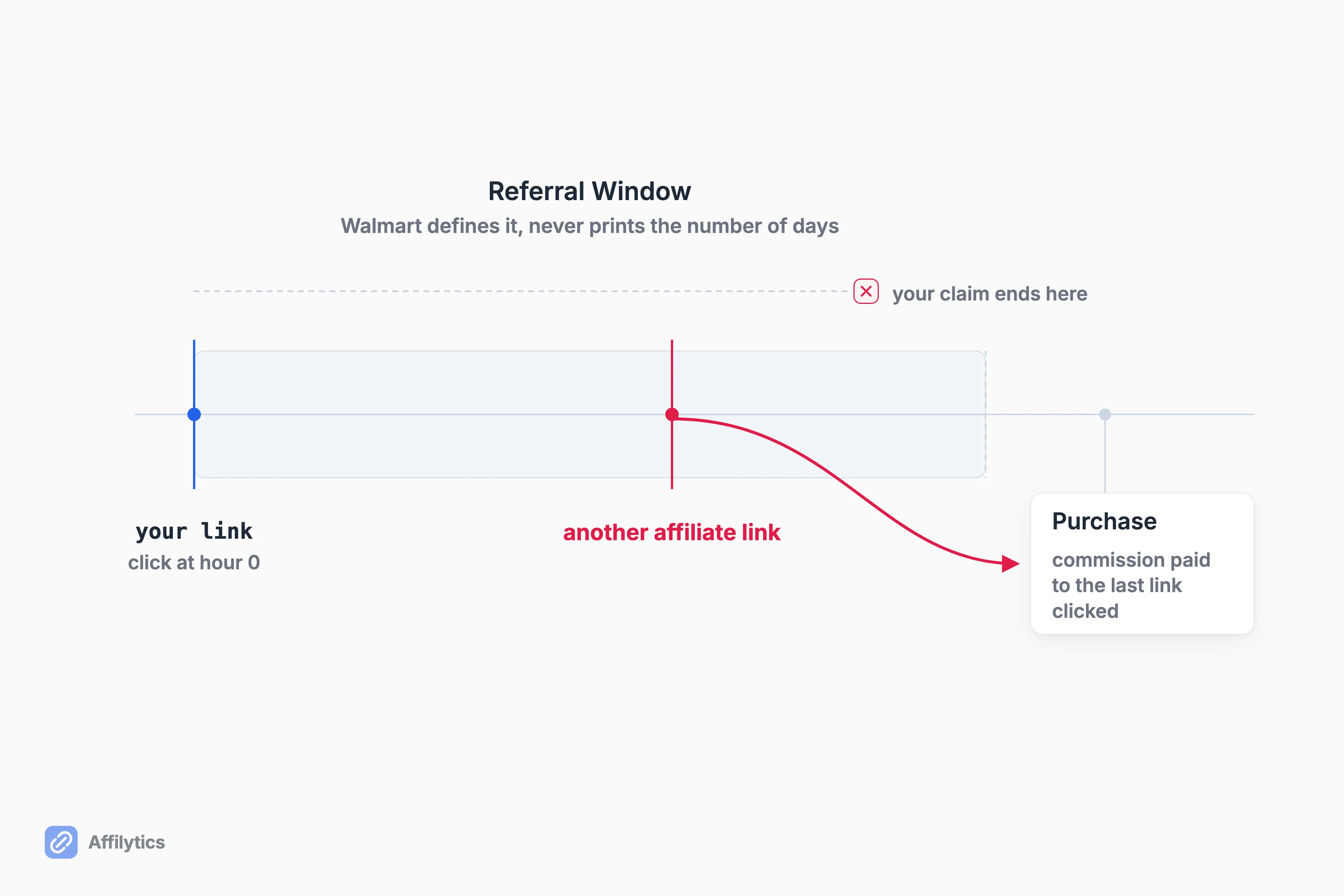
Notice something else Walmart never writes: the phrase “cookie duration”. It does not appear. The affiliate agreement gets closest, defining a “Referral Window” tied to a cookie window, and then never prints the number of days. The only number Walmart itself publishes is “three return days”, on the benefits page, in the same sentence as the rate.
So where do the other numbers come from?
Three wrong ones circulate, and each is worth knowing on sight:
- An 8% ceiling. It contradicts Walmart’s own FAQ and its own benefits page. That is two primary sources against one article.
- A bare “3-day cookie”. Three days is a defensible reading of “three return days”, but Walmart never words it as a tracking cookie, and an article printing it as a plain stat is reporting its own interpretation as Walmart’s.
- “Up to 18%”, which circulates on social. The most plausible origin is a time-boxed Creator promotion: Walmart Creator was advertising an elevated 11% commission for a beauty event running 8/14 to 9/4. A limited promotion on the other program is not a standing rate on this one.
One more error is worth avoiding because it survives in an otherwise reasonable page-one result: some guides still say Walmart runs on LinkShare. It does not. Walmart’s own FAQ names Impact.
Which number should you plan around? The ceiling is 4% and it applies to eligible sales, which makes the sensible planning assumption somewhere inside the published range rather than at the top of it. If a comparison table hands you a Walmart figure above 4%, it did not come from Walmart.
How to join, and what “at our sole discretion” means
Section titled “How to join, and what “at our sole discretion” means”Applying takes a few minutes. The signup runs through an Impact-hosted page for the Walmart program, the URL sits on app.impact.com rather than on walmart.com, you describe the site or channel you publish on, and then you wait.
Walmart’s own program home page sells the wait as short: “The fastest approval process. Sign up and get started within a day.”
The counterweight sits two clicks away, in the FAQ: “We review each application carefully and determine eligibility at our sole discretion. We reserve the right to reject or remove sites at any time, for any reason.”
Both of those are true at once. One is a marketing promise about speed. The other is a legal reservation about outcome, and it covers not just your application but everything after it.
What actually gets an application approved?
Walmart does not say. There is no published checklist on its public pages: no traffic minimum, no post count, no list of acceptable niches. That absence is the honest answer, and it is worth more to you than an invented set of requirements.
What creators experience varies. The same poster in r/WalmartSellers also described a run of bad luck: “I applied for the Walmart Affiliate program in March 2026 and was denied within about 2 weeks. I applied again in May and never heard anything back.” That is one person’s experience rather than a pattern, and it does not disprove Walmart’s same-day claim. It does show what “sole discretion” looks like when it goes the other way.
The practical version:
- Apply through Impact, not through a Walmart account page
- Apply with the site or channel you actually publish on, since that is what gets reviewed
- Treat approval as revocable, because the FAQ says it is
That last one is the part I would underline. A program that can drop a site later is a program whose links can go quiet without changing at all: the URL still resolves, the page still loads, the commission just stops arriving. Nothing about the link looks different from the outside.
The three ways a Walmart commission disappears
Section titled “The three ways a Walmart commission disappears”Walmart’s affiliate agreement is short, and three passages in it decide whether a click ever becomes money. None of the articles ranking for this term quote any of them.
Here they are, in roughly the order they are likely to hit you:
- Someone else’s affiliate link lands after yours
- The shopper’s browser blocks cookies
- The sale does not complete all the way through delivery and payment
First, the override. Walmart pays commission on products purchased “within the relevant cookie window after the customer has initially entered our Site (‘Referral Window’)” and then adds the condition that decides everything: the customer has to re-enter the site directly during that time and “not through another affiliate link”. Your click opens the window. Another creator’s link inside that window ends your claim on it.
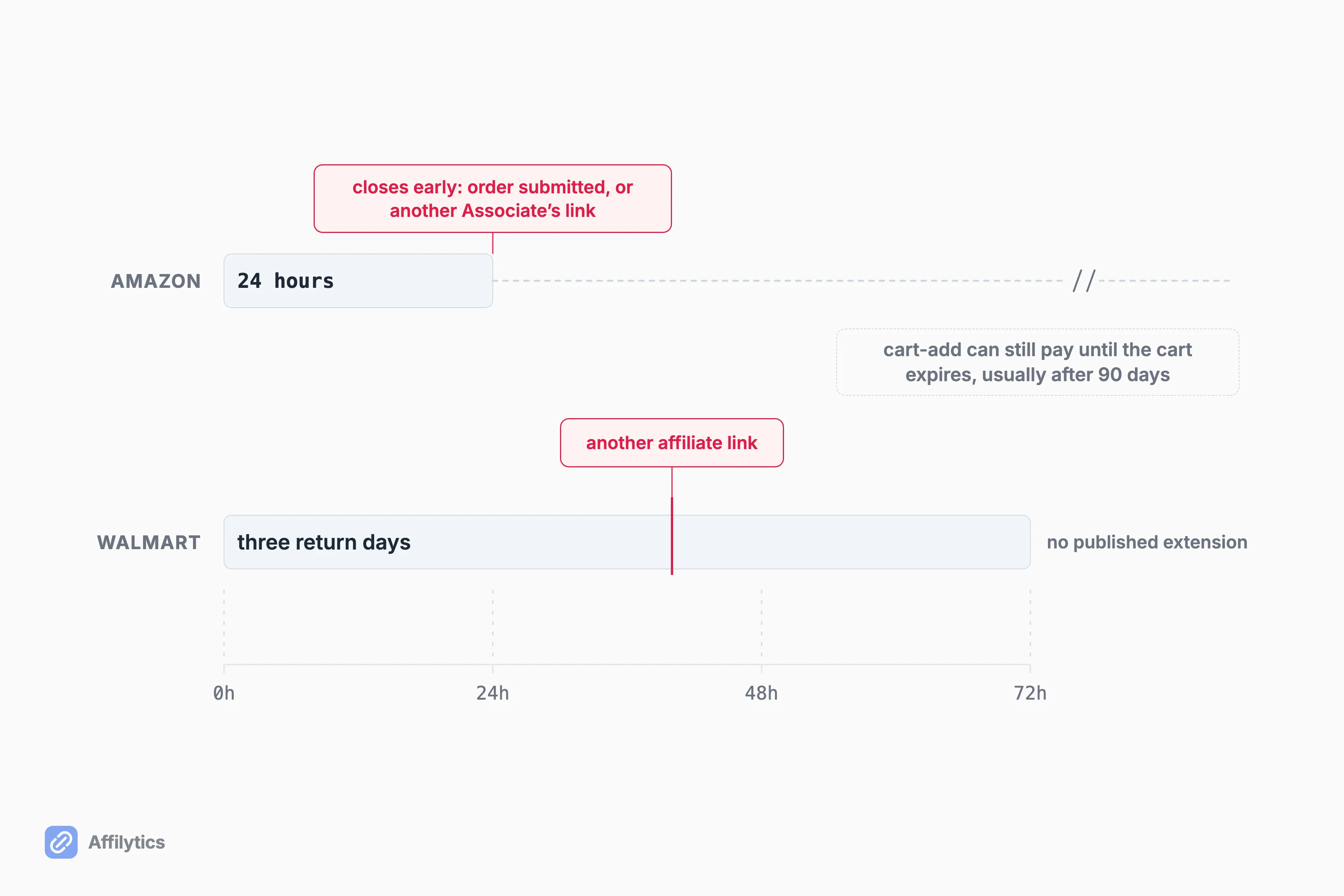
If that reads as harsh, it is the industry norm rather than a Walmart quirk. Amazon words it almost identically, saying its 24-hour window “closes once the customer submits his order or reenters Amazon.com through another Associate’s link”. Both programs pay whoever got clicked most recently. If you have ever wondered why commissions vanish between the click and the sale, that clause is most of the answer, on every program you run.
Second, cookies. The agreement is direct about this failure mode: Walmart is “unable to track or provide credit for sales from customers that are referred to us with browsers that block cookies or that otherwise do not have their browser settings enabled in a way that permits the tracking of a Qualifying Link”. No credit. Not reduced credit.
Third, the sale has to finish. Walmart’s conditions are cumulative, and reading them as a list makes the point: the customer must have cookies enabled, follow a Qualifying Link, buy through the automated ordering system, accept delivery, and remit full payment. A shipped order refused at the door earns nothing. And if the purchase is later returned or the charge reversed, the FAQ says “your account will be debited for any commission earned on that transaction”.
That one is standard too. Amazon’s own help pages say a referral commission “will not be credited to your Associates account until the customer has purchased the item, accepted delivery, and remitted full payment to Amazon.com”. Same rule, different logo.
So what is genuinely Walmart-specific here?
Not the clauses. It is how thin the published record is around them: a Referral Window the agreement defines and never numbers, a rate chart the benefits page promises and never renders. Walmart asks you to accept the mechanics without showing you the dial settings.
None of the three announces itself. The failure you can actually check from the outside is the one next door: a link that has gone dead, or quietly started redirecting somewhere it did not used to go. That is the kind of thing worth watching rather than discovering at payout.
Walmart vs Amazon, honestly
Section titled “Walmart vs Amazon, honestly”Set the two programs’ own pages next to each other and the gap is smaller than the internet suggests, and shaped differently than you would expect.
| Term | Walmart Affiliate Program | Amazon Associates |
|---|---|---|
| Published rate | 1-4%, with a stated ceiling of up to 4% | 0.00% to 10.00% by category, with a 4.00% “All Other Categories” catch-all |
| Attribution window | ”three return days”, per the benefits page | 24 hours from arrival |
| What closes it early | The shopper arriving through another affiliate link | Submitting the order, or arriving through another Associate’s link |
| Cart extension | None published | Items added inside the window can still pay until the cart expires, “usually after 90 days” |
| Network | Impact | Amazon’s own |
| Cost to join | Free | Free |
| Published rate detail | Ceiling only, no public per-category table | Full per-category rate card |
Start with the row everyone skims. Amazon’s range looks decisive until you actually read the card. The bands run 0.00% to 10.00% by category, with a 4.00% “All Other Categories” catch-all, and that catch-all pays more than a long list of Amazon’s own named categories. Toys, furniture, home, beauty, sports, tools, headphones, computers and televisions all sit at 3.00% or below.
Read that again with Walmart in mind. Walmart’s 4% ceiling is level with Amazon’s catch-all, and above the band Amazon pays on the exact categories a home, family or gear creator links to most often. “Walmart pays less than Amazon” is true at the top of Amazon’s card and false through much of its middle.
Amazon’s card is a live page rather than a fixed schedule, so treat those bands as where they stand at the time of writing and open the card yourself before planning around any of them. The fuller breakdown of what Amazon actually pays by category is its own post.
The window is the row where Amazon is plainly better documented. Amazon states that you earn on qualifying items placed in a cart within 24 hours of their arrival, names the two ordinary shopper actions that close that window early, and then explains that an item added inside the window can still pay if the shopper places the order before the cart expires, “usually after 90 days”.
Walmart’s three return days are longer on their face. Nothing on Walmart’s public pages extends attribution the way Amazon’s cart does, though, and nothing numbers the window inside the agreement. Longer, less documented. The trade is yours to pick, and if the fine print on Amazon’s 24-hour window is new to you, the cart extension is the part worth reading first.
None of that tells you how Walmart converts, which is the question that actually decides this, and that part I have to hand to the people running both.
A practitioner on X, replying to someone claiming an 18% Walmart rate, was blunt about it: “You never tested Walmart affiliate program. It doesn’t convert at all. Amazon has 10x better conversion rate.” The 10x is his assertion rather than a measured figure, and I am repeating it because it is the sharpest version of a complaint one other creator makes more mildly. A creator in r/Affiliatemarketing who tried both described “lower product variety and clunkier tracking/reporting in my experience”.
One row in that table is not about money at all. Amazon publishes a full per-category rate card you can read before you write a single link. Walmart publishes a ceiling and a range, and the chart its own benefits page promises is not there. That difference does not change what either program pays you. It changes how much you can plan before you commit, and for a creator deciding where to point two hundred existing product links, that is not a small thing.
Does Walmart pay better or worse?
Better than a good chunk of Amazon’s card, worse than its top bands, and both of those matter less than whether the readers you already have are shopping at the one storefront this program points at.
Is it worth adding? A test you can run on your own traffic
Section titled “Is it worth adding? A test you can run on your own traffic”The answer is genuinely different for a US home-and-family blogger than it is for a globally read tech channel, so a verdict from me would be worth less than three questions you can answer about yourself.
- Does your catalog look more like Walmart’s strength than Amazon’s top bands? Walmart is general merchandise: home, family, groceries, everyday goods. If that is most of what you link to, a 4% ceiling is competitive with what Amazon already pays you. If your links live in the categories where Amazon’s card reaches its top band, it is a step down.
- How much of your audience is outside the US? This is the one I would check before either of the others. Walmart’s agreement points every Qualifying Link at a single storefront, Walmart.com or the Walmart mobile app, and the program offers no regional sibling to send a reader in Manchester or Toronto to the way Amazon’s international storefronts do. A click from outside that one market is a click you already paid for in content and are unlikely to convert.
- Can you carry a second reporting platform? Adding Walmart means adding Impact: another login, another payout threshold, another set of numbers to reconcile against your own analytics.
The “it depends” is not a hedge, and there is a live example of how much it can depend. Creators report that Walmart tags running through YouTube Shopping have been paying nothing. One described the change this way: “Late last year, Walmart changed its commission schedule from something like ‘0% - 10%’ to ‘Commission may apply’ on many of its YouTube Shopping Affiliate listings.” Another wrote, “I have removed most of my Walmart tags. Have had not one commission from them in the first 2 weeks of 2026 despite many sales.”
Those are firsthand reports about one surface, YouTube Shopping, rather than about the affiliate program’s own links, and they are individual accounts rather than a measured trend. I include them because they are exactly the kind of thing you find out three months in, and because they point at the only test that settles this: ship a slice and read the numbers.
What does a yes look like?
A mostly-US audience, a catalog of everyday household goods, and enough link volume that a second dashboard earns its keep. A no looks like a globally read tech channel with a wall of gear links under every video. Most creators sit somewhere between, which is why the honest move is to add Walmart to part of your content and measure it, rather than committing the whole library on the strength of a rate table.
The clicks a single-storefront program is unlikely to convert
Section titled “The clicks a single-storefront program is unlikely to convert”So where does adding Walmart actually cost you money?
In your click data, long before it shows up in a commission report. Walmart’s affiliate agreement defines the destination in one line: “Site” means Walmart.com or the Walmart mobile app that you will link to using Qualifying Links. That is one storefront, where Amazon hands you a family of regional ones, and most creators’ international share is far larger than they assume.
The first move is not monitoring, it is routing: you build one smart link, set a rule per country, and the clicks a single-storefront program is unlikely to convert land somewhere that will actually pay you.
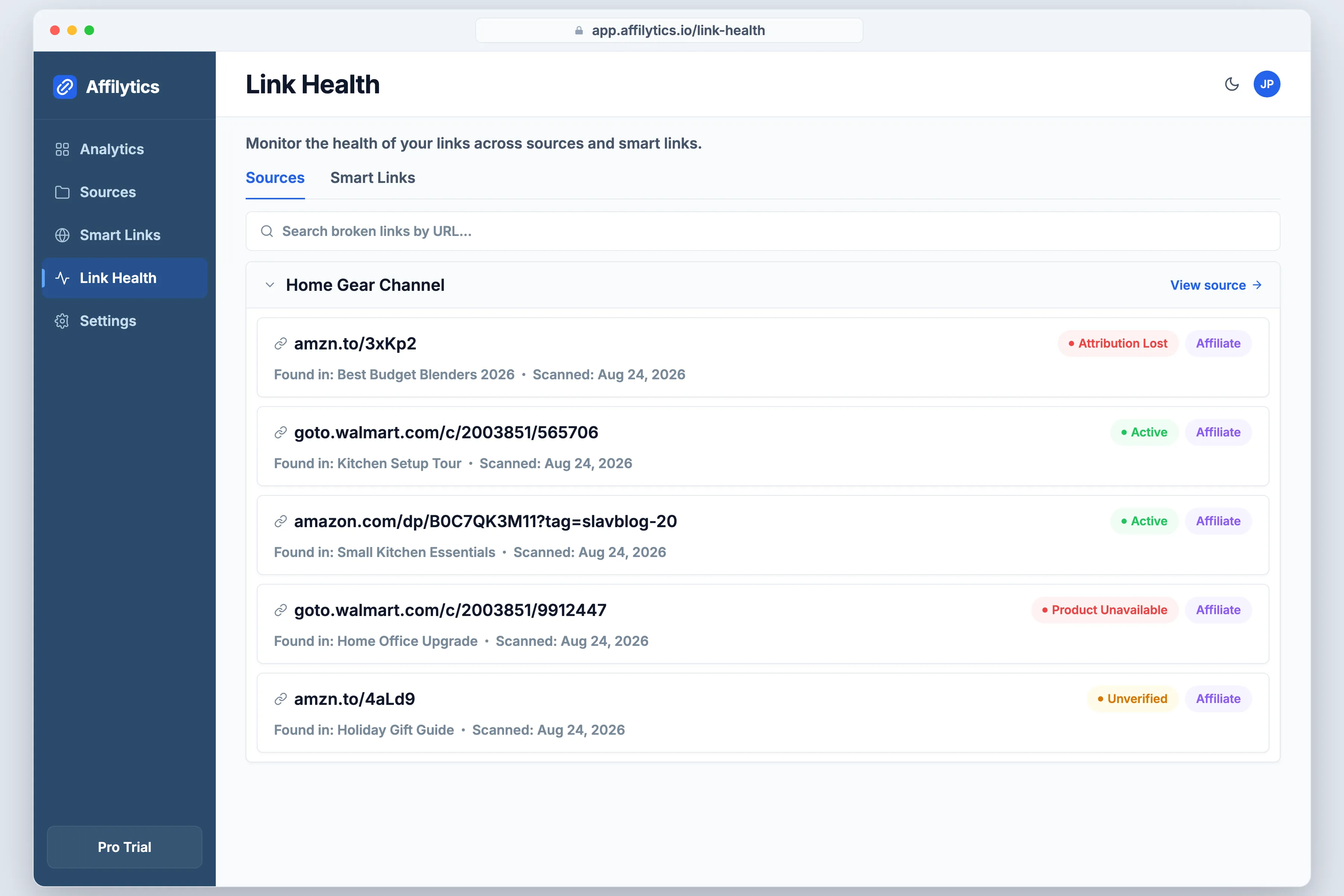
The second move follows from the first. Your links now run on two networks instead of one: Amazon’s are Amazon’s, Walmart’s go through Impact. If the tool watching your links only understands Amazon URLs, your Walmart links are invisible to it. Affilytics scans a channel or a site, finds the affiliate links you already published across Amazon, Impact and the other major networks, and watches them together, which is what one scan across every network you run is for.
Create your free account and you get two full weeks with everything unlocked, no credit card. That is long enough to route your international clicks somewhere useful and to find out which of your existing links stopped paying while you were off reading about a new program.
How much do Walmart affiliates make?
Section titled “How much do Walmart affiliates make?”Walmart publishes a ceiling, not an income. Its FAQ says affiliates can earn up to 4% on each eligible sale, and its benefits page states a structure that pays 1-4% with three return days. What that turns into depends on your category mix, your traffic volume, and how much of that traffic is in the US. Anyone quoting a per-creator dollar figure for Walmart is guessing, because Walmart does not publish one.
What is the Walmart affiliate program cookie duration?
Section titled “What is the Walmart affiliate program cookie duration?”Walmart never publishes a field called cookie duration. The closest thing to a number on its own pages is the benefits page, which states the commission structure as 1-4% with three return days, and that is its attribution window. The affiliate agreement goes further and defines a Referral Window tied to a cookie window, then never prints the number of days. So three days is the best-supported reading of Walmart’s own wording, and any article presenting a flat three-day cookie as a stated fact is reporting its own interpretation.
Is Walmart’s affiliate program better than Amazon’s?
Section titled “Is Walmart’s affiliate program better than Amazon’s?”Neither wins outright. Walmart’s 4% ceiling is level with Amazon’s 4.00% All Other Categories catch-all and above several named Amazon categories, including toys, furniture, home, beauty, sports, tools, headphones, computers and televisions, which all sit at 3.00% or below. Amazon’s rate card runs to 10.00% at the top, and its shopping cart extension can pay well past the original click. Walmart’s program also points at a single storefront while Amazon runs a family of regional ones, so a creator with a large audience outside the US is comparing a one-destination program against a many-destination one.
Do I need to be in the US to join?
Section titled “Do I need to be in the US to join?”Separate the two programs first. Walmart Creator states that you must be 18 years or older and live within the US to apply. The affiliate program sets its gate in the affiliate agreement rather than on its marketing pages: you must be of majority age in the jurisdiction you reside, which is at least 18 years or older in most states, and not a current Walmart employee. What that gate does not include is a country requirement. Approval is still at Walmart’s sole discretion, and the agreement points every Qualifying Link at a single destination, Walmart.com or the Walmart mobile app, so practically this is a program for US traffic whatever your own address says.
What is Impact and why do I need an account?
Section titled “What is Impact and why do I need an account?”Impact is the third-party affiliate platform Walmart uses to run its program. Walmart’s FAQ names it directly, saying Walmart.com uses Impact Radius as its affiliate service provider and that Impact gives affiliates one interface to track sales, impressions, click-throughs and commissions. So your links, your reporting and your payouts all live in Impact rather than in a Walmart dashboard. One caveat from the affiliate agreement: creating an Impact account does not by itself guarantee your participation in the program.