Amazon Influencer Program Requirements by Platform (2026)
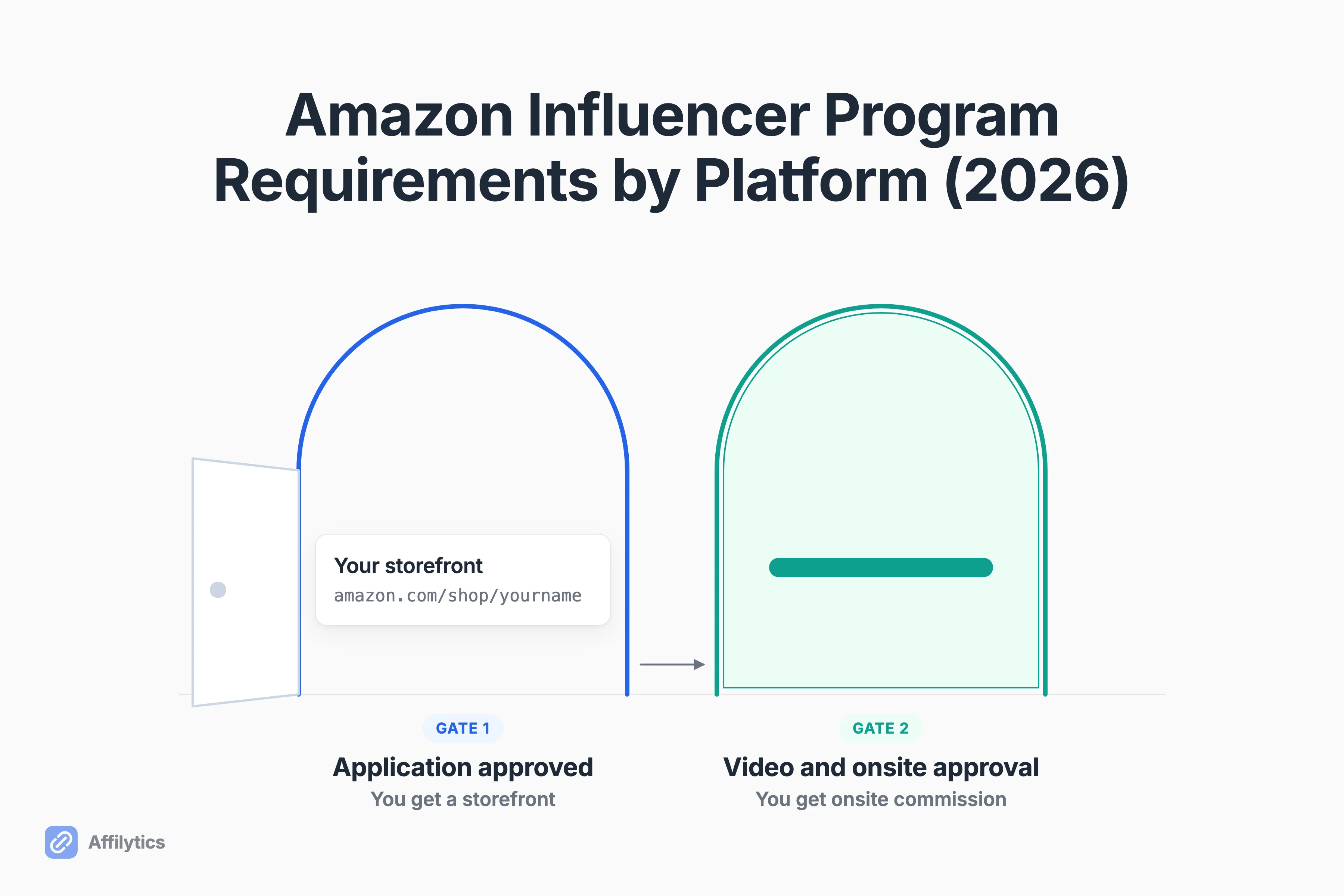
Search for Amazon Influencer Program requirements and you will have a follower number inside of ten seconds. One guide says roughly 1,000. Another opens on more than 1,000, then concedes that creators with under 100 have been accepted, and a third prints a 200 to 5,000 range that its own platform table contradicts. Amazon publishes none of those numbers, on any of its pages.
I build Affilytics with my co-founder. It routes affiliate clicks to the right regional store and watches published links for the day they quietly stop earning, so I spend a lot of time reading the fine print of programs like this one.
That fine print matters here more than usual, because the Influencer Program is not a separate program. It sits inside Amazon Associates and runs on the same 24-hour cookie every Associates link runs on.
This guide covers what Amazon actually says you need, and how that reads on YouTube, Instagram, TikTok, Facebook, and Pinterest. It also covers the second approval gate that decides whether you earn on Amazon product pages at all, and what changes the day you get in.
What the Amazon Influencer Program actually is
Section titled “What the Amazon Influencer Program actually is”Clear one thing up before any requirement matters. The Amazon Influencer Program is not a rival to Amazon Associates, and it is not an application to a different company. It lives inside Associates. Amazon’s own Associates Program Policies file it under the heading “The Associates Program ‘Amazon Influencer Program’”, a program nested inside a program, governed by the same agreement you already sign as an Associate.
What you get on top of an ordinary Associates account is a storefront: a page on Amazon’s own domain holding the products you picked and the videos you shot about them. Amazon’s shopper-facing explainer describes the people behind those pages in a single line. “An Influencer or Associate is anyone who has a meaningful social media following.”
So what is the actual difference?
An Associate earns on links they publish in their own content. An Influencer gets that, plus the storefront, plus, after a second approval step I will come back to, the ability to earn on Amazon’s own product pages. Same 24-hour session window. Same category rate table. Same account.
The full Influencer versus Associates comparison is its own post. For requirements, the part that matters is that you are applying to an add-on, not to a different program.
What Amazon actually says you need
Section titled “What Amazon actually says you need”Here is the entire published bar, in Amazon’s own words. It comes from three Amazon pages, and it is much shorter than you expect.
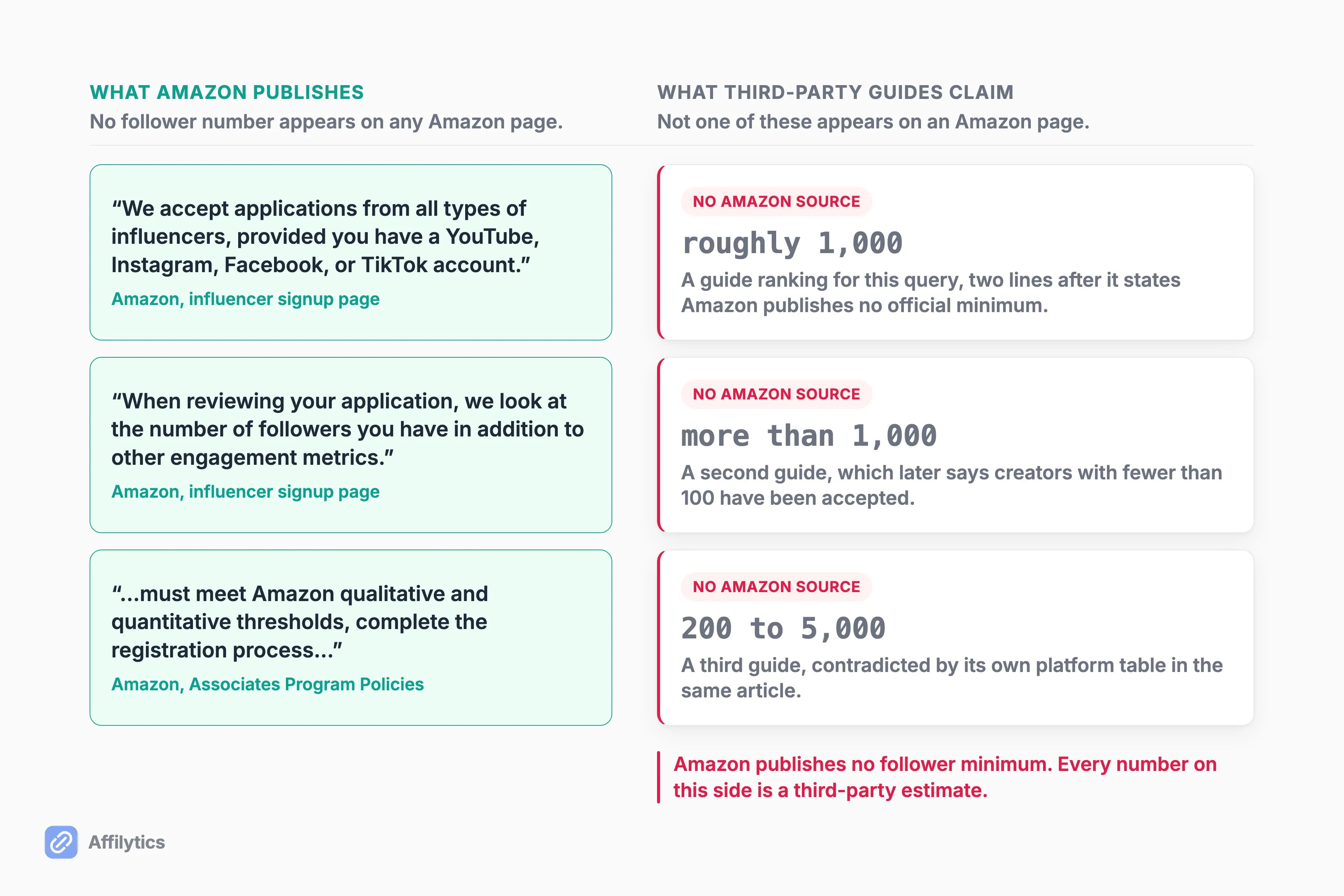
The signup page answers the qualification question directly. “We accept applications from all types of influencers, provided you have a YouTube, Instagram, Facebook, or TikTok account. If you are applying using an Instagram or Facebook account, you are required to use a business account.”
The same FAQ then describes the review itself: “When reviewing your application, we look at the number of followers you have in addition to other engagement metrics.” Amazon names follower count as one input among several. It never names a follower threshold at all.
The Associates Program Policies are the only place Amazon concedes that a numeric bar exists. To take part, an eligible Associate “must meet Amazon qualitative and quantitative thresholds, complete the registration process, and comply with the applicable provisions of the Agreement.” Quantitative thresholds. Named in the contract, printed nowhere.
So what is the bar?
The registration step is the closest thing to an answer anybody gets. The same policy section says that to register you must complete all information requirements, “including granting requests to access data regarding your social media presences.” That is the mechanic, and it explains the silence. You do not type a follower count into a box and get measured against a published cutoff. You hand Amazon read access to the account, and Amazon reads the account. A published number would be a number to game, and Amazon has no reason to hand one out.
Which leaves three things Amazon will commit to in writing:
- You need an account on a qualifying platform.
- Instagram and Facebook applicants need a business account.
- Followers are one signal among several, weighed by somebody looking at your actual account rather than at a figure you reported.
Why every guide gives you a follower number
Section titled “Why every guide gives you a follower number”None of that stops anyone. An unanswered question is unbearable, so the field answers it anyway, and the answers get repeated until they look like policy.
Look at what ranks for Amazon Influencer Program requirements right now. One guide states, correctly, that Amazon publishes no official minimum, then supplies roughly 1,000 as a realistic figure two lines later. A second opens on more than 1,000 followers, later says creators with fewer than 100 have been accepted, and cites a community thread whose own title says 200. A third opens on a practical threshold of 200 to 5,000, then publishes a platform table that contradicts its own range. Three guides, four numbers, and not one of them from an Amazon page.
If you have repeated one of those figures, you repeated it for a reasonable reason. Three of the first results agreed loudly enough to look like consensus.
So what does the community inside the program say?
When somebody posts in r/Amazon_Influencer that their application keeps getting rejected, the first reply is not a follower count. It is “What’s your engagement rate like?”
The counterexamples run the other way too. One creator in that subreddit, describing their own approval, wrote: “I had less than 500 followers and one video went well with only 2500 views. And I was accepted.” That is one person’s experience and not a rule, and it carries exactly as much evidential weight as any number in the guides. The difference is that they said so.
The honest version of this section is three lines. Amazon looks at followers. Amazon has never said how many. Anyone who hands you the number is guessing, including the guesses that land close.
Requirements platform by platform
Section titled “Requirements platform by platform”This is where Amazon Influencer Program requirements get concrete, and also where Amazon contradicts itself.
The signup page names four platforms: YouTube, Instagram, Facebook, and TikTok. Amazon’s own shopper-facing page names five. “Currently you must have a YouTube, Instagram, Tiktok, Facebook or Pinterest account to qualify.” Pinterest is on one page and absent from the other two. The business-account rule follows the same pattern: present on the signup page, missing from the other two. Neither page carries a date.
| Platform | Where Amazon names it | Account type required | Notes |
|---|---|---|---|
| YouTube | Signup page and the /shop/info explainer | None stated | Named on both Amazon pages with no account-type condition |
Signup page and the /shop/info explainer | Business account, per the signup page | The explainer names Instagram and says nothing about account type | |
| TikTok | Signup page and the /shop/info explainer | None stated | Same as YouTube: on both pages, no account-type condition |
Signup page and the /shop/info explainer | Business account, per the signup page | Same split as Instagram: the rule appears on one page only | |
The /shop/info explainer only | None stated | Absent from the signup page and from the Influencer Program Policy |
Which page wins?
Amazon has not said, and neither page is dated or versioned, so there is nothing to break the tie. The Influencer Program Policy, the document that actually governs the program, names no platforms at all.
So which account do you apply with? Work down this list:
- The platform where your audience is genuinely most active, if it appears on both Amazon pages.
- YouTube or TikTok when you are choosing between two similar accounts, since neither carries an account-type condition.
- Instagram or Facebook only after you have switched the account to a business account, because that is one of the very few unambiguous rules Amazon states anywhere in this program.
- Pinterest last, and only when it is clearly your strongest platform.
Pinterest is the one to be careful with. It appears on the shopper-facing explainer and nowhere else Amazon writes about this program, which makes it the weakest ground an application can stand on. That is not a reason to skip the program if Pinterest is where you built your audience. It is a reason to lead with a second platform if you have one.
The second gate nobody warns you about
Section titled “The second gate nobody warns you about”Getting into the program is not the thing that earns you money on Amazon product pages. There is a second gate behind the first one, and it is where the community actually gets stuck.
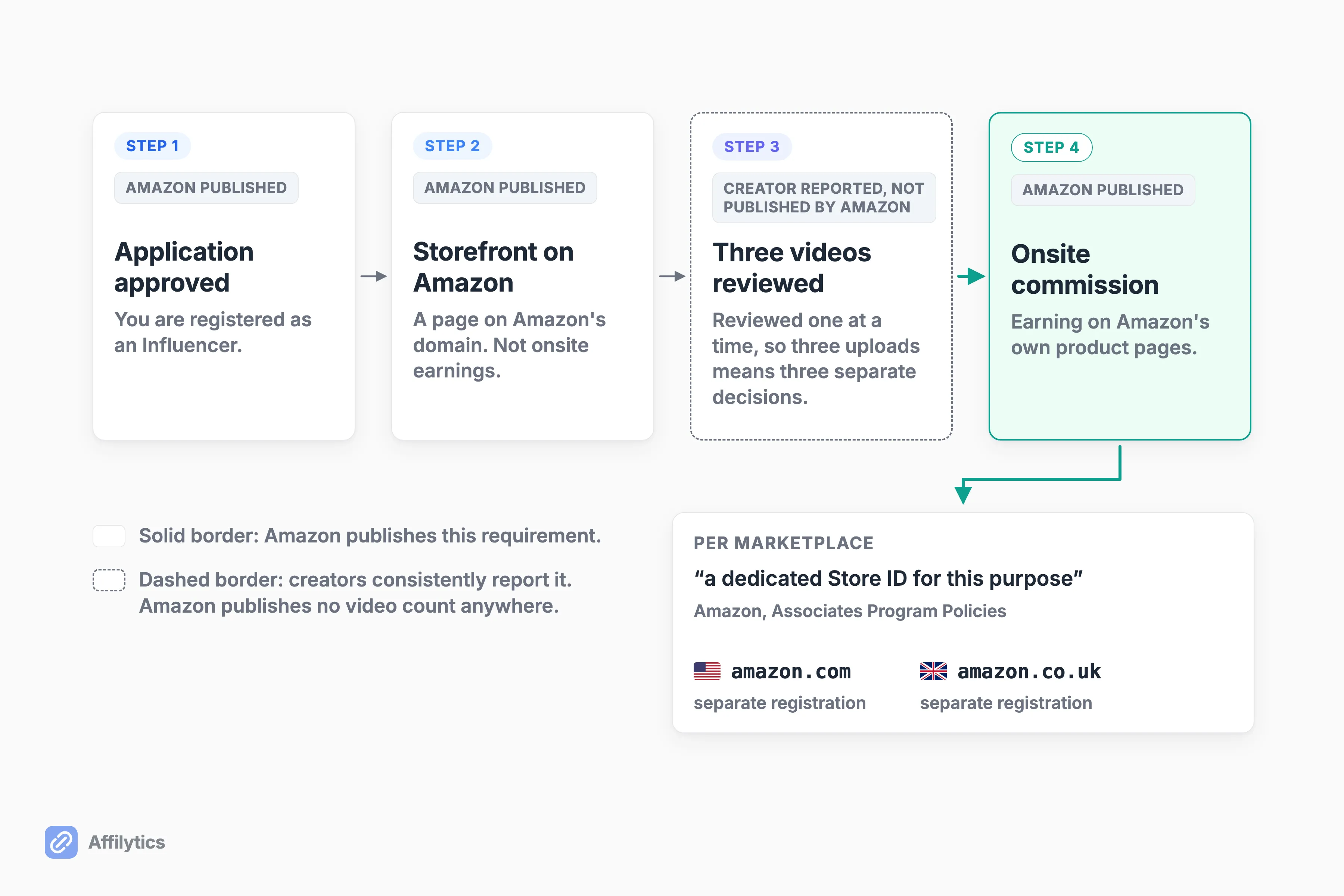
Amazon’s published requirement for it is one sentence. “To be eligible to earn Onsite Commission Income from the applicable Amazon Site, you must be registered as an Influencer for the applicable Amazon Site with a dedicated Store ID for this purpose.” That is the whole thing. A dedicated Store ID, tied to one marketplace.
What Amazon does not publish, and what every applicant runs into, is the video review sitting in front of onsite placement. Creators consistently describe the same shape: upload three shoppable videos, wait while each one is reviewed on its own, then onsite commission eligibility follows.
One creator in r/Amazon_Influencer described uploading their three videos and then: “After the weekend, on Monday, July 13th, I was officially granted onsite commissions.” A creator on X posted the same sequence mid-flight: “I was approved for Amazon influencer program… Currently waiting on my 1 out of 3 videos to get approved.”
Is it definitely three?
A post in the same subreddit asked whether Amazon had raised it from three to ten, and the two highest-scored replies answered it inside the thread. “That is a very old link. When I joined back in 2020, it was indeed 10 videos. It has been 3 videos for several years now.” Ten was the requirement in 2020. Three is what creators report today. Neither number appears on a page Amazon publishes, which is precisely why the rumor traveled.
The other thing this gate carries is that Amazon owes you nothing on the content. The policies say Amazon “may (as determined by Amazon in its sole discretion) but is not obligated to use Influencer Content”, and reserves the right to reject or remove any of it. A rejected video is not an appeal. It is a re-shoot.
So the practical read on the second gate:
- Program approval gets you a storefront, not onsite earnings.
- Onsite commission needs a dedicated Store ID for that specific Amazon marketplace.
- The video review creators describe is per video, so three uploads means three separate decisions, each on its own clock.
- None of it appears on the signup page you applied through.
Where you can apply
Section titled “Where you can apply”The program does not exist everywhere, and Amazon says so in one sentence: “The Associates Program ‘Amazon Influencer Program’ is a country specific program that is available in select countries.” Select countries. It does not list them. That wording is worth reading twice, because “select” is doing a lot of work in a program most guides describe as though it were global.
You can see the per-marketplace structure in Amazon’s own plumbing. There is an influencer signup page on affiliate-program.amazon.co.uk sitting alongside the .com version, and an amazon.co.uk/shop/info alongside amazon.com/shop/info. Enrollment follows the marketplace, not your passport.
The payout mechanics say the same thing from the other end. Onsite commission requires a dedicated Store ID “for the applicable Amazon Site”. Applicable site, singular. Clearing the bar on one marketplace is not an enrollment on another.
So what do you do if you are in the UK, Canada, or anywhere outside the US?
- Apply through your own marketplace’s signup page, not the .com one.
- Check which countries Amazon runs affiliate programs in before you assume yours is covered.
- Register separately on any second marketplace you want onsite commission from, since the Store ID is tied to one Amazon site.
What you agree to when you get in
Section titled “What you agree to when you get in”One clause is worth reading before you build anything on top of the storefront. Section 3 of the Influencer Program Policy says: “We reserve all right, title and interest (including all intellectual property and proprietary rights) in and to, and you do not, by virtue of the Agreement or otherwise, acquire any ownership interest or rights in or to, the Influencer Page, the Influencer Page URL, information and materials on the Influencer Page or any other aspect of the Amazon Site.”
Read plainly, that says the storefront is not yours. Not the page, not its URL, not the material on it. You made the videos. They sit on a page Amazon owns.
Does that mean skip the program?
No. It means being honest with yourself about which half of your setup you control.
The storefront is a placement you rent, and a good one. The links you publish on your own channel, in your own video descriptions, in your own posts, are the half that belongs to you. That one keeps growing after approval, and it quietly breaks when nobody is watching.
After you are approved, your links multiply
Section titled “After you are approved, your links multiply”Approval is the start of a maintenance problem, not the end of one. A creator in r/Amazon_Influencer put the feeling exactly: “I was approved 5 months ago but I’m just not getting into it and understanding. I was so confused.”
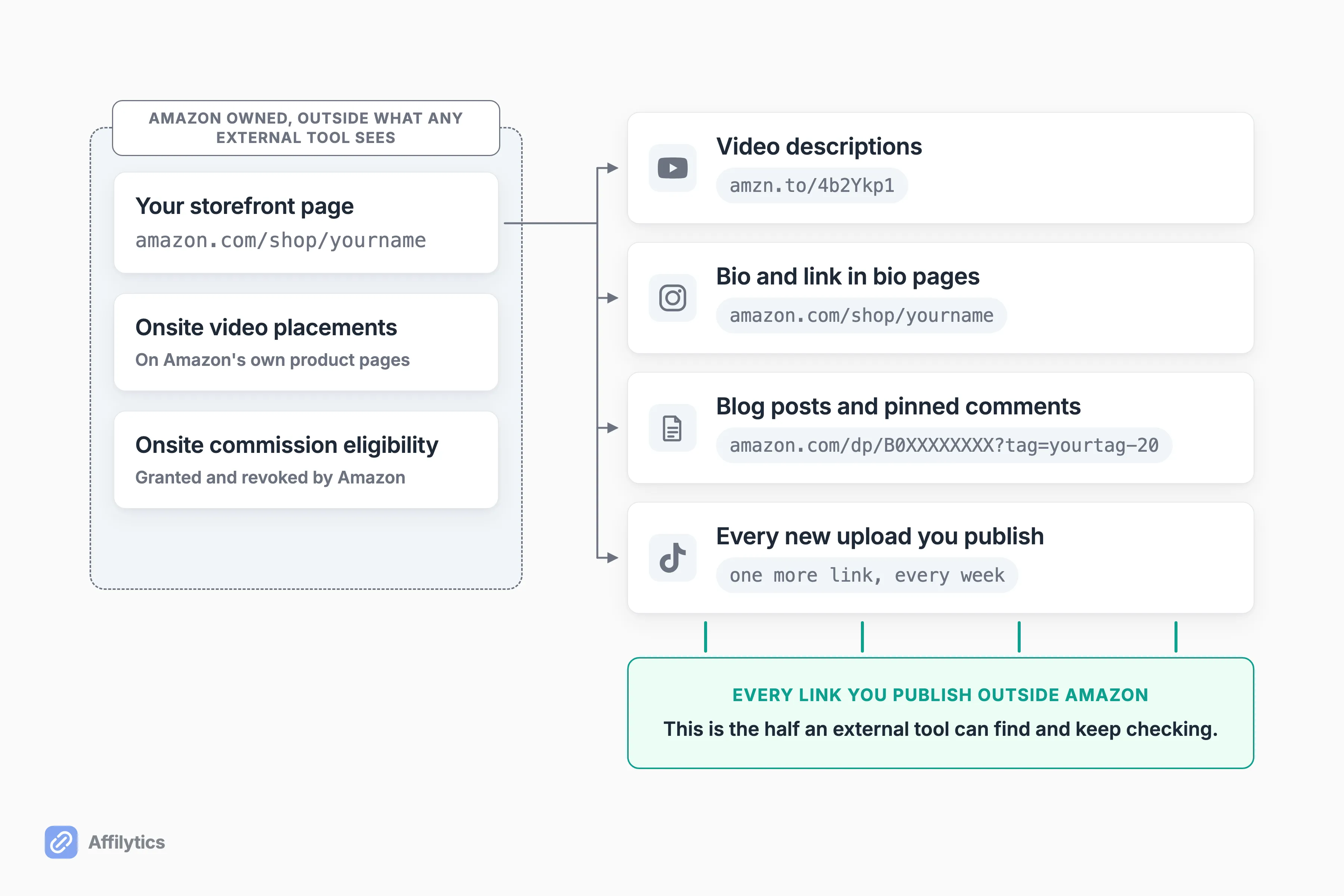
Here is the shape nobody describes at signup. One storefront turns into:
- a storefront link in every bio you keep
- product links in every video description you publish
- links inside blog posts and pinned comments
- a link-in-bio page pointing at several of the above
That surface spans several platforms, and it keeps growing every week you keep working. Another creator in the same thread gave the long-run version: “after 550 videos uploaded I’m consistently bringing in enough money to pay rent or two car payments.” That is one person’s figure built over years, not a forecast for anybody else.
So what actually goes wrong with a surface that size?
Two things, and the first is geography. The section above established that this program runs per marketplace. Your audience does not.
A link pointing at amazon.com sends a shopper in Manchester or Toronto to a store that is not theirs. Every one of these links runs on the same 24-hour session window as any other Associates link, so a misrouted click spends a session as well as losing a sale. Amazon’s Earn Globally program covers part of that gap, but earning a cross-border commission is not the same thing as putting the shopper in front of their own store, in their own currency.
That is the problem we built Affilytics for first: one link that resolves the visitor’s country and routes them to the marketplace that can pay you, at whatever commission rates by category apply there.
The second failure is quieter. A product goes out of stock, a URL changes, a merchant leaves the program, and the link keeps returning a page that looks healthy while earning nothing. That is the second thing we built for: continuous checks against every link we find, so you hear about it when a check catches the change, not when you notice a flat month. If you would rather do it by hand first, how to check whether your affiliate links still work is a separate post, and manual works fine right up to a few hundred links.
One boundary, because it keeps the claim honest. None of this touches what happens inside Amazon. Not the storefront page itself, not onsite video placements, not onsite commission eligibility. Amazon owns those surfaces. All we ever see is the links you publish outside Amazon that happen to point at your storefront or a product page.
The half of this you actually control
Section titled “The half of this you actually control”You cannot control Amazon’s approval bar, and you cannot control the storefront. What you can control is whether the links you publish still send people to a store that can pay you, and whether they still work at all. That is where I would start. Before a hundred of them are hanging off a storefront you do not own.
Create your free account and you get two full weeks with everything unlocked, no credit card. Point it at the channel or the site you already publish on and see what your link surface actually looks like.
How many followers do you need for the Amazon Influencer Program?
Section titled “How many followers do you need for the Amazon Influencer Program?”Amazon publishes no follower minimum anywhere: not on its influencer signup page, not on its shopper-facing explainer, and not in the Associates Program Policies. What it does say is that when reviewing your application it looks at “the number of followers you have in addition to other engagement metrics”, and that an influencer must meet “qualitative and quantitative thresholds” it never prints. Any specific number you find is somebody’s estimate rather than Amazon’s rule.
Can you join the Amazon Influencer Program with a small following?
Section titled “Can you join the Amazon Influencer Program with a small following?”Creators report being accepted with small accounts. One creator in r/Amazon_Influencer wrote that they had fewer than 500 followers and one video with around 2,500 views when their application went through. That is one person’s experience rather than a threshold. What the community consistently points at instead is engagement: the first thing a rejected applicant gets asked there is about their engagement rate, not their follower count.
Do you need a business account for Instagram or Facebook?
Section titled “Do you need a business account for Instagram or Facebook?”Yes, for those two platforms specifically. Amazon’s influencer signup page states that if you are applying using an Instagram or Facebook account, you are required to use a business account. It is one of the very few unambiguous requirements Amazon states anywhere in this program. Amazon’s shopper-facing explainer names both platforms without repeating the rule, so switch the account over before you apply rather than trusting the shorter page.
Is the Amazon Influencer Program available in the UK and Canada?
Section titled “Is the Amazon Influencer Program available in the UK and Canada?”Amazon describes it in its policies as “a country specific program that is available in select countries”, and it does not list them. Enrollment runs per marketplace, and Amazon operates separate influencer signup and info pages for its country sites, so apply through the marketplace you actually sell into rather than the .com one. Clearing the bar on one marketplace does not enroll you on another.
What happens after you get approved?
Section titled “What happens after you get approved?”You get a storefront on Amazon, but not yet the ability to earn on Amazon’s own product pages. That needs a second step: Amazon requires a dedicated Store ID for onsite commission income, and creators consistently report a video review of three uploads standing in front of it. After that, the work is maintenance. Your links start multiplying across descriptions, posts, and bios, and keeping them alive and pointed at the right regional store becomes the job.