
Amazon Associates Canada: Sign-Up, Rates, and Payouts
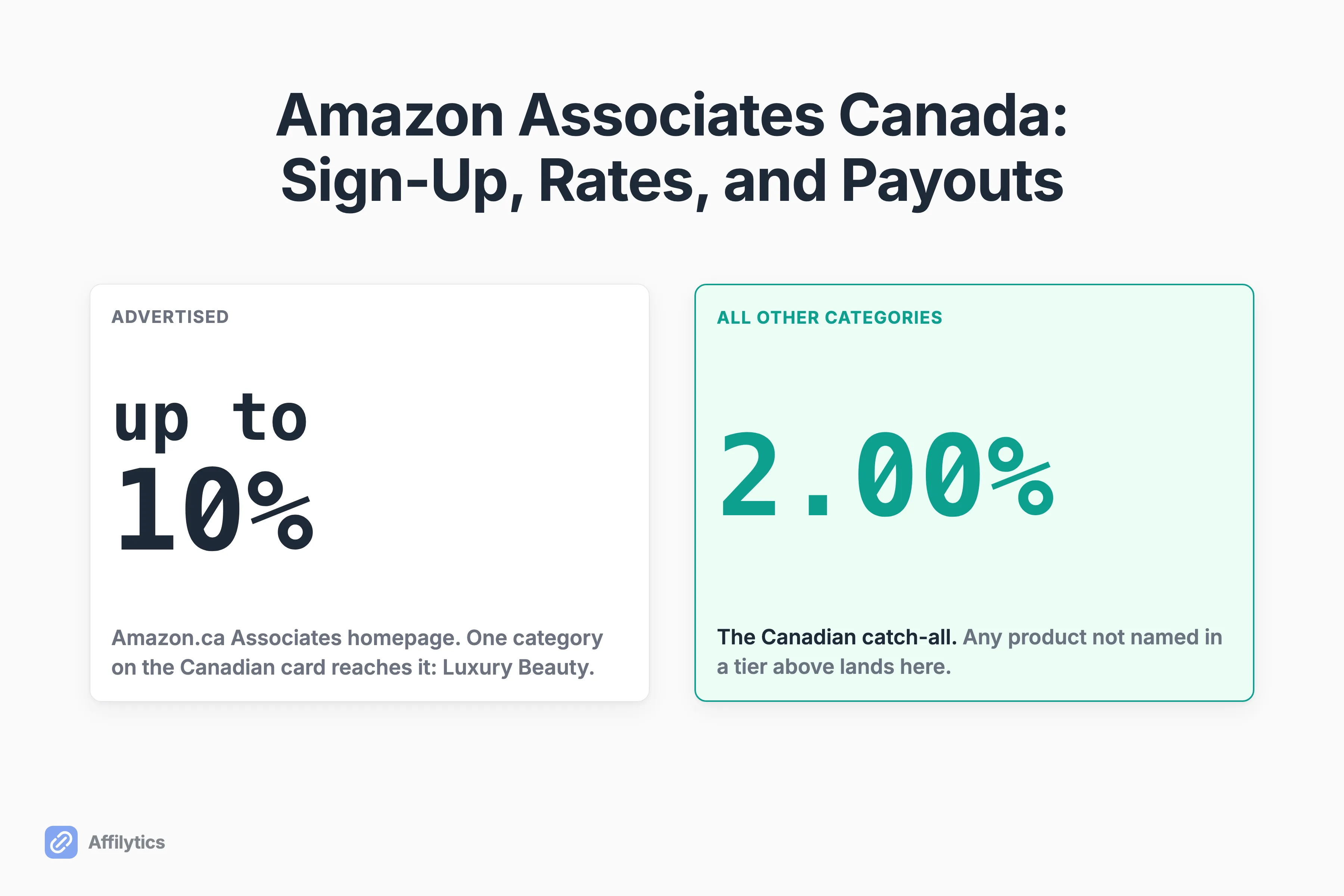
Amazon Associates Canada advertises up to 10% commission, and exactly one category actually pays it. Every other row on Amazon’s Canadian rate card sits lower, and the row most links quietly land on pays 2.00%.
We build the geo-routing and link-health layer that sits underneath affiliate links. It sends each click to the storefront where your tag actually pays, then checks whether the link still works, so I spend more time than is reasonable inside the commission tables and payout rules of Amazon’s regional programmes.
Canada is one marketplace among many, and we keep a running list of every Amazon Associates country programme. This post stays on Canada and goes deeper.
It covers how to join, what the Canadian table pays category by category, when the money lands, the tax step nobody warns Canadian Associates about, and what to do about the large share of your audience that is not in Canada.
How to Join Amazon Associates in Canada
Section titled “How to Join Amazon Associates in Canada”Amazon frames joining as three steps on the Canadian portal: sign up, recommend, earn. The first one is the only one that can go wrong, because Amazon reviews your application rather than approving it the moment you hit submit.
Here is what that actually asks of you:
- A qualifying place to put links. A website, blog or mobile app that already exists and already has content on it, not a plan to build one after approval.
- A real review. Amazon decides whether you meet the criteria. Nothing in the sign-up flow promises you a yes.
- Tax information on file. Amazon must hold your tax information before it can make any payment at all, which makes the tax interview part of onboarding rather than paperwork you get to later.
So what does “qualifying” actually mean?
Amazon does not publish a subscriber count or a traffic floor on the Canadian portal, and we could not find one anywhere else on the site either. Read it as a human looking at whether your site is a finished thing with an audience or an empty shell with three posts and a placeholder logo. Finish the site first. Apply second.
The tax point is the one people underestimate. It is easy to treat the tax interview as a formality you clear on the way to the dashboard, and then discover months later that a payment never moved because something in it was incomplete. Canada adds a second layer to that step which almost nobody warns you about, and it gets its own section further down.
Amazon’s own social proof on the Canadian portal is worth a second of attention too. Sitting directly beneath the headline rate is a quote from BuzzFeed, calling the programme “a critical driver of our commerce initiatives”. That is who the marketing copy is built around. It is not a reason to stay out, but it does tell you which end of the market Amazon is describing.
One thing this section deliberately does not answer: whether Amazon Associates Canada is the programme you should be joining at all. If most of your readers or viewers are American, that is a real question with a real answer, and it comes near the end of this post rather than here.
What Amazon Associates Canada Actually Pays
Section titled “What Amazon Associates Canada Actually Pays”The number that governs your income is not the one on the front page. The Canadian portal invites you to earn up to 10% in Associate commissions from qualifying purchases. Amazon’s Canadian commission schedule is where the rates you will actually be paid live, and it runs the whole way from 10.00% down to 0.00%.
| Commission rate | Categories |
|---|---|
| 10.00% | Luxury Beauty |
| 9.00% | Pet Food & Supplies |
| 7.00% | Jewelry, Luggage |
| 6.00% | Amazon Fashion Private Brands, Beauty & Grooming, Clothing & Accessories, Furniture, Home, Home Improvement, Outdoor Recreation, Patio Lawn & Garden, Shoes, Handbags, Wallets, Sunglasses |
| 5.00% | Baby & Nursery, Camera/Photo/Video, Cell Phones & Accessories, Home Entertainment, Major Appliances, Musical Instruments, Office & School Supplies, Software |
| 4.00% | Amazon devices (Echo, Kindle, Fire TV, Fire tablets, Ring, eero), Audible Audiobooks, Books & Textbooks, Business & Industrial Supplies, Kitchen & Dining, Power & Hand Tools, Sports & Fitness, Watches |
| 3.50% | Automotive, Blu-Ray & DVD, CDs & Vinyl, Tires & Wheels |
| 3.00% | Health & Household, Kindle Books, Toys & Games |
| 2.00% | All Other Categories |
| 1.00% | Computers/Tablets & Components, Video Games Hardware & Consoles |
| 0.00% | Amazon Gift Cards, Grocery & Gourmet Food, Kindle Unlimited Memberships, Other Gift Card Brands, Coach |
Luxury Beauty is the only category in Canada that reaches the advertised headline. It is one row. The named rows below it are narrower than they look, and everything that does not fit one of them falls to All Other Categories at 2.00%.
Which row are your own links in?
Do not guess, and do not average. Put three real products from your last piece of content through the table and read the number off it. A gaming laptop pays 1.00%. A console pays 1.00%. A gift card pays 0.00%, which means a click that converted perfectly is worth nothing at all. A bag of dog food pays 9.00%, which is the best rate on the Canadian card outside a single beauty category.
That spread is the whole story of a Canadian Associates account. Two creators with identical traffic and identical conversion can be five times apart on income, 2.00% against 10.00%, or nine times apart at the extremes, 1.00% against 9.00%, purely because of what sits in their links. A pet channel and a home-and-garden blog are working the top half of that table. A consumer-tech channel is working the bottom of it, where volume is the only lever available.
The 2.00% catch-all deserves one more line of attention, because it is not an edge case. It is the default. Any product that is not explicitly named in one of the tiers above lands there, and most creators have more links sitting on that row than they expect.
Why the Canadian Table Is Not the American One
Section titled “Why the Canadian Table Is Not the American One”Canadian creators hear constantly that the US programme simply pays more. Put the two schedules next to each other and that turns out to be true in some aisles, false in others, and identical at the top.
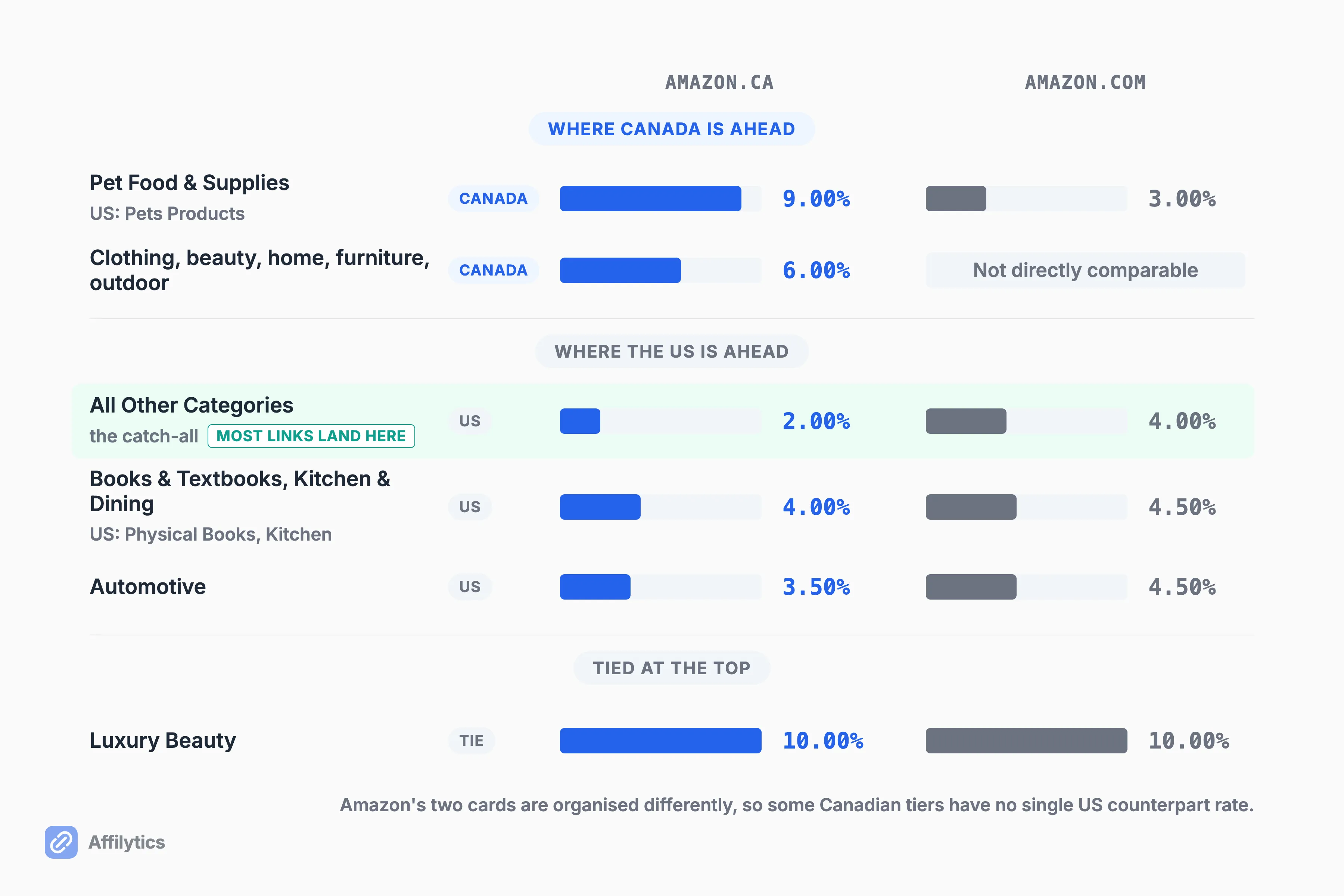
Where Canada is ahead:
- Pet Food & Supplies pays 9.00% in Canada. On the American schedule, Pets Products sits in the 3.00% tier. That is not a rounding difference, it is three times the rate.
- Clothing, beauty, home, furniture, home improvement and outdoor all sit in Canada’s 6.00% tier, which is a broad and genuinely well-paid band for the kind of content a lifestyle creator publishes anyway.
Where the US is ahead:
- The catch-all. The US All Other Categories rate is 4.00%, double Canada’s 2.00%. Because that row is the default, this is the single most consequential difference between the two cards.
- Books, kitchen and automotive. The US puts physical books, kitchen and automotive at 4.50%. Canada pays 4.00% on Books & Textbooks and Kitchen & Dining, and 3.50% on Automotive.
And at the very top, they match: Luxury Beauty pays 10.00% on both cards.
The two tables are not the same document with different numbers dropped in. They are organised differently. Canada carries standalone tiers the American card has no equivalent for at those rates, Pet Food & Supplies on its own at 9.00% and a Jewelry and Luggage tier at 7.00%, while the US groups those products into broader bands. So a category-by-category translation is not always possible, and anyone who hands you a single multiplier for converting one card into the other is guessing.
So which programme pays more?
Yours does or it does not, depending entirely on what you link to. If you write about dogs, cats, clothes, furniture or skincare, the Canadian table is the better card and it is not close. If most of your links land in the catch-all, which is the common case, the American card pays you double for exactly the same click. Anyone who tells you Canada is simply the worse programme has not read both tables.
None of that is stable across the rest of Amazon’s world either, which is why how Canada’s rates compare across every marketplace, not only the US is worth a look before you decide where your effort goes.
When and How You Actually Get Paid
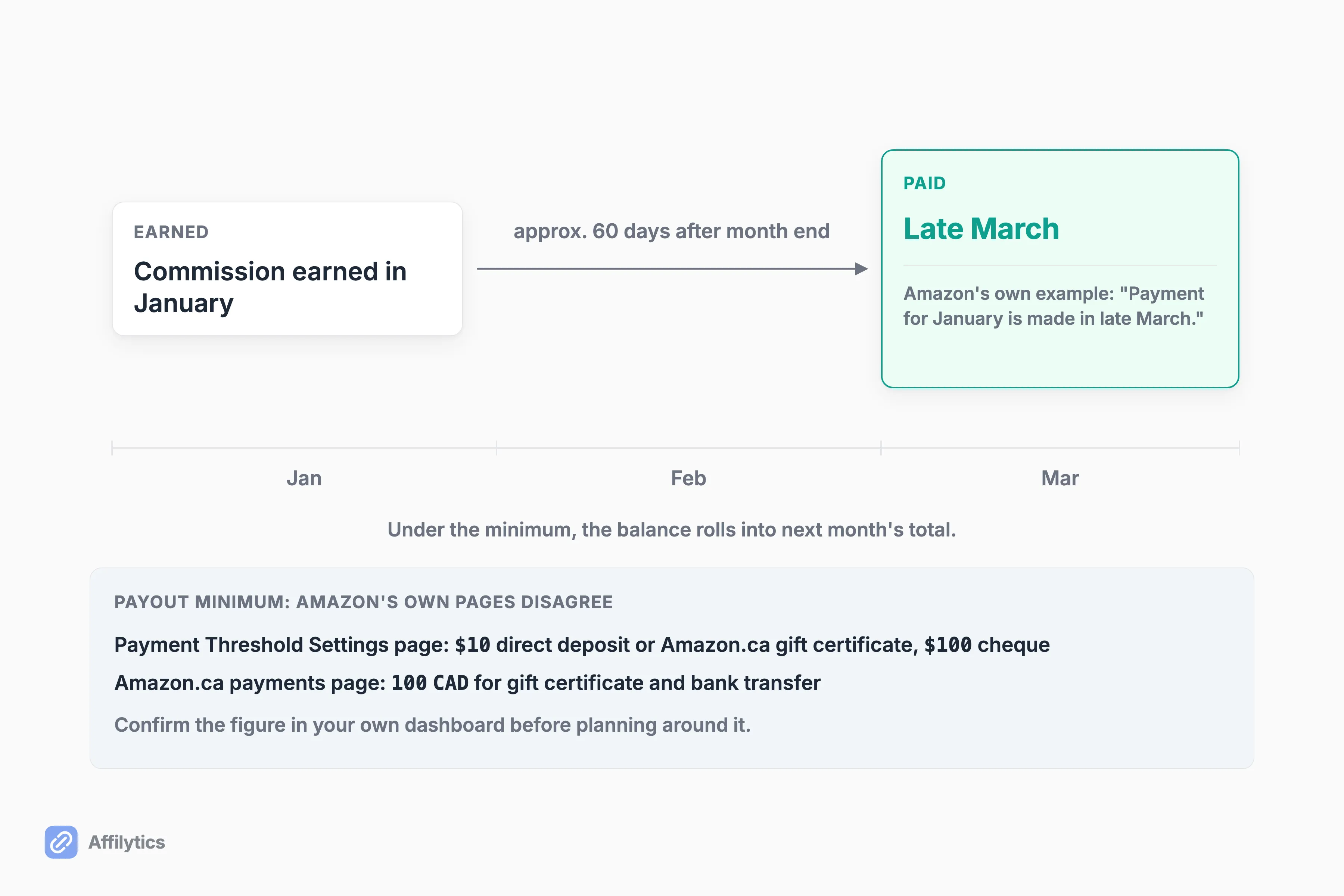
Section titled “When and How You Actually Get Paid”Amazon pays Canadian Associates monthly, and each month’s commission arrives roughly 60 days after the end of the month you earned it in. Amazon’s own worked example is blunt about what that means in practice: “Payment for January is made in late March.”
There are three ways to be paid, and on the threshold page’s account the one you pick sets your minimum:
- Direct deposit into a bank account.
- An Amazon.ca gift certificate, which shares the lower minimum with direct deposit.
- A cheque, which carries the higher minimum.
The Payment Threshold Settings page puts the floor at $10 for direct deposit or a gift certificate and $100 for a cheque. Read those as Canadian dollars, and check the figure in your own dashboard before you plan around it: a separate Amazon.ca payments page still states a 100 CAD minimum for gift certificate and bank transfer, so Amazon’s own help pages do not agree with each other here. On that threshold page’s own account, the $10 floor is fixed and you cannot change it. The $100 cheque minimum works differently: you may raise it, you may never lower it, and a change has to be submitted by the first day of the payment month to take effect for that month.
Nothing is forfeited below the line. A month that comes in under the threshold rolls into the next month’s total and waits there until the balance clears. And before any of it moves, Amazon has to hold your tax information.
Sixty days is a long time in content. What does the lag actually cost you?
Visibility, mostly. A link that stopped paying in January does not show up as a smaller deposit until late March, and by then the video or post carrying it has already spent most of its traffic. The delay is not the problem on its own. It is a problem because it outlasts the attention almost anyone gives a single piece of published content, so the feedback arrives after you have stopped looking.
The payment method you pick is therefore a bigger decision than it looks, and how much bigger depends on which of those two Amazon pages is current. If the threshold page holds, choosing cheque puts you behind a $100 floor rather than a $10 one, and for an account earning modestly that turns a monthly schedule into an occasional one, on top of the 60-day delay that was already there. If the payments page holds, you are behind $100 whichever method you pick, which is a stronger reason to confirm the number in your own dashboard than to take either page at its word. The timing rule on changes has a sharp edge as well: a new threshold has to be submitted by the first day of the payment month, so deciding halfway through March that you want a different figure does nothing for March’s run.
One more effect worth naming for smaller accounts. If your monthly commission hovers near whichever floor applies to you, the roll-over means your schedule is not really monthly at all, and that is a slow loop to learn anything from.
The Tax Step That Only Canadian Associates Hit
Section titled “The Tax Step That Only Canadian Associates Hit”Here is the Canada-specific mechanic almost no guide covers. It lives in the Canadian operating agreement, not in the payments help pages, which is why it goes unread.
Amazon adds applicable tax on top of your commission payment only if you have supplied a valid GST/HST registration number in the Canadian Tax Interview. No number, no added tax. When it does apply, Amazon remits that tax in the same form as the commission itself, so a gift-certificate payout carries it as a gift certificate.
The verification step is the part that surprises people. By registering for or using the Associates Site, you authorize Amazon to contact the Canada Revenue Agency to verify your GST/HST registration. If the CRA cannot verify it, Amazon does not pay the tax amount. A typo in that field is not a small clerical problem, it is a payment that quietly does not include something you expected.
Three more lines from the same agreement are worth having in your head:
- If you become GST/HST registered later, Amazon adds applicable taxes to commission income accruing from the first calendar month after it receives your notification, not retroactively.
- Amazon may deduct or withhold taxes it is legally obliged to, and may hold your commission income entirely until you provide requested tax information.
- The agreement was last updated October 15, 2025, and exists in a French translation, with the English version controlling in any conflict. If you are reading the French version, the English one is the one that binds you.
The practical version of all of this is short. Complete the tax interview properly the first time, enter your registration number exactly as the CRA holds it if you have one, and treat any warning banner about missing tax information as a payment problem rather than a notification to dismiss.
Do you need a GST/HST number to be an Amazon Associate in Canada?
Not to join, and not to be paid commission. What the number changes is whether Amazon adds tax on top of what it pays you. Whether you should be registered at all depends on your total revenue, your business structure and things about your situation that no blog post has any business guessing at. That is a conversation with a Canadian accountant, and it is a cheap one relative to getting it wrong.
Your Audience Is Not Only in Canada
Section titled “Your Audience Is Not Only in Canada”Canada is a small market sitting next to a very large one, which is why a Canadian creator’s audience map and a Canadian creator’s tracking ID so rarely agree with each other.
A creator on r/Affiliatemarketing put the problem in one sentence: “I’m based in Canada, 90% of my blog’s viewers are from the US. When applying for Amazon Associates program, should I apply for the US or the Canadian option?” That thread is years old and the question has not aged a day.
Here is the actual mechanic, because the shorthand people use for it is wrong in a way that matters. A link you build on amazon.ca carries a Canadian tracking ID and pays on the Canadian storefront. An American clicking it is not blocked from anything. They are simply sent to a Canadian store, where prices are in Canadian dollars and shipping is cross-border, and one of two things happens:
- They look at the Canadian storefront and do not buy, because the price and the delivery estimate are wrong for where they live.
- They close the tab, go to amazon.com themselves, search the product and buy it there, with nothing attached to the click you earned.
You did the work in both endings. Somebody else got paid in the second one, and in the first one nobody did.
Another Canadian creator on the same subreddit described exactly this: building affiliate links from Amazon.ca while more than half the audience for his Twitch channel sits in the United States, plus Europe and Asia, and reading the result as the links simply not working for those viewers. They work. They work in the wrong country, which is a conversion and attribution problem rather than a hard block, and it is worse than a broken link because it looks fine from the outside.
How much of your traffic is this?
More than you would guess, is the honest answer, and you should not take our word for it when your own analytics has the number. Most creators carry a 30 to 50% international audience without ever having checked. For a Canadian creator the split usually leans harder still, because the country next door publishes in the same language and buys the same products.
For a sense of scale, a US-based YouTube channel typically sees roughly 60% United States, 12% United Kingdom, 8% Canada, 6% Australia and 14% everywhere else. Read that from the Canadian side and the point lands hard: even the American creators are sending a slice of their traffic to Canada, and almost none of them have a Canadian tag on it. The traffic crosses the border in both directions and the tracking IDs mostly do not.
Amazon’s own answer to this is OneLink, and it is worth understanding before you reach for anything else. We wrote up how OneLink decides which storefront a click lands in, including the ways it quietly fails.
The routing part is what we build at Affilytics. A smart link works out which country a visitor is in from their IP address, then sends that click to the storefront where your tag actually pays, with a default destination for everyone who matches no rule. It works for any merchant, not just Amazon, and it is one link in your content instead of one per country.
Be clear about the shape of that, though. You create the smart link and swap it into your content yourself. A scan finds and monitors the links you already published, it never silently rewrites them into something else, and I would not trust a tool that claimed otherwise.
Should You Join the Canadian Programme or the American One?
Section titled “Should You Join the Canadian Programme or the American One?”This is the question the busiest Reddit thread on the subject is actually about, and Amazon answers it in two places that do not agree with each other.
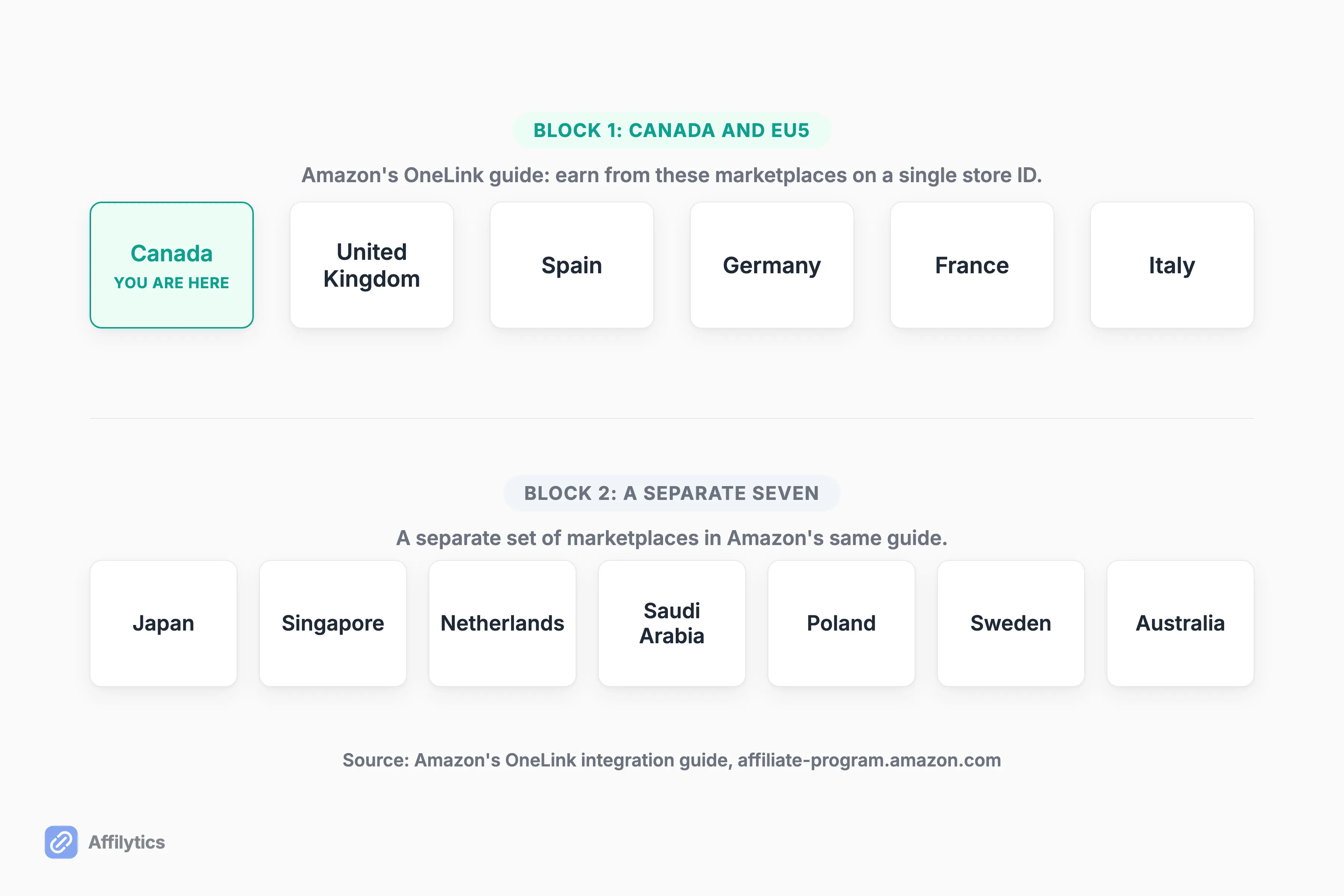
Start with the American documentation, because it is the clearer of the two. Amazon’s OneLink integration guide sorts the marketplaces into exactly two blocks. The first is Canada and the EU5 countries, which Amazon names as the United Kingdom, Spain, Germany, France and Italy. The second is a separate set of seven: Japan, Singapore, Netherlands, Saudi Arabia, Poland, Sweden and Australia. Canada sits in the first block, which is to say Amazon’s own guidance puts Canada and the EU5 marketplaces on a single store ID.
Now read the Canadian portal on the same subject. Its International Affiliate Programs page says “We now operate the Associates Program in twelve locations around the world”, and then tells you that if you wish to participate in a program outside the U.S., you will have to “apply for each program individually”. There is no mention of a single store ID on that page. There is no mention of Earn Globally anywhere on the Canadian portal that we could find, and the help node that carries the marketplace grouping on the American site returns nothing at all on the Canadian one. That same page also lists more country sign-up links than its own sentence counts, so do not treat “twelve” as a number to plan with; the running list linked at the top of this post is where we keep track of that.
Be precise about what that gap is and is not. It is a documentation gap, not an eligibility one. Canada is named by Amazon, in Amazon’s own words, as part of the single-store-ID group. What is missing is any trace of that on the portal a Canadian creator would naturally read, which leaves people applying country by country because the only page they were shown told them to.
So which one do you apply to?
Two questions decide it, and neither of them is about which table pays better:
- Where do the people who actually buy live? Not where your views come from, where your purchases come from. Join the programme for that country first.
- Can you be paid there? A payout destination and a tax interview you can complete are not optional, and they are the part that stops people rather than the application form.
The community answer on Reddit is to start with the biggest audience and add the rest afterwards, and it is not bad advice. What it misses is that “add the rest afterwards” means something very different inside the Canada and EU5 group than outside it, which is why what Earn Globally actually pays is the piece to read before you open a second account you may not need.
One consequence of joining that group catches people off guard. A creator on r/Amazon_Influencer reported: “Today I got a notification to fill out a tax form for Canada. I have never sold anything outside the U.S market.” They were told payments would be held until it was done.
What is documented here is narrow, so here is only the documented part. Amazon must hold your tax information before it can pay a linked account, and the Canadian agreement lets it hold commission income until you provide what it asks for. We could not find Amazon documentation explaining exactly when that Canadian prompt fires or what triggers it for an account with no Canadian sales. We are not going to fill that gap with a guess, and we are certainly not going to tell you what it means for your tax position. If it lands in your dashboard, complete it and ask your accountant what, if anything, it changes for you.
What to Do About the Traffic You Already Have
Section titled “What to Do About the Traffic You Already Have”Before you open a second Associates account, rewrite a link, or read one more rate table, go and look at where your clicks are already coming from. Everything above is theory until you have that number.
The order to work in:
- Pull the country split for your audience. Your analytics already has it. Fifteen minutes.
- Route what you already published, so the clicks arriving from outside Canada land on a storefront where a tag of yours pays.
- Then check whether those links are even alive, because routing a dead link to the correct country still pays nothing.
Routing is the income half of this and it goes first. Affilytics puts a country rule on each link and sends the click to the matching storefront, which turns a click that was going to earn zero into a click that earns whatever that storefront’s category rate happens to be. That is a smaller claim than most tools in this category make, and a more honest one: it does not raise the rate Amazon pays you, it stops clicks landing where no rate applies at all.
The second half is quieter and slower. Links rot. A product goes out of stock, a merchant redesigns its URLs, a programme closes, a redirect somewhere in the chain strips your tag, and none of that announces itself. Continuous health checking is what turns “something feels off in the numbers” into “this specific link went broken on the fourteenth”, and the statuses that come back are the plain kind: active, broken, tag stripped somewhere in the chain, product out of stock.
Worth saying plainly: none of this is Amazon-only. If your content also carries links to gear brands, software or any other programme, those clicks cross borders the same way and break the same way, and Amazon Associates Canada is only one of the tags in your library that can end up pointing at the wrong place.
Which of those two is costing you more right now?
For most creators with a mixed international audience it is the routing, by a wide margin, because it applies to every single foreign click rather than to the handful of links that happen to have died. We put the full version of that argument in our guide to earning from every country your audience is in.
Start With the Clicks You Already Have
Section titled “Start With the Clicks You Already Have”Find out where your Amazon clicks are actually coming from before you assume your Canadian tag is catching them. Create your free account and you get two full weeks with everything unlocked and no credit card, which is enough time to see the country breakdown behind the links you have already published and decide whether any of this is worth acting on.
If it turns out your audience really is almost entirely Canadian, you will have learned that for free and this post collapses back into the rate table. That is a fine outcome too.
Can I join Amazon Associates in Canada?
Section titled “Can I join Amazon Associates in Canada?”Yes. The Canadian programme is its own portal at associates.amazon.ca, with its own commission schedule and its own payout rules, separate from the American one. Amazon asks for a qualifying website or app rather than a plan to build one, and it reviews the application instead of approving it on submission. Approval is a decision, not a formality. Amazon also has to hold your tax information before it can pay you anything, so the tax interview belongs to onboarding rather than to some later stage.
How much does Amazon Associates Canada pay?
Section titled “How much does Amazon Associates Canada pay?”It depends entirely on the category. Amazon’s Canadian standard commission table runs from 10.00% at the top, which only Luxury Beauty reaches, down to 0.00% for gift cards, grocery and Kindle Unlimited memberships. Pet Food and Supplies pays 9.00%, jewelry and luggage 7.00%, and a broad clothing, beauty and home tier 6.00%. The row that matters most is All Other Categories at 2.00%, because that is where a link lands when it does not fall into one of the named categories. The up to 10% headline on the Canadian portal describes the ceiling, not the typical rate.
When does Amazon Associates Canada pay you?
Section titled “When does Amazon Associates Canada pay you?”Monthly, roughly 60 days after the end of the month you earned the commission in. Amazon’s own worked example is that payment for January is made in late March. Amazon’s Payment Threshold Settings page puts the minimum at 10 Canadian dollars for direct deposit or an Amazon.ca gift certificate and 100 Canadian dollars for a cheque, but a separate Amazon.ca payments page still states a 100 CAD minimum for gift certificate and bank transfer, so check the figure in your own dashboard before you plan around it. Anything under the threshold is not lost, it rolls into the next month’s total. Amazon must also hold your tax information before it releases any payment at all.
Do I need a separate Amazon Associates account for the US?
Section titled “Do I need a separate Amazon Associates account for the US?”Amazon answers this in two places that do not match. Its US-side OneLink integration guide groups Canada with the United Kingdom, Spain, Germany, France and Italy as marketplaces you can earn from on a single store ID. The Canadian portal’s own International Affiliate Programs page never mentions that route and still tells you that if you want to participate in a program outside the US you will have to apply for each program individually. The single-store-ID option genuinely does cover Canada. It is simply not documented on the Canadian side, so read Amazon’s US pages before you open a second account.
Do I have to charge GST/HST on Amazon affiliate commission?
Section titled “Do I have to charge GST/HST on Amazon affiliate commission?”That is a question for your accountant, not for us and not for a forum thread. What Amazon documents is narrower and worth knowing: it adds applicable tax to your commission payment only if you have supplied a valid GST/HST registration number in the Canadian Tax Interview, and by using the Associates Site you authorize Amazon to contact the Canada Revenue Agency to verify that number. If the CRA cannot verify it, Amazon does not pay the tax amount. If you register later, Amazon starts adding tax from the first calendar month after it receives your notification.