
Amazon Commission Cuts: What Changed and What to Do
Amazon’s rate changes arrived the way these things usually do, with no announcement, no email, and a smaller number in your reports one morning. One clarification before anything else, because Google keeps mixing the two up: Amazon commission cuts in this post means the Associates program, what Amazon pays you as an affiliate, not the referral fees merchants pay Amazon to sell on the marketplace.
I build Affilytics with my co-founder. It sends each affiliate click to the shopper’s own country’s storefront and health-checks every link it finds, so I spend most of my week looking at exactly where affiliate income leaks out between a click and a payout.
Amazon has never paid one flat percentage. Amazon’s affiliate commission rates vary by category and by country, which is a large part of why nobody can tell you what this did to your specific account.
Below: exactly what changed and when, why the headline number is probably not your number, and the three responses ranked by how fast each one pays you back.
What Amazon actually changed, and when
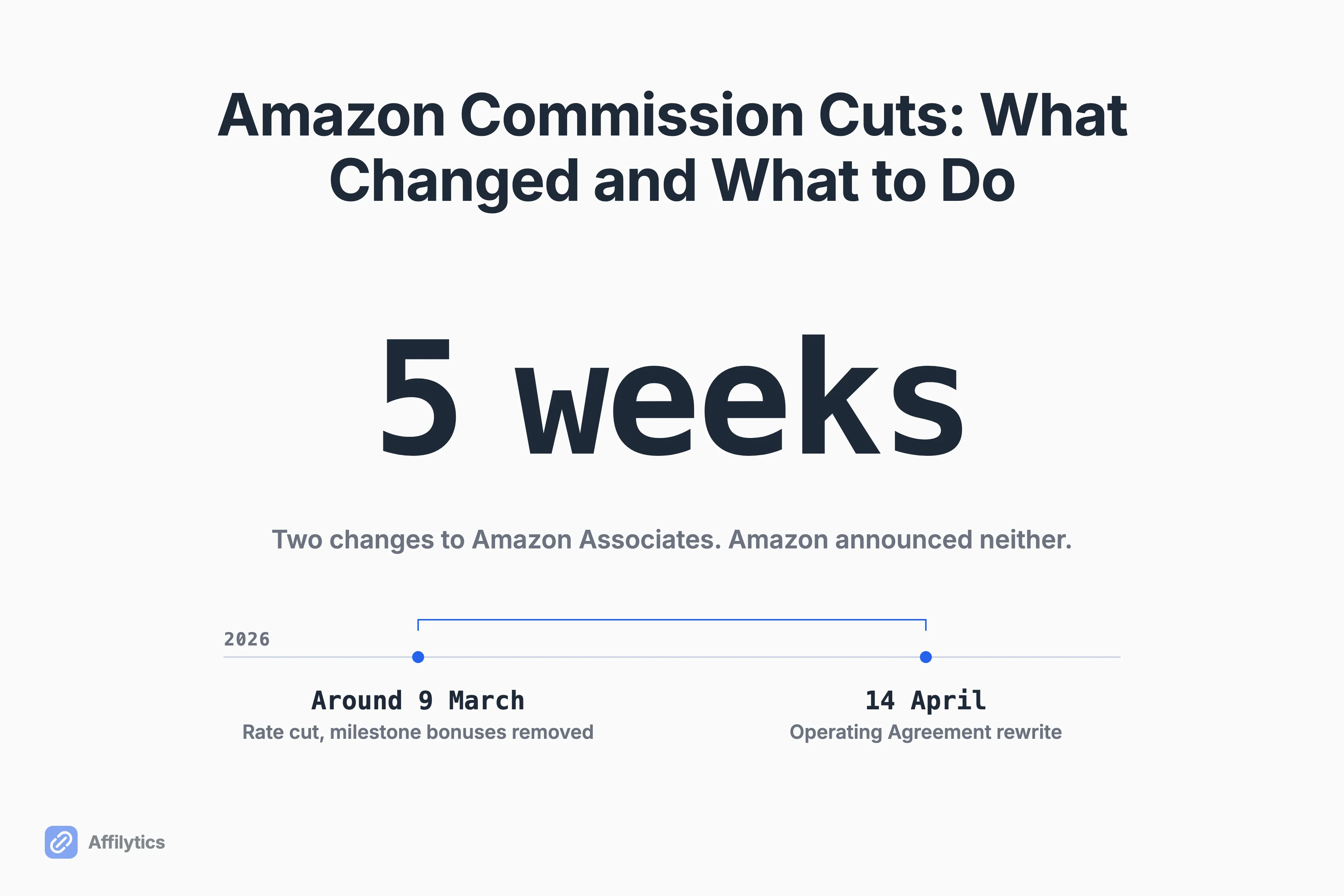
Section titled “What Amazon actually changed, and when”Two things happened to Amazon Associates in 2026, weeks apart, and Amazon publicly announced neither. The timeline as reported:
- Late 2025. The rate changes began rolling out in Asia-Pacific markets.
- Around 9 March. They landed in the US. Adweek reported the cuts, citing seven publishers and partners with direct knowledge: rates slashed by as much as 50% for some publishers, milestone bonuses eliminated for most, reporting tools degraded. Publishers found out in one-on-one conversations with their account managers.
- 14 April. The updated Associates Operating Agreement went live. It ended halo-sale commissions, added a 180-day shipping window that puts pre-order commissions at risk, disqualified purchases from boosted posts using certain Amazon keywords, and began requiring original commentary on every page linking to Amazon.
One qualifier travels with that 50% wherever it appears: the cuts were not applied across the board, some associates were unaffected, and Amazon is on record calling the change “a tiny fraction of associates”.
So are these one change or two?
Nobody can say. No source I found cross-references the other, so I cannot tell you the March rate cut and the April rewrite are one restructuring, and I cannot tell you they are unrelated either, or that either caused the other. Creators lived through both inside five weeks. Amazon announced neither.
The halo-sale change is the one creators feel longest, because it is invisible in a way a rate cut is not. Carrie Loranger, who writes a creator newsletter, put it plainly: “If someone clicked your link, then bought a bunch of other stuff in the same cart, you used to earn on all of it. That was the single best thing about Amazon affiliate revenue, passive income from products you never mentioned. Gone.”
Hello Partner reported that premium categories previously paying up to 10% dropped to 4 and 5 percent in some cases, and that the new reporting system makes affiliates clear a sales-volume threshold before they see detailed metrics. The cut and the reporting downgrade arrived together.
Amazon has published no before-and-after, so the only thing you can check directly is where the rates stand now. On Amazon’s standard commission income rates, 10% survives in exactly one place, Luxury Beauty and Luxury Stores Beauty and Amazon Explore. Furniture, Home, Pets Products, Toys, Beauty, Tools, Sports and Outdoors all sit at 3%. Grocery and Health & Personal Care pay 1%.
Why the 50% headline is probably not your number
Section titled “Why the 50% headline is probably not your number”So how much did this actually take out of your account?
The Amazon commission cuts are real. The number attached to them is not one you can apply to yourself, and three documented things get in the way.
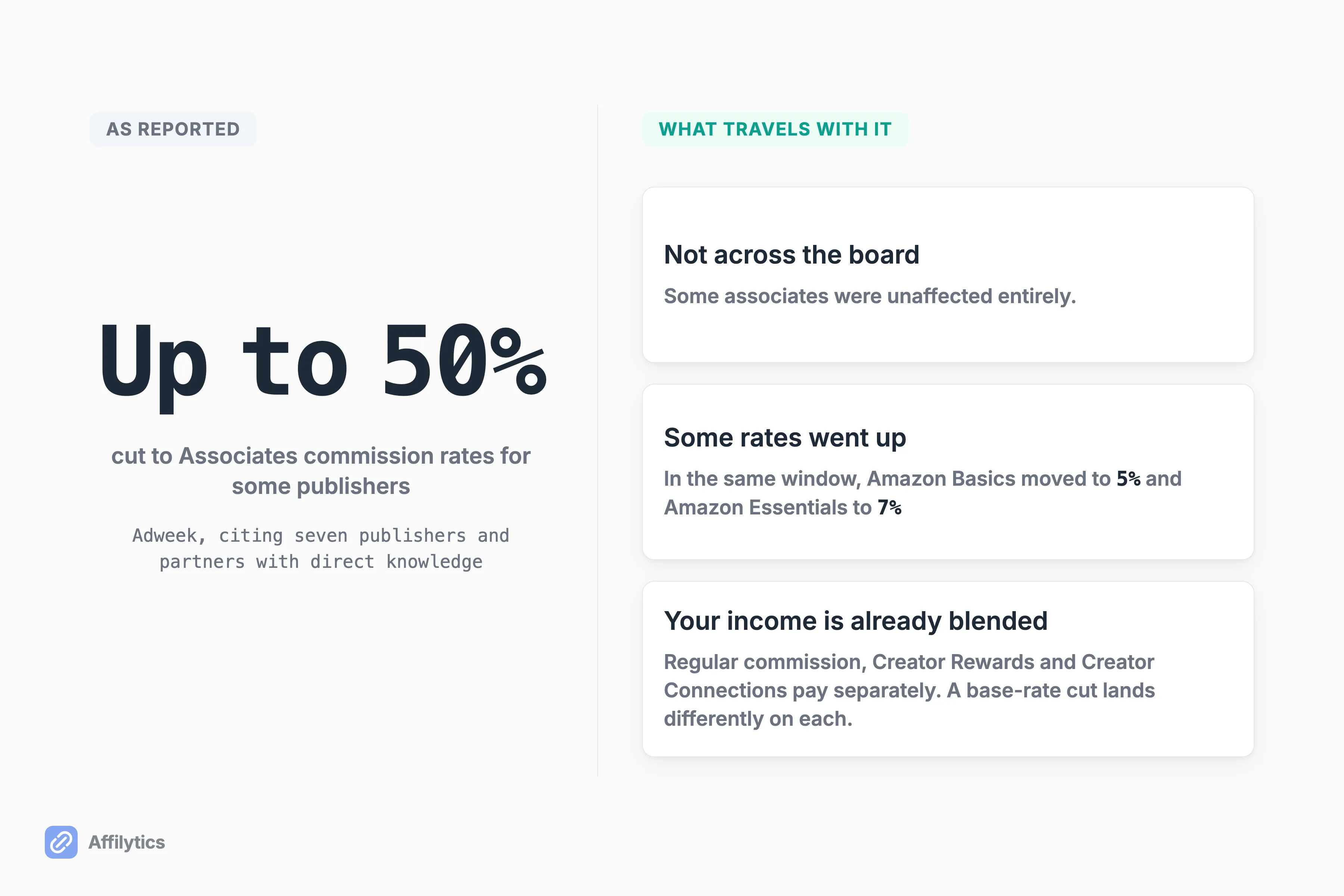
- The cuts were not applied across the board. Hello Partner reported that some associates were unaffected entirely.
- Amazon disputes the framing. Its statement: “The commissions rate changes affect a tiny fraction of associates. We continue to periodically offer select bonuses, and have added other incentives”. It has not published a table showing which associates or which categories, which is why you cannot check that claim against your own account.
- Some rates went up in the same window. Creators in r/Amazon_Influencer posted an Amazon email raising Amazon Basics to 5% and Amazon Essentials to 7%. As u/JakeReviews put it: “Now the one Amazon basics item I sell a crap ton of will pay me 50 cents instead of 30. I might retire tomorrow.”
A fourth reason: your income is already blended. On X, @roi_hacks broke a roughly $500 commission day into about $270 in regular commission, about $127 in Creator Rewards, and about $110 in Creator Connections. A cut to the base rate lands hard on a creator whose income is mostly that first bucket and barely registers for one whose income is mostly the other two.
The honest version: something got cut, the reported ceiling is 50%, Amazon says it touched a tiny fraction of associates, and nobody outside Amazon can tell you which side of that line you sit on. Your own reports are the only rate card you have.
Response 1: diversify, and what it actually costs you
Section titled “Response 1: diversify, and what it actually costs you”Every article about the Amazon commission cuts ends on “diversify,” and it is genuinely the right advice. It is also the slowest thing on this list, and almost nobody says that part out loud.
Single-program income is fragile enough to be worth the work anyway, and this is not the first time. In April 2020 Amazon cut home improvement and furniture commissions from 8% to 3%, and those categories are still at 3% on today’s rate card. A creator in r/Amazon_Influencer did the math in public: “I bought $1000 Segway now they get a 0.75% commission now, at the rate its moving it will take about two years to make the money back.” One company sets the rate, and one decision decides whether the thing you bought to review was an investment or a purchase.
How long does a second income stream take to matter?
Longer than you want. Diversifying means:
- New applications, each with its own approval bar.
- New links swapped by hand into old posts and old video descriptions.
- A second and third dashboard, tag format, and payout threshold.
One counterpoint worth carrying. On X, @JamesEbringer argued Amazon’s rates were never generous: the program launched in 1996 paying 4% because that was “the maximum they could survive paying. It wasn’t a commission rate it was a desperation rate,” and every network after copied the number. When you go looking at Amazon affiliate program alternatives, you are comparing against a low bar, not a golden age.
Rebuilding an income stream takes months. The two responses below pay back this week, because they recover money you have already earned.
Response 2: stop leaking international clicks
Section titled “Response 2: stop leaking international clicks”A rate cut lowers what you earn per qualifying sale. An international click often earns nothing at all, and most creators have never counted how many they get.
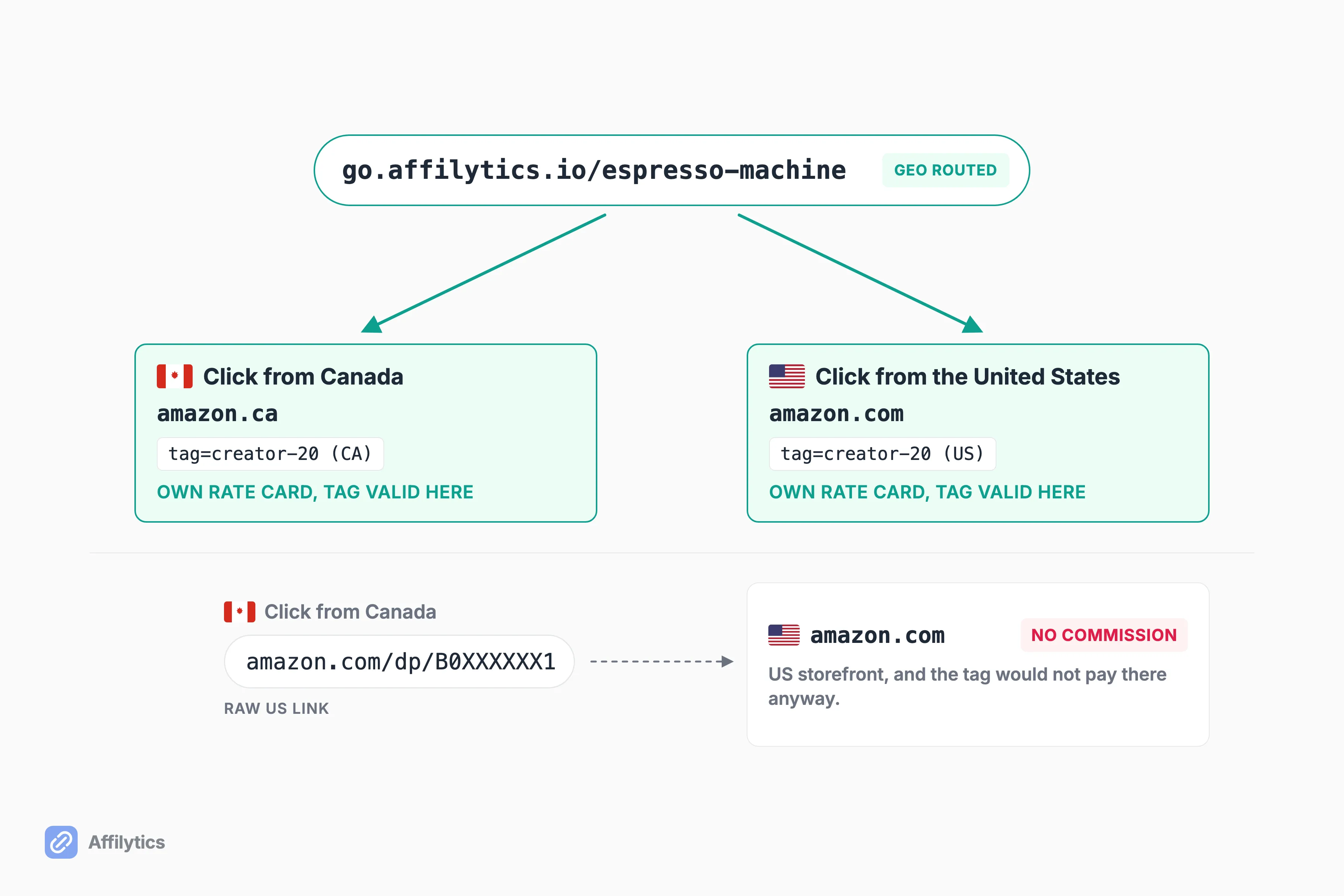
Amazon runs a separate Associates program per country. Three consequences most creators never see:
- Each program issues its own tracking ID, and a tag from one is not valid on another.
- Each program sets its own rate card, so the same category pays differently in different countries.
- A link to amazon.com clicked from Toronto or Manchester lands that shopper on a storefront they often cannot buy from, carrying a tag that would not pay there anyway.
The commission does not go to a competitor. It just does not happen.
What share of your clicks comes from outside your own country?
Most creators have never looked, and the number is usually higher than the guess. A US channel with a real UK, Canadian and Australian following is the norm, which is why what your international traffic is worth is the question to answer first.
The rates across the border are not always worse, either. @roi_hacks flagged 9% Amazon Associates commission on Furniture, Home and Pets in the Canadian program. Amazon’s US rate card, the one linked above, pays 3% on those same three categories. That is a practitioner’s observation, not an Amazon-published comparison, and it points at what the rate-cut coverage skips: what you earn depends on which storefront the click lands on, not only on what Amazon decided in March.
The fix is how affiliate geo-routing works: one link that reads the visitor’s country and sends each click to that country’s storefront with a tag valid there. That is the primary thing we built Affilytics to do.
Each smart link carries per-country rules, the visitor’s country comes from a lookup on their IP, the first matching rule wins, and anything unmatched falls through to a default URL you choose. The free tier shows the country breakdown of every click, so you can size the leak before paying anything.
Response 3: stop leaking broken clicks
Section titled “Response 3: stop leaking broken clicks”This is the one that pays back fastest, because a dead link earns 0% no matter what Amazon’s rate card says.
When did you last click one of your own links from two years ago?
Old content is where this lives. A video from two years ago still gets views and still gets clicks, and its products have had two years to go out of stock, get discontinued, or move to a URL that no longer resolves. Nobody emails you. The clicks just stop converting.
Redirects add their own failure mode. In r/Affiliatemarketing, u/frdiersln warned that “deep linking via third-party tools adds an extra redirect hop that can strip your attribution tags if their server latency spikes,” and that a typo in a tag parameter means “sending free traffic to Amazon without getting paid.” That is the worst version: the link works, the shopper buys, and the sale gets credited to nobody.
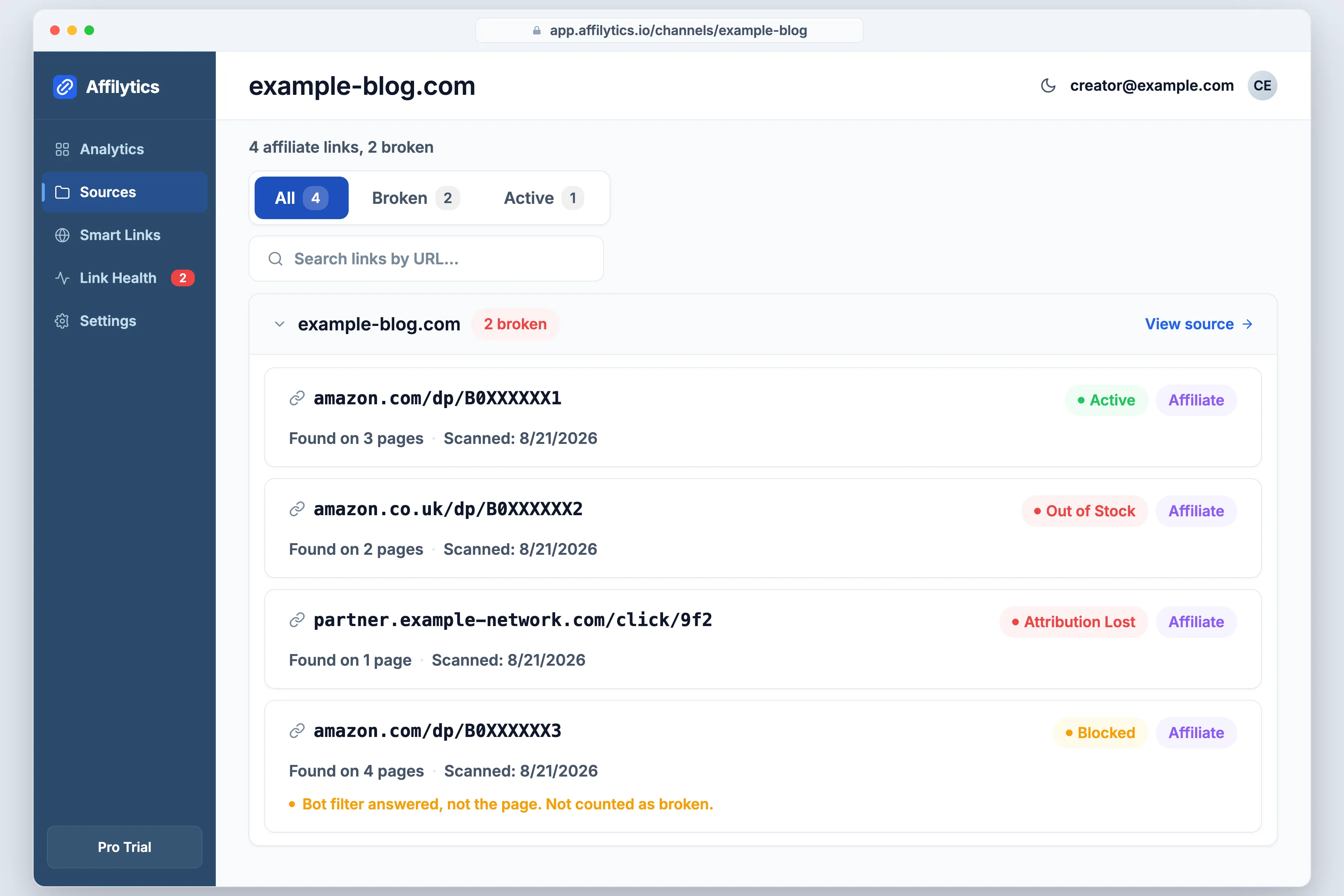
“Broken” is not one state, which is the part most checkers get wrong. A link can be:
- Broken. The page is genuinely gone.
- Out of stock or product unavailable. The page loads fine and cannot be bought.
- Attribution lost. The hops between the click and the store ate your tag.
- Blocked. The retailer’s bot-blocking layer refused the checker, which tells you nothing about the link.
That last one matters more than it looks. A checker that reports a bot block as “broken” hands you a list of links that were never broken, and you spend a Saturday editing video descriptions for nothing. Affiliate link monitoring is only worth running if it tells those apart.
We built ours so checks go out through a client that fingerprints like a real browser rather than a script, which keeps a block reading as a block. It also finds the links itself: point it at a channel or a blog and it discovers everything already published there.
Start with one source
Section titled “Start with one source”You do not get a vote on Amazon’s rate card. You do get a vote on whether your Canadian clicks land on a storefront they can actually buy from, and on whether the links in your best post from 2024 still work.
Both are measurable this afternoon. Create your free account, point it at one channel or blog, and read the country breakdown of your own clicks before deciding anything else. Everything is unlocked for two weeks with no credit card, and after that the free tier keeps showing you where your clicks come from.
Did Amazon cut affiliate commissions in 2026?
Section titled “Did Amazon cut affiliate commissions in 2026?”Yes, for some publishers. Amazon cut Associates commission rates by as much as 50% and removed milestone bonuses for most publishers, rolling the change out in Asia-Pacific markets in late 2025 and in the US around 9 March. It was never publicly announced. The qualifier matters as much as the number: the cuts were not applied across the board, some associates were unaffected, and Amazon’s own position is that the change affects a tiny fraction of associates.
Which Amazon commission rates changed?
Section titled “Which Amazon commission rates changed?”Premium categories that previously paid up to 10% were reported down to 4 and 5 percent in some cases, but the cut was not across the board and some rates went up in the same period. Creators posted an Amazon email raising Amazon Basics to 5% and Amazon Essentials to 7%. Amazon’s own published fee schedule is the only authoritative current list, and it is the thing to check against your own categories.
What is the Amazon halo commission change?
Section titled “What is the Amazon halo commission change?”The Associates Operating Agreement that went live on 14 April 2026 ended halo-sale commissions. You used to earn on the other items a shopper added to the same cart after clicking your link, including products you never mentioned. That stopped. For creators whose audience buys a basket of household goods after one recommendation, it was the quietest and largest part of the loss.
How do I stop losing Amazon commission on international clicks?
Section titled “How do I stop losing Amazon commission on international clicks?”Send each click to the shopper’s own regional Amazon storefront with a tracking ID that is valid in that country, instead of pointing everyone at one storefront. Before you set anything up, measure it: find out what share of your clicks already comes from outside your home country. If that share is small, this is not your problem. If it is large, it is the biggest one on this list.
Are Amazon seller referral fees the same as affiliate commission cuts?
Section titled “Are Amazon seller referral fees the same as affiliate commission cuts?”No, and mixing the two up is easy because both get called commission. Referral fees are what a merchant pays Amazon for each sale made on the marketplace. Associates commissions are what Amazon pays you for sending a shopper who buys. Amazon has changed both over the years, and a headline about one tells you nothing about the other.