
Target Affiliate Program: What Changed, and What It Pays
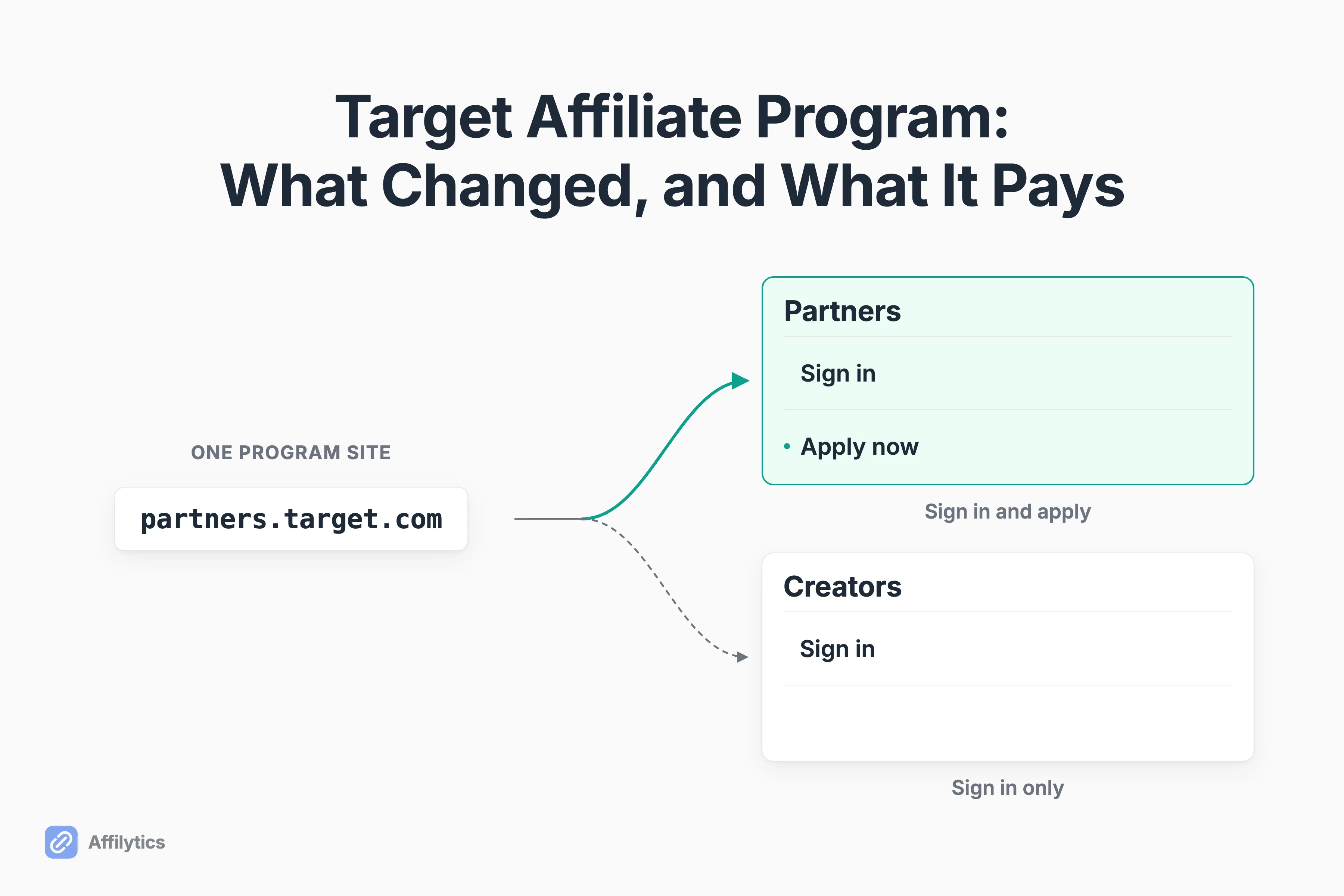
If you searched the Target affiliate program recently, you probably ran into someone claiming it is shutting down. It is not. Target is still taking applications today, and I checked the program’s own site before writing a word of this, because the rumor is loud enough that repeating it without looking would be lazy.
We build the link scanner and geo-router behind Affilytics, which watches affiliate links across networks including Impact, the network Target runs on, so cookie windows and attribution rules are what I spend my days inside.
Target comes up constantly when creators go hunting for other programs worth adding alongside Amazon, and right now it arrives with more rumor attached than any of them. Some of that rumor is about a second track on the same site, not about the affiliate program.
Below: what is actually going on with Target’s two tracks, what the program pays once you get past the “up to 8%” headline, how the 7-day cookie stacks up against Amazon’s 24 hours, who qualifies, and the terms that quietly claw commission back.
Is the Target Affiliate Program Ending?
Section titled “Is the Target Affiliate Program Ending?”No. The affiliate program is live, and Target is still accepting applications right now.
The program’s public brand is Target Partners, it runs on Impact, and the header dropdown labeled Partners offers two things: a sign-in for people already in, and an Apply Now button for people who are not. That button hands you straight into Impact’s own signup flow, which is about as unambiguous as an open door gets.
Three things I confirmed on Target’s own pages before writing anything else:
- The affiliate track is open and has a working application path.
- It is free to join. Target’s FAQ says there is no charge to sign up and no charge to add banners, widgets, or links to your site.
- Acceptance makes you, in Target’s own wording, an associate of Target, tracked through Impact Radius.
So where is the shutdown talk coming from?
Not from the affiliate program. It comes from Target’s separate creator track, which sits on the same website under a different label. That distinction is the whole story, and almost nobody writing about this keyword makes it. The next section is where it gets genuinely murky.
Target Partners and the Creator Track: Why Everyone Is Confused
Section titled “Target Partners and the Creator Track: Why Everyone Is Confused”Target’s program site speaks to two audiences and never once explains the difference between them.
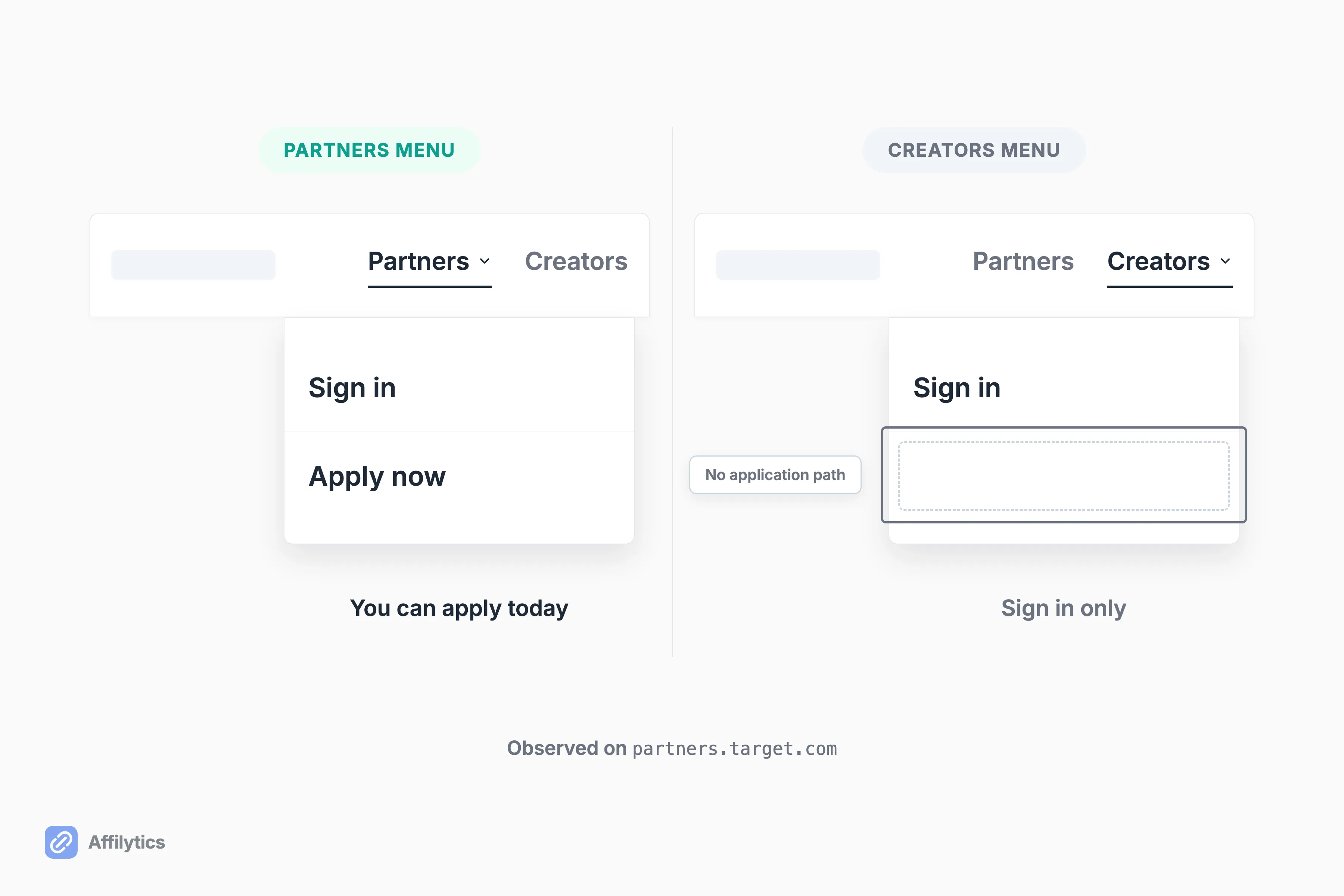
Here is exactly what that header does. The dropdown labeled Partners contains “Sign in” and “Apply now”. The dropdown labeled Creators contains “Sign in”. That is the whole menu. There is no application path for the creator track anywhere on the site, on any page I could reach.
Part of the confusion is that one thing here carries three names. The site brands it Target Partners. The legal document behind it is titled the Target Affiliate Program Terms & Conditions and calls you an “Affiliate” throughout. Impact’s own signup flow calls the account a media partner account. Three labels, one program, and three guides will hand you three vocabularies.
Then there is the one place in Target’s own paperwork where two tracks appear at the same time. The terms say a partner who wants out must send written notice to targetpartners@target.com and targetcreators@target.com. Two mailboxes, one legal document, zero explanation of what separates them.
So has the creator track ended?
Here is the caveat almost every guide skips. A sign-in with no application path is consistent with a creator track that has been wound down. It is equally consistent with a creator track that was always invite-only and never had a public application form to begin with.
I cannot tell you which one it is, and nobody working from Target’s public pages can either. Target has published no announcement and no date.
So the honest split looks like this:
- Confirmed on Target’s site: the affiliate track has a sign-in and an application path; the creator track has a sign-in and nothing else.
- Confirmed in Target’s terms: two contact addresses, one for partners and one for creators.
- Not confirmed anywhere: that the creator track was removed, replaced, renamed, or dated. Every version of that story I found traces back to a guide with no source or a screenshot nobody transcribed.
Creator chatter points in a direction without proving anything. Through 2023 and 2024, creators posted acceptance announcements about a Target creator track, and the replies underneath are the interesting part. One working creator answered a peer’s announcement with “WAIT.. there’s a target creator program? Why am I just now hearing about this??”
Then those posts thin out. That is chatter, not evidence, and it dates nothing. People stop posting about things for reasons that have nothing to do with a program changing, and I am not going to put a date on a change nobody has documented.
Your decision is simpler than the mystery anyway. The affiliate track has a form. You can fill it in today.
What Target Actually Pays
Section titled “What Target Actually Pays”“Up to 8%” is the headline rate Target advertises on its own program landing page. It is also the least useful number in this post.
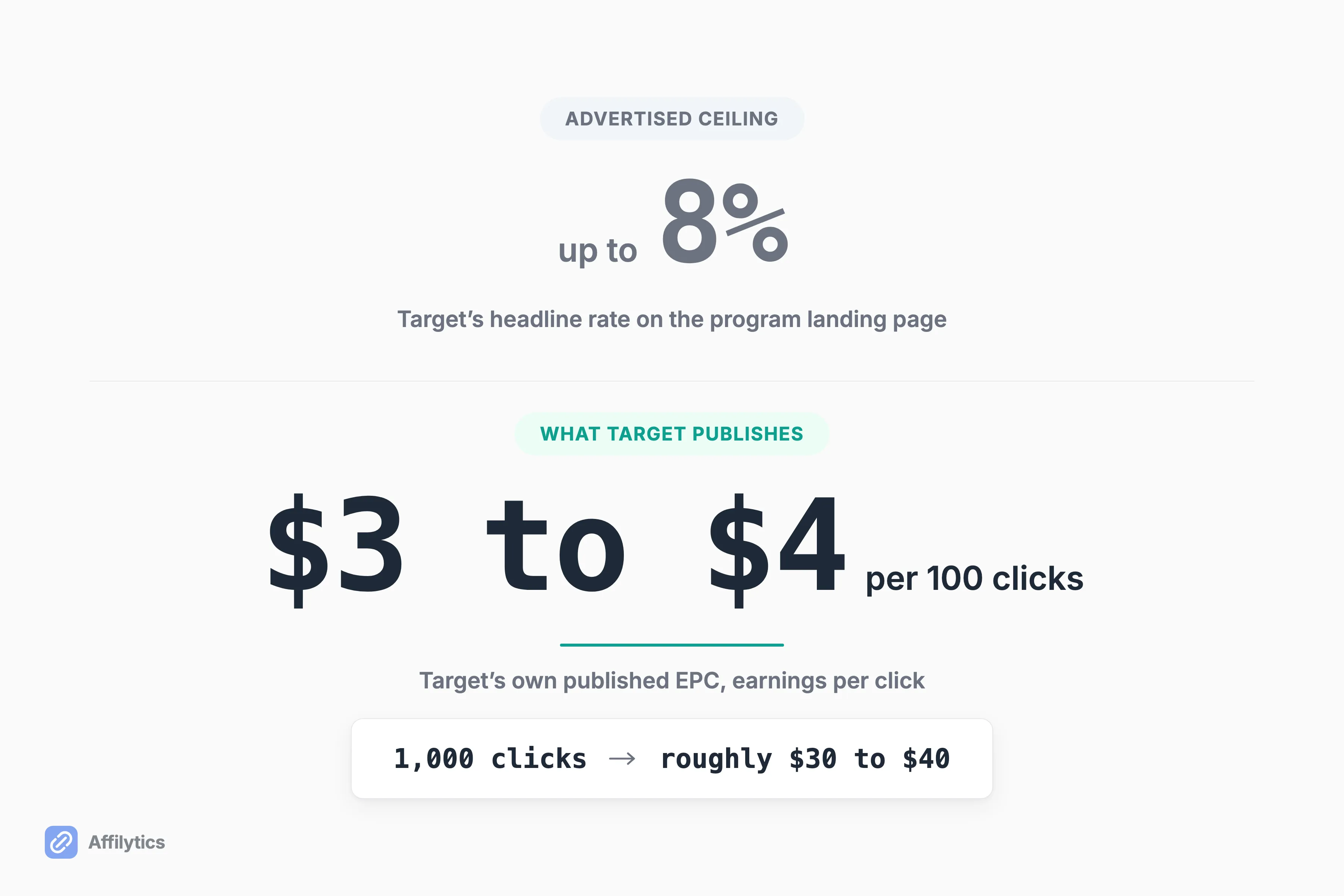
EPC means earnings per click, and Target reports it per hundred clicks: what a hundred clicks pay out on average once the winners, the browsers, and the zeros are averaged together. Target publishes its own figure, and it is refreshingly blunt about it: approximately $3 to $4 per 100 clicks.
Run that forward. A thousand clicks, at the number Target itself reports, is roughly $30 to $40. That is the line that should shape your expectations, not the 8%.
And the low figure makes sense once you know what EPC is measuring. It blends everything: the categories that pay near the ceiling, the categories that barely pay at all, the handful of readers in that hundred who actually buy, and the rest who clicked, browsed, and closed the tab. It is not a rate. It is the honest average of what happens after a click.
Higher EPC figures for Target circulate on other sites, some of them several times what Target publishes. I am not linking them and I am not using them. When a merchant’s own FAQ disagrees with a roundup about that merchant, the merchant wins.
So where is the per-category schedule that decides what “up to 8%” means for you? Nowhere you can read. Target’s terms put your rates in your own contract: “Please refer to your Insertion Order/Contract for your specific rates and exclusions.” The same section says “Standard rates are published on affiliate.target.com”, and the definitions link them at affiliate.target.com/?q=commissionRate. That domain no longer resolves. I checked, and it returns no DNS record at all, so the rate page Target’s own agreement points you to is gone.
That leaves you somewhere specific: you cannot see category rates before applying, and afterwards the numbers that bind you are in your contract, not a public table. Treat 8% as a ceiling, and treat any per-category Target rate table on a roundup site as unverifiable, because the source it would need is unreachable.
What should you actually plan around?
Three things:
- Model your income from the EPC, not the headline rate. Traffic times $0.03 to $0.04 is a forecast. Traffic times 8% is a fantasy.
- Find out where your niche sits before you build a page around it. “Up to” is doing an enormous amount of work in that phrase.
- Compare it against what your existing links already earn per click. If you have Amazon numbers in front of you, you have the only benchmark that matters, and it is yours rather than an industry average.
None of this means skip the Target affiliate program. It means size it correctly before you rebuild a content plan around an 8% figure you will probably never see.
Target vs Amazon: Cookie, Rates, and What Each Is Good For
Section titled “Target vs Amazon: Cookie, Rates, and What Each Is Good For”The cookie is the part of this program worth being genuinely enthusiastic about, and it is the one place Target beats Amazon outright.
A cookie window is simply how long after a click the merchant will still credit a sale back to you. Nothing more complicated than a timer that starts when your reader arrives.
| What you are comparing | Target Partners | Amazon Associates |
|---|---|---|
| Cookie window | 7 days | 24 hours |
| Headline commission rate | Up to 8% | 4.00% catch-all (“All Other Categories”) |
| How the window works | Starts at the click; the last click before the order wins | Starts when the shopper arrives at Amazon through your link |
Target documents a 7-day cookie with last-click attribution. Amazon’s cookie lasts 24 hours, counted from the moment the shopper arrives through your link. Seven days versus one day is seven times the runway for the reader who taps your link on Saturday, thinks about it, and buys on Wednesday. We broke down Amazon’s 24-hour cookie and the ordinary shopper behaviors that close it even earlier.
Amazon’s answer is the rate card. Its US schedule is public and specific: a 4% catch-all rate on All Other Categories, 3.00% on Home, Beauty, Toys, Furniture, Pets, Outdoors, Sports and Baby, 2.00% to 2.50% on televisions and PC components, and 1.00% on Grocery and Health & Personal Care. Our walkthrough of Amazon’s own category rates covers the rest.
So which one should you actually run?
- Target is better on time. Seven days covers the way people really shop: save it, sleep on it, come back midweek. Twenty-four hours does not.
- Amazon is better on breadth. Almost anything you review has a linkable Amazon page and a published rate against it, which is not something you can say about a single retailer’s catalogue.
- Target is US-shaped by design. The eligibility rule below makes that explicit, and it is the constraint that decides whether the 7-day window is worth anything to your particular audience.
Run both. They are not competing for the same slot in your content, and the cookie difference alone makes a Target link worth having next to an Amazon one on any product Target actually stocks.
Who Gets In, and What the Terms Actually Say
Section titled “Who Gets In, and What the Terms Actually Say”Target’s eligibility line is one sentence long, and most guides misread half of it.
“Any website owner, blogger or creator network that runs a family-friendly website and has mainly US-based viewership is eligible to join the Target Partners Program, subject to the program’s terms and conditions.”
Read mainly US-based viewership again. That is a rule about your audience, not about your passport.
Target’s FAQ answers the international question head on: it accepts partners from anywhere in the world, as long as Impact Radius supports your country of residence and you direct your content toward the U.S. market. A creator in Manchester writing for American readers qualifies. A creator in Ohio whose readers are mostly outside the US is the harder case.
What is actually in the terms nobody reads?
Two clauses bite, and both live in the legal document rather than on the sign-up page.
Brand bidding is out. You may not bid on Target brand keywords in search engines, may not put Target brand terms in the headline, display URL, or description of a paid ad, and may not point a paid ad directly at your affiliate link. If paid search is how you acquire readers, that closes the channel before you start.
Returns come back out of your payment. The terms are plain: if a customer returns a qualifying product that generated a referral fee, Target will deduct the corresponding Referral Fee from your monthly payment. Retail returns are ordinary. Your reported earnings and your paid earnings are not the same number.
An affiliate marketer in r/Affiliatemarketing framed the whole vetting problem better than any program page manages: “‘High paying’ only matters if EPC stays high after reversals.” That is exactly the lens to hold Target under, because the headline rate and the post-clawback rate are different animals.
Before you apply, three lines in the terms are worth reading in full:
- The brand-bidding ban, if you run any paid search at all.
- The returns clause, which decides what your payment looks like versus what your dashboard looked like.
- The termination clause, which is the one that quietly tells you two tracks exist.
One more thing to plan around: payment is neither fast nor fixed. Target ties it to your contract, not a published schedule: “Referrals are only considered for payment according to the dates and timelines detailed in the current Insertion Order/Contract”, and it reserves the right to hold fees “until sixty (60) days after the refund period expires”. No date, but a clear enough shape to plan around: the money follows the return window, not the sale.
Where Target Commissions Quietly Disappear
Section titled “Where Target Commissions Quietly Disappear”A Target link can be live, clickable, and correctly tagged, and still pay you nothing. There are four ways it happens, starting with the one that catches the most people out.
Leak 1: the click that could never convert. Target’s eligibility rule is a US-audience rule, and the program is built around Target.com. Your audience is not that tidy. Every reader in Toronto or Berlin who taps your Target link is attention you earned from a shopper the program is not built to pay you for.
A creator in r/Affiliatemarketing described the fix for the Amazon version of this problem perfectly: “Instead of juggling multiple Amazon links, you use one link with a rule: US clicks to amazon.com with your US tag, EU clicks to amazon.de with your EU tag. Reader lands on their local store, you get the right commission.”
That is geo-routing, and it is the core of what we build at Affilytics: one link, a rule per country, every click resolved to a storefront that can actually credit you, and it works for any merchant rather than only Amazon. To be straight about the work involved, you create that link and swap it into your content yourself. Nothing converts your existing links for you.
Leak 2: someone else takes the last click. Target uses last-click attribution, which means the fee goes to whoever set the final click before the order. That is the entire rule.
A coupon or cashback browser extension that fires during checkout sets a click of its own, after yours, on a sale your content created. Nothing broke. You simply stopped being last. We take that mechanism apart in how a commission gets attributed to someone else.
Leak 3: the refund nobody tells you about. The clawback clause above is a leak, not a footnote. A commission you saw in a dashboard in March can be gone from the payment in April, and the only signal is a smaller number.
Leak 4: the link that dies quietly. A discontinued product, a URL redesign, a stock-out. The link still looks fine in your post. The clicks just stop earning, and nothing emails you about it.
How would you ever actually find out?
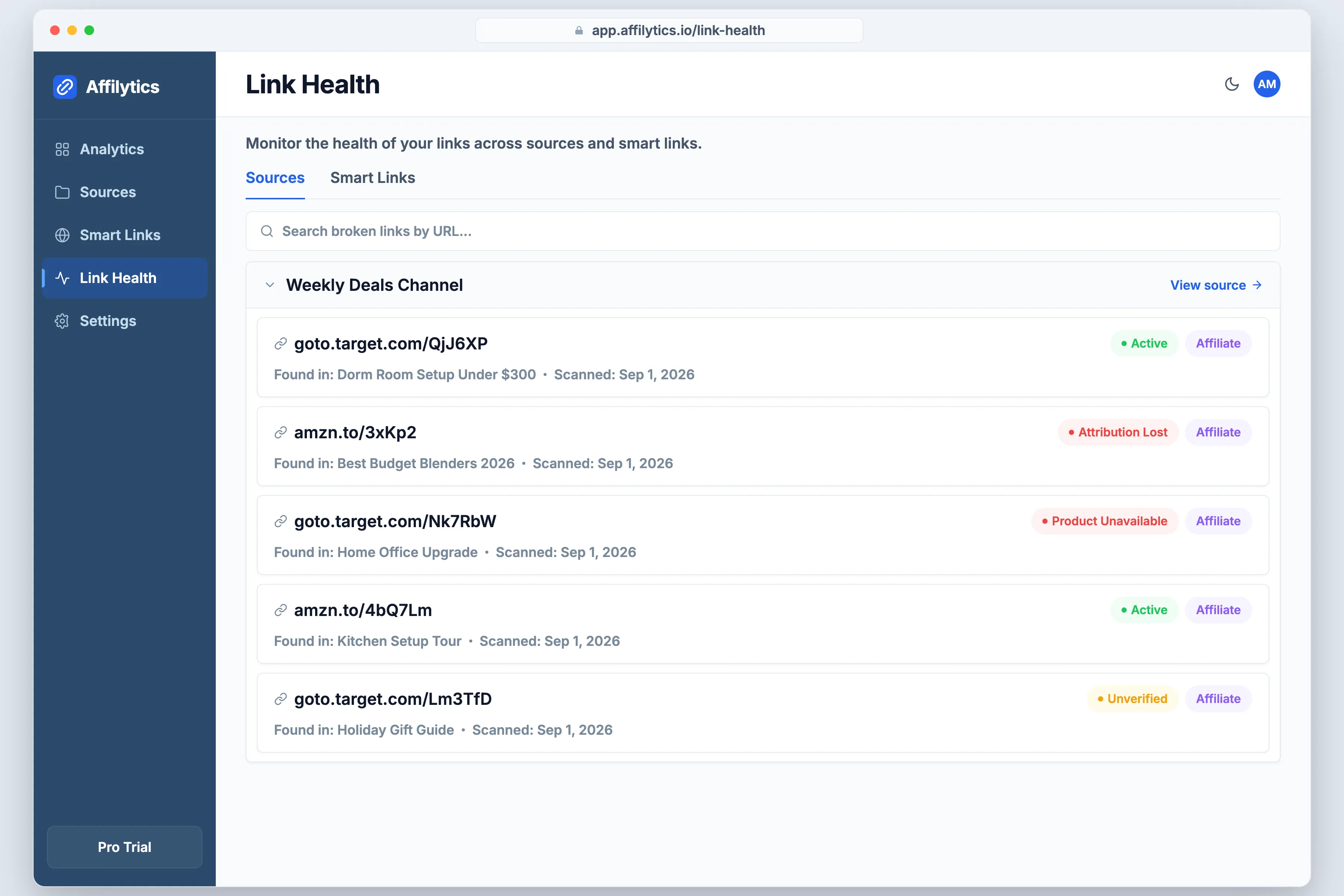
This last one is where the network matters. Target runs on Impact, and an Amazon-only link checker cannot see an Impact link at all. One scan across every network finds what you published wherever you published it, Impact included, including links you never created through Affilytics in the first place.
Start With the Links You Already Have
Section titled “Start With the Links You Already Have”If you already have Target links running, the useful next move is not applying to another program. It is routing the clicks that currently cannot convert anywhere at all, and finding out which of the links you have already published still pay. The reverse trial is two full weeks with everything unlocked and no credit card, which is plenty of time to see the country breakdown behind your own clicks.
Create your free account and point it at one channel or one site. If you would rather browse first, our affiliate-programs directory is the place to work out what else is worth applying to.
Is the Target affiliate program still active in 2026?
Section titled “Is the Target affiliate program still active in 2026?”Yes. Target Partners is live and taking applications, and the program site carries a working Apply Now path that hands you into Impact’s own signup flow. The program runs on Impact Radius, and Target’s FAQ says it is free to join.
How much does the Target affiliate program pay?
Section titled “How much does the Target affiliate program pay?”Up to 8% is the headline ceiling Target advertises, but Target’s own FAQ publishes an EPC of approximately $3 to $4 per 100 clicks. At that rate, a thousand clicks is roughly $30 to $40. Estimate from the EPC, not from the ceiling.
How long is the Target affiliate cookie?
Section titled “How long is the Target affiliate cookie?”7 days, with last-click attribution. You get credit for any order placed within 7 days of the original click, as long as nobody sets a later click before the order. That window is seven times Amazon’s 24 hours.
Can I join the Target affiliate program from outside the US?
Section titled “Can I join the Target affiliate program from outside the US?”Yes. Target says it accepts partners from anywhere in the world as long as Impact Radius supports your country of residence and your content is directed toward the U.S. market. It is a rule about who your audience is, not about where you live.
What happened to the Target Creator Program?
Section titled “What happened to the Target Creator Program?”Target’s program site still offers a Creators sign-in, but there is no application path for that track anywhere on the site. That is consistent with a track that was wound down and equally consistent with one that was always invite-only, and we cannot tell which. Target has published no announcement and no date.