
Amazon Affiliate Program Alternatives: 7 Best Options
Every list of Amazon affiliate program alternatives prints the same confident table of commission rates and cookie windows, and almost none of those numbers came from the merchants themselves. Two of the articles ranking for this exact search disagree about Walmart: one prints a flat rate, the other a tiered range many times higher, and Walmart’s own FAQ says it pays up to 4%.
I build Affilytics with my co-founder. It’s the layer that sits over whatever programs a creator runs, sending clicks to the right regional store and flagging links that have quietly stopped paying, so I spend a lot of time reading the fine print of affiliate terms.
If you got here because of the cookie, start with how long an Amazon affiliate cookie actually lasts, because the 24 hours everyone quotes is only half of the rule.
This guide covers the seven alternatives worth a look, what each merchant actually publishes about its terms, and the part nobody warns you about: what changes when you are running five programs instead of one.
What are the best Amazon affiliate program alternatives?
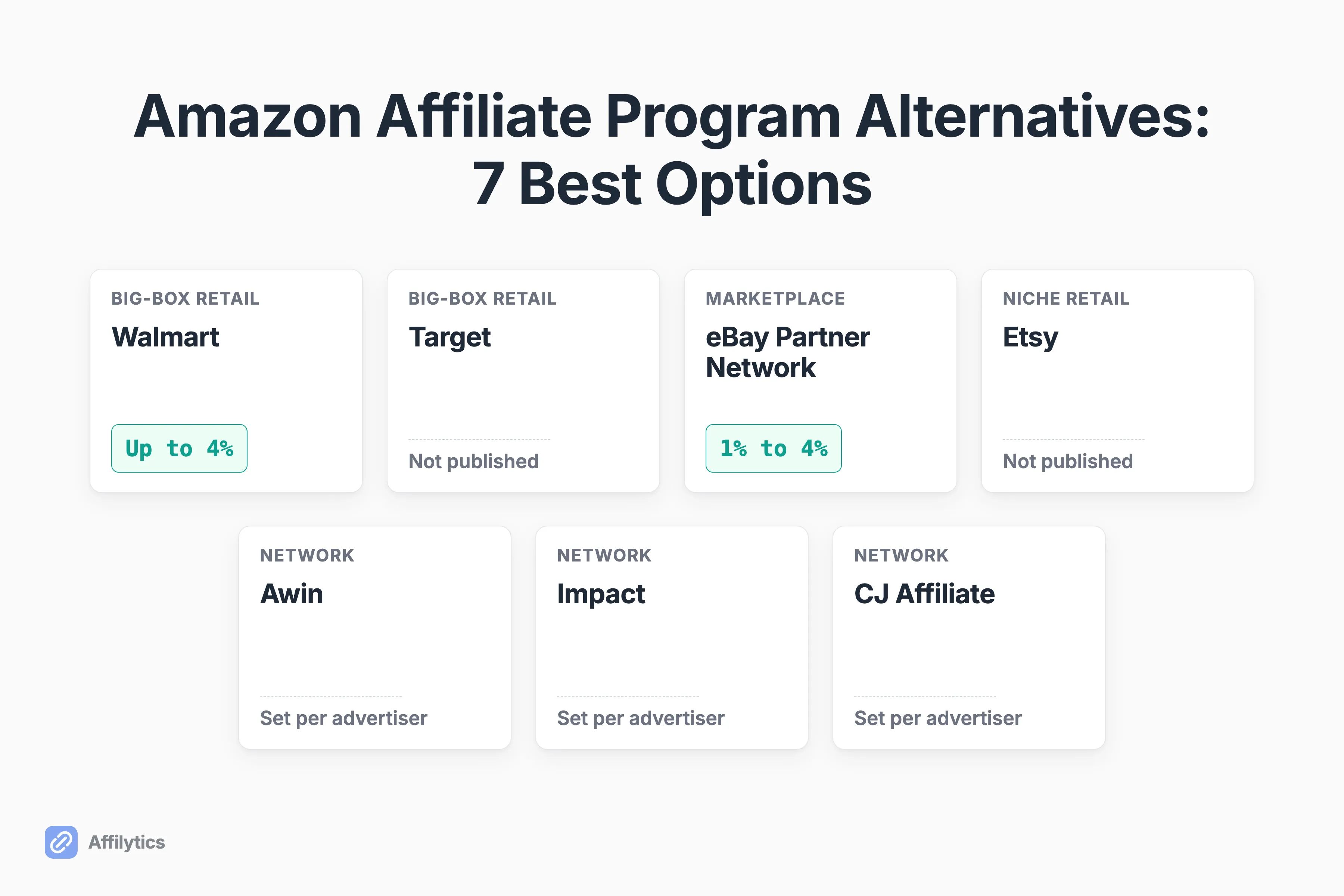
Section titled “What are the best Amazon affiliate program alternatives?”Here they are, grouped by category rather than ranked. Ranking them on numbers most of these merchants never published would be exactly the failure this post exists to call out.
Two things got a program onto this list: a broad enough catalog to absorb the kind of links you already have, and mainstream audience fit. A couple of familiar names are missing for a different reason. Two of the roundups ranking for this term independently flag AliExpress on a very short cookie window and Best Buy on a poor commission rate, and I have no primary-source figure for either.
| Program | Category | What the merchant publishes | Best for |
|---|---|---|---|
| Walmart Affiliate Program | Big-box retail | Up to 4% on eligible sales, and a 1-4% range on its benefits page. No cookie window published. | General merchandise, home, and family creators |
| Target | Big-box retail | Not published. | US lifestyle, home, and family creators |
| eBay Partner Network | Marketplace | A public rate card: 1% to 4% of sale by category, with a per-transaction earnings cap. 24-hour click window. | Collectibles, parts, vintage, and hobby creators |
| Awin (absorbing ShareASale) | Network | Nothing network-wide. Each advertiser sets its own terms. | Breadth without applying one merchant at a time |
| Impact | Network | Nothing network-wide. Each advertiser sets its own terms. | Creators who care about tracking reliability |
| CJ Affiliate | Network | Nothing network-wide. Each advertiser sets its own terms. | Creators pitching recognizable national brands |
| Etsy | Niche retail | No rate and no cookie duration. Only “Our cookie period is competitive.” | Handmade, vintage, and craft niches |
Two of those seven publish a rate on their own site. eBay puts a full category table in public; Walmart publishes only a ceiling. The other five publish nothing usable, and those five blanks are the finding.
So which one do you apply to first? That depends entirely on what you already link to, which is what the rest of this post is for.
One quick fork in the road: if what you actually wanted was a WordPress plugin rather than a new program, that is a different post and it already exists. Everything below is about programs you join.
Why creators are looking past Amazon right now
Section titled “Why creators are looking past Amazon right now”So what is actually pushing people out? Four things, and only one of them is the commission rate everybody argues about.
The first is earnings that no longer match the traffic. Amazon’s rates are category-specific and its live rate card sits behind an Associates login, so any single percentage you see quoted for “Amazon” is somebody’s average rather than a published figure. The rates also move: several categories were cut in 2026 with no announcement at all, which what changed with Amazon’s commissions covers in detail. What creators can tell you is what lands in their account. One publisher in r/Affiliatemarketing, u/LondonSurfer, put it as bluntly as it gets: “It’s not worth having hundreds of links on my website to Amazon, driving $16,000 in sales, to earn around $400 in commission.”
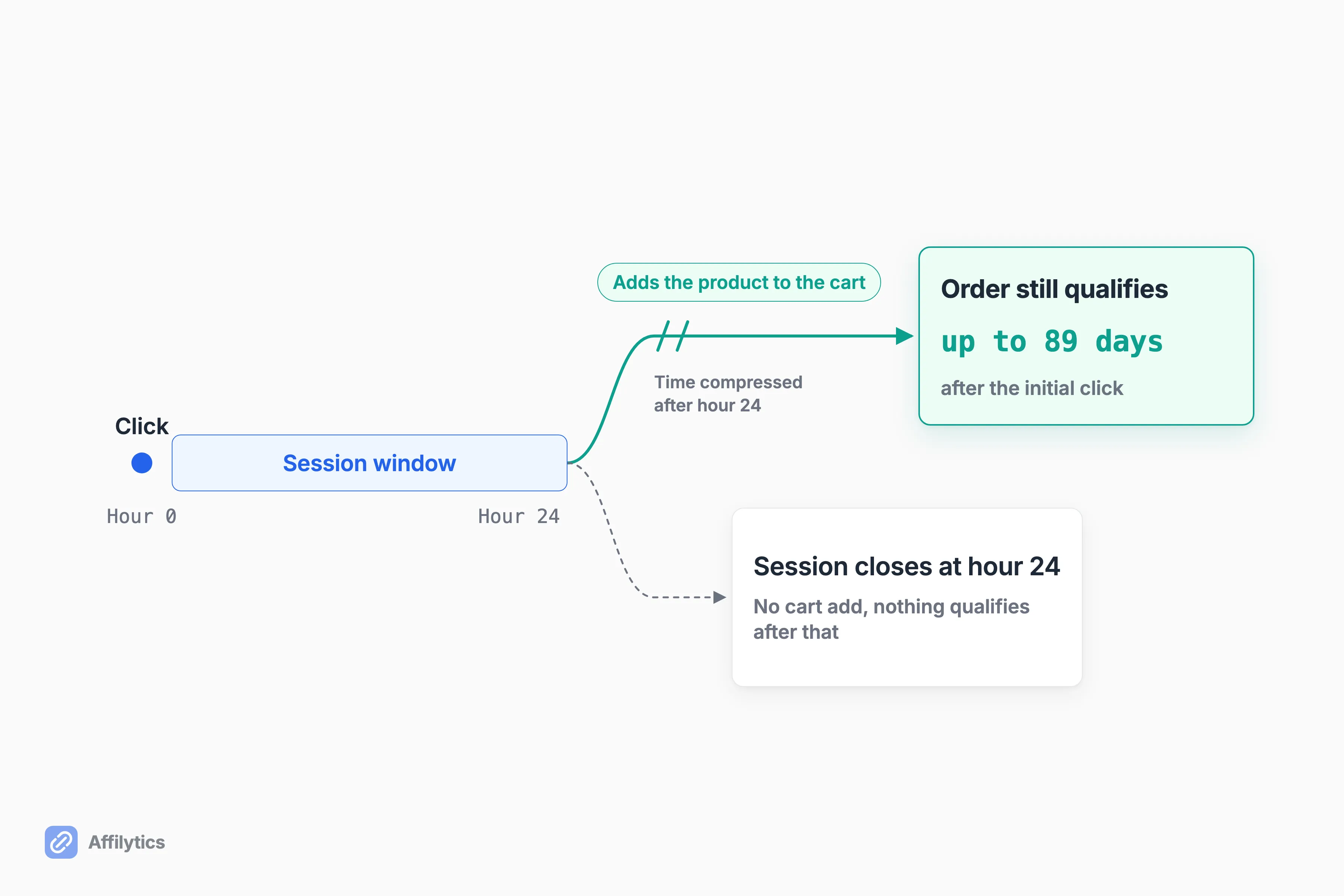
The second is the cookie, and this is the part every roundup gets slightly wrong. Amazon’s own program policies define a session as beginning when a customer clicks your link and ending when 24 hours elapse from that click. Everyone stops there. The same page goes on to say that if the shopper adds the product to their shopping cart during that session, the order can still qualify when it is completed up to 89 days after the initial click. So 24 hours is the click-to-cart window, not the full attribution story. For a $30 impulse buy that distinction is academic. For a mattress somebody researches for two weeks, it is the whole game, and why commissions vanish between the click and the sale is worth understanding before you blame the program.
The third is visibility. Creators in r/Amazon_Influencer and r/adops are less upset about rates than about not being able to see what sold: “I HATE not having full visibility of what’s selling,” as u/WhiteOak1986 put it, while a media buyer in r/adops, u/East-Sky-5914, summarized their situation as “Amazon basically killed reporting visibility, and now we can’t properly track conversions anymore.”
The fourth is the one no other roundup mentions: the account itself. A domain investor on X, @KenLin1985, described applying, generating a few sales, and then losing everything before payout: “Amazon closed my account because I had not generated enough qualifying sales within the required period. The commissions were voided as well.” Amazon’s own policies back the general shape of that risk, reserving the right to withhold the accrued commission income after three years without substantial activity on an account, with seven days’ written notice.
One correction worth carrying, because the panic threads are noisier than the facts: the affiliates in those threads keep correcting each other on this, saying the commission-scope change that set the loudest alarms off applies to the on-site Influencer program rather than to off-site Associates links. That is the community’s read, not a policy quote, and it is a good reason to read the terms yourself before you close an account.
Big-box retail programs: the closest catalog substitutes
Section titled “Big-box retail programs: the closest catalog substitutes”If you are replacing Amazon links one for one, this is the category that actually works, because the products in your old content mostly exist here too.
Which of the three is worth your time? Mostly it comes down to whether you write about new mainstream goods or the long tail of used and rare ones.
Walmart Affiliate Program
Section titled “Walmart Affiliate Program”Walmart is the closest thing to Amazon’s breadth in general merchandise, and it does something most of this list does not: it publishes its ceiling. Its FAQ states that Affiliates can earn up to 4% on each eligible sale, and its benefits page describes a structure that pays 1-4%. I went through all of those pages line by line in the full Walmart affiliate program breakdown.
- Pros: the widest general-merchandise catalog outside Amazon, a published rate ceiling, and a real competitive gap. As one media buyer in r/adops, u/Federal_Standard5917, described it, “walmart connect and target circle both have affiliate programs that barely anyone runs paid traffic to, way less competition than amazon and their tracking is actually server-side.”
- Cons: that published ceiling is low, and the program runs through Impact, so joining Walmart means learning a second platform’s reporting whether you wanted to or not.
- Best for: general-merchandise, home, and family-niche creators.
Target
Section titled “Target”Target gets named alongside Walmart by the same media buyer, for the same two reasons: tracking quality and the fact that almost nobody is competing there yet.
Here is the honest part. I could not confirm a published commission rate or cookie window for Target anywhere on its own partner site. Every table you will find online quotes one anyway. I would rather leave the cell blank than copy somebody’s guess into it. I have since gone through Target’s partner pages properly and written up what Target does and does not actually publish: the 7-day cookie window is there in its FAQ, and the per-category rate schedule genuinely is not, because the URL Target’s own terms point to no longer resolves.
- Pros: mainstream catalog, strong brand trust, low affiliate competition.
- Cons: no published rate or cookie window that I could confirm.
- Best for: US-audience lifestyle, home, and family creators.
eBay Partner Network
Section titled “eBay Partner Network”eBay is the one genuinely differentiated catalog on this list. Used, refurbished, discontinued, and collectible inventory is where it wins, and that inventory is the part of the catalog Amazon covers least well.
- Pros: an enormous catalog of things Amazon does not carry well, and the only full category rate card in public on this list. eBay’s global rate card runs from 1.0% on real estate to 4.0% on fashion, with most other categories at 2 to 3%.
- Cons: every category also carries a per-transaction earnings cap, mostly $550 and as low as $100, so one large sale pays far less than the percentage suggests. The click window is 24 hours, same as Amazon’s, though an auction bid placed inside it still counts if the auction is won within 10 days. And the roundups covering eBay position it as the weaker converter on mainstream new goods, which is positioning rather than a published fact.
- Best for: collectibles, parts, vintage, and hobby creators.
Affiliate networks: one application, many merchants
Section titled “Affiliate networks: one application, many merchants”Start with the single cleanest proof that these lists get copied forward without anyone checking: Awin and ShareASale are not two options anymore. Awin’s own transition page says it “has owned ShareASale since 2017” and that it is now bringing everything onto one platform, pointing new publishers at Awin instead. Nearly every roundup ranking for this keyword still lists them as separate choices.
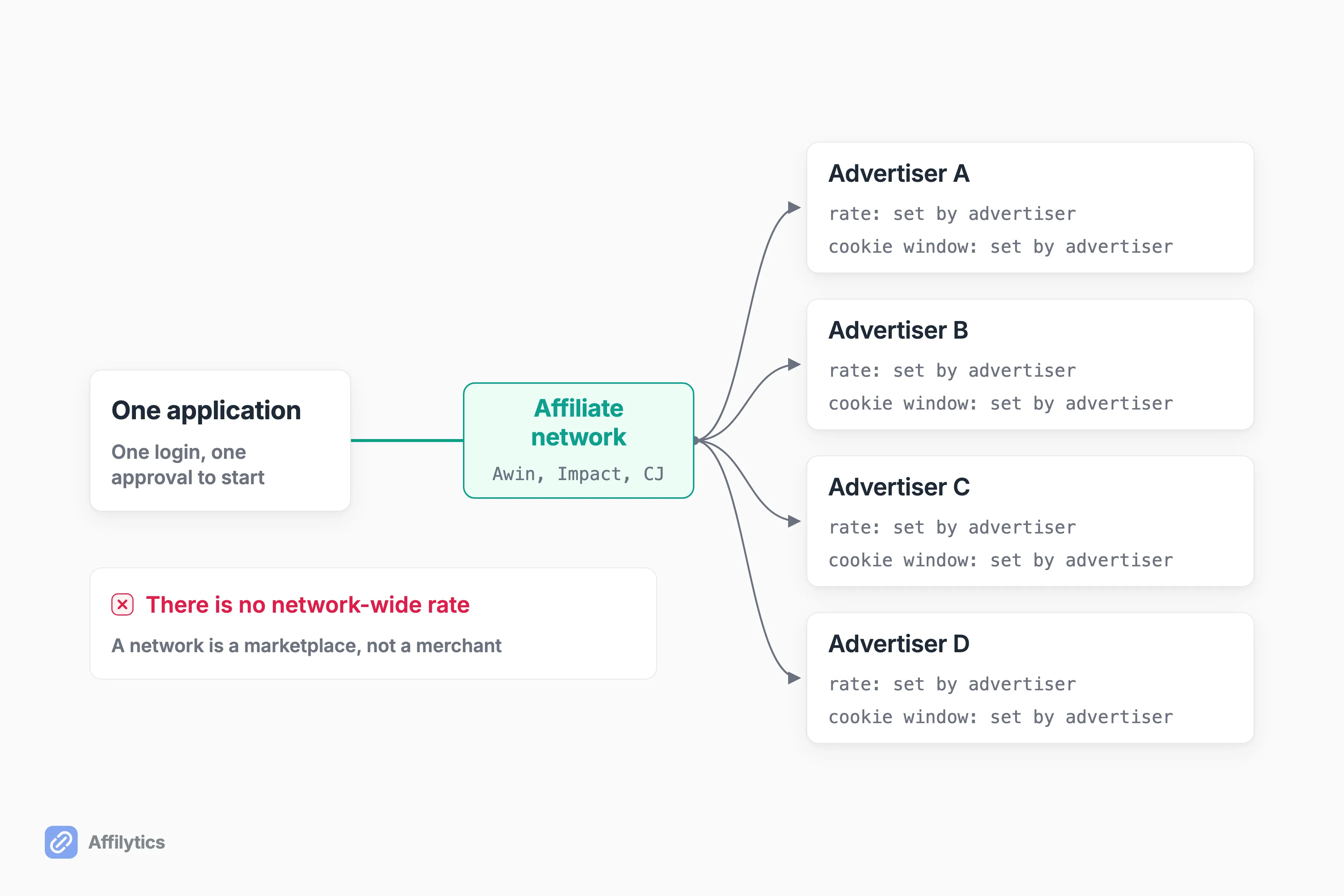
So what does a network pay? That question has no answer, and not because I failed to find one. A network is a marketplace: each advertiser sets its own commission rate and its own cookie window. A single network-wide rate is a category error rather than an unverified number, which is why you will not see one below. It is also why the creator recommendations in the Reddit threads name networks without naming rates, as in u/StandInTheCorner’s flat “My favorite alternatives are AWIN & Impact”.
Awin (now absorbing ShareASale)
Section titled “Awin (now absorbing ShareASale)”- Pros: a large merchant roster and one application that reaches many brands. The roundups that mention it position it as strongest in Europe.
- Cons: you still need per-merchant approval, and the ShareASale consolidation means older tutorials and older links point at a platform Awin is retiring.
- Best for: creators who want breadth without applying to programs one at a time.
Impact
Section titled “Impact”- Pros: it is the platform running Walmart’s program, so a creator who joins Walmart is already on it. Server-to-server tracking is the thing the media buyer quoted above singles out.
- Cons: merchant-set terms mean the answer to “what does it pay” is permanently “depends on the advertiser”.
- Best for: creators who care more about tracking reliability than about a headline rate.
CJ Affiliate
Section titled “CJ Affiliate”- Pros: the roundups that cover it position CJ on its roster of recognizable national brands, which is a real advantage when you are pitching yourself to a brand rather than picking from a catalog.
- Cons: same structural answer as the rest of the category, and there is no published network-wide rate or window to quote.
- Best for: creators pitching recognizable national brands.
Niche and direct programs worth a look
Section titled “Niche and direct programs worth a look”Etsy is the anchor example for this whole post. Its affiliate page tells you that “Our cookie period is competitive; creators and affiliates will receive a commission on sales attributed to their account during this period.” That is the entire disclosure. No percentage, no number of days, nothing else on the page. Every “Etsy pays roughly X% on an N-day cookie” table you have read invented the specifics.
Where else do creators go? A few directions worth knowing:
- Home improvement. A creator in the r/Amazon_Influencer thread named Home Depot and Lowe’s as their own fit, because that is the niche they publish in. Treat it as one creator’s recommendation rather than a verified program comparison, and check the terms yourself.
- Going direct to a brand. This is where the highest rates live and also the highest friction: one relationship, one negotiation, one integration at a time. Great for a creator with a tight niche and a real audience number to quote. Slow for everybody else.
- Sub-affiliate aggregators. Skimlinks and Sovrn cover merchants you have no account with and take a share of the commission for it. Whether that trade pays depends on how long your tail of one-off merchant mentions is.
Before you trust any commission table, including this one
Section titled “Before you trust any commission table, including this one”Here is the five-minute check I ran on every program above, and you can run it on anything I did not cover.
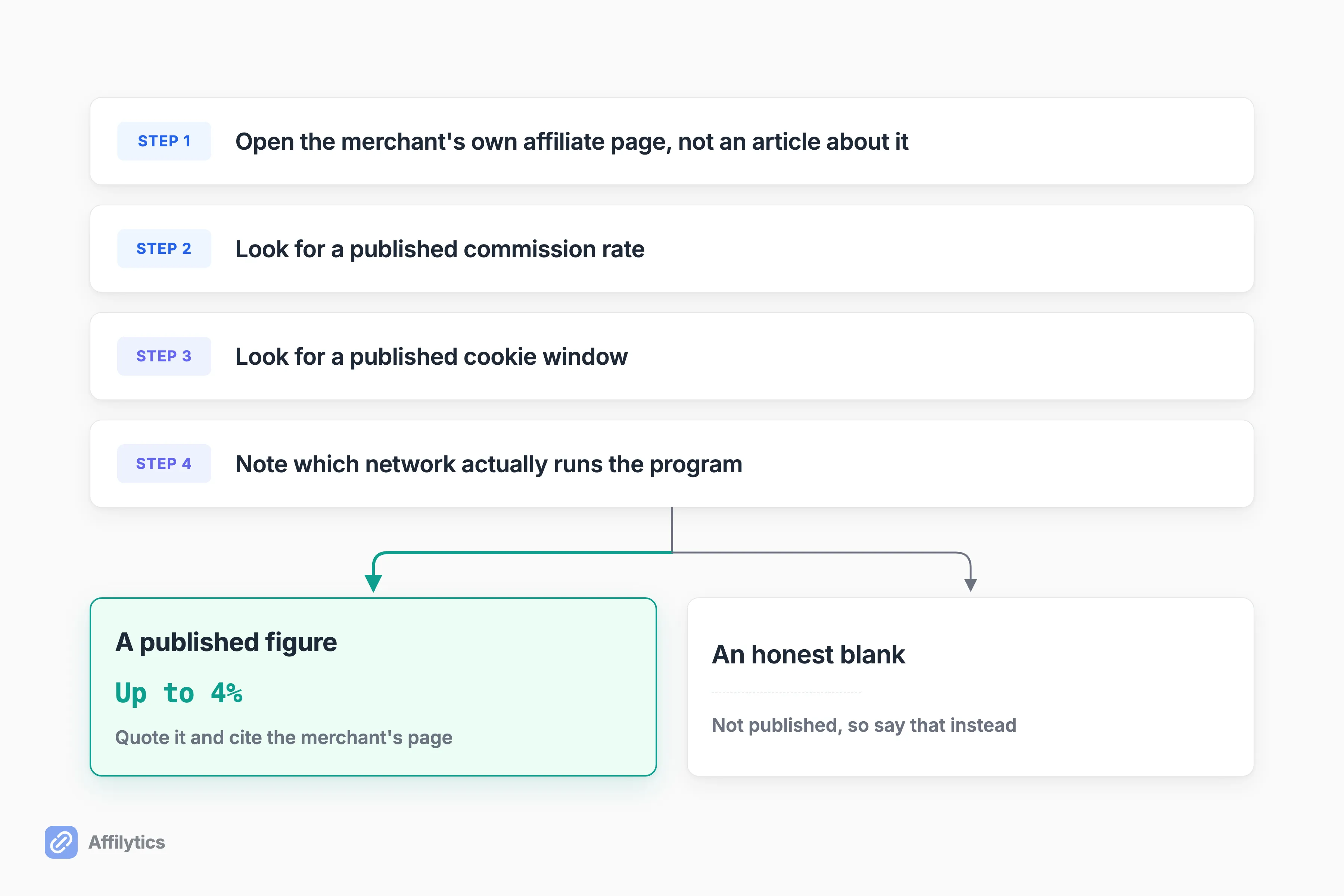
- Find the merchant’s own affiliate page, not an article about it.
- Look for a published rate. If there is no number on the merchant’s own page, there is no number.
- Look for a published cookie window. Same rule.
- Note which network runs the program, because that is who you will actually log into.
- Check whether the page looks like it has been updated since the terms you are quoting.
Walmart is the worked example. Two articles ranking for this keyword print two different Walmart commission structures that cannot both be true, and neither matches what Walmart itself publishes on two separate pages.
So how does a number nobody can source end up in five different articles? Nobody is lying on purpose. An unsourced number gets published once, then copied into the next list, then the next, until it looks like consensus.
The same discipline applies to link checkers, which is where I spend my working hours. A link that returns a perfectly healthy page can still have lost your tracking tag on a redirect, or point at a product that no longer exists, so we surface attribution-lost and product-unavailable as their own states instead of folding them into “fine”.
What running five programs actually costs you
Section titled “What running five programs actually costs you”Nobody in the search results tells you this part, because “add more programs” reads like a free win. It’s not free.
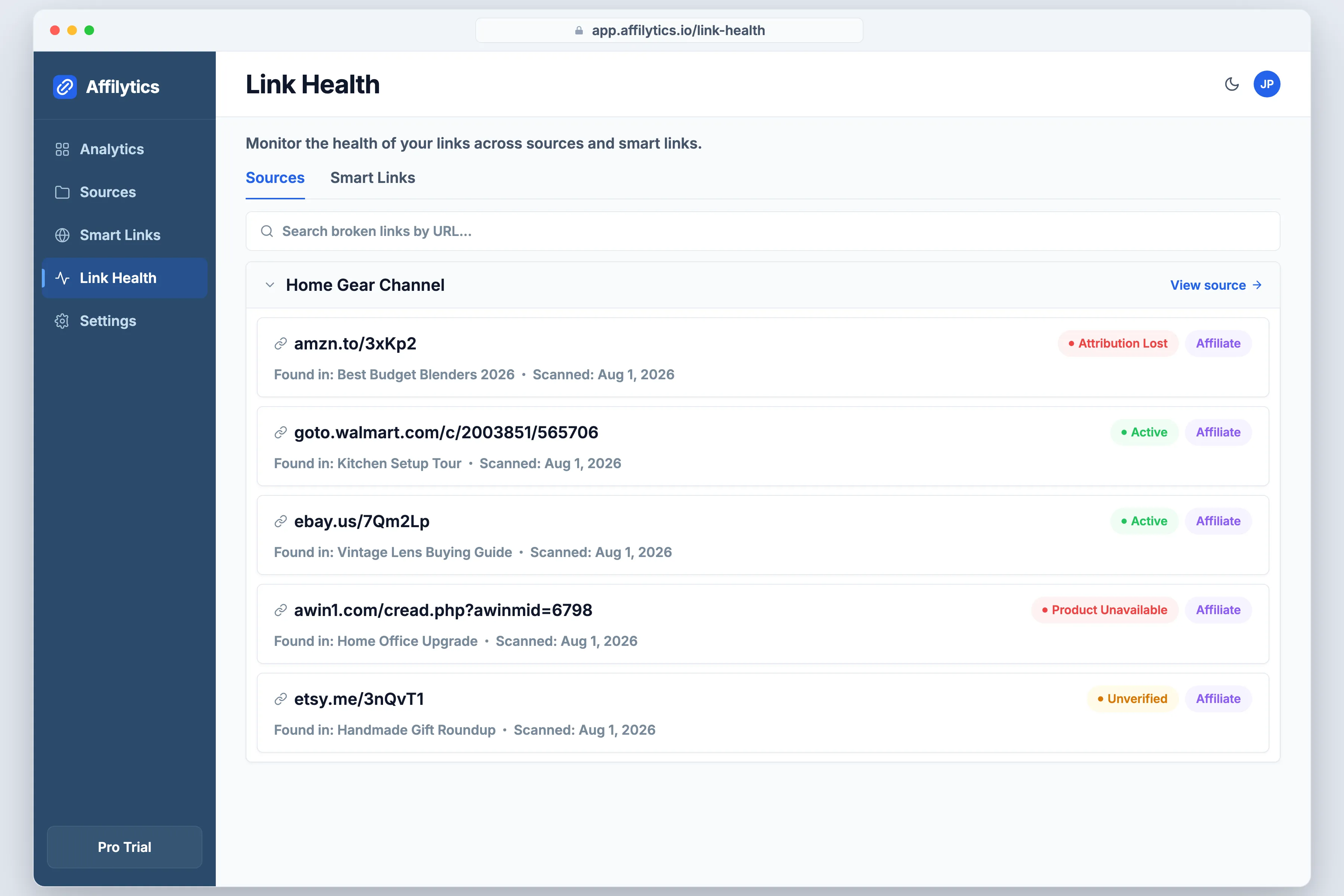
Every program you add is another tag format to get right, another dashboard to log into, another payout threshold to clear, and another set of links sitting in posts and video descriptions you wrote two years ago and will never open again. The links do not announce their death. A merchant redesigns its URLs, a program shuts down, a product gets discontinued, and the click still happens. It just stops paying.
So what do you actually have to run to keep five programs alive?
One thing that does not multiply as you add programs: the routing layer, since a smart link that sends each visitor to their own country’s store works for any merchant you join, not just Amazon.
The monitoring half is where the multi-program cost actually shows up. One health check across every program’s links is the difference between catching a dead affiliate link before it costs you a quarter and finding out from a revenue chart. It matters that the check starts from what you already published: one scan across every network you join reads your channel or your site and finds the affiliate links that are already out there, rather than only watching the links you created inside a tool.
And the honest counterpoint, because you have probably already felt it. A disillusioned affiliate, @CentralDomain, replying to that account-closure thread on X, put it better than I could: “Unfortunately there isn’t any other program as good as them, but they got greedy and lost many partners that way.” Amazon’s catalog, checkout, and conversion rate are genuinely hard to replace. Most creators don’t leave. They add.
Start with the links you already have
Section titled “Start with the links you already have”If you are about to add a second or third program, the useful first move is not signing up. It is seeing every affiliate link you have already published in one place, whatever program each one points at, and knowing which of them still pay.
Create your free account and you get two full weeks with everything unlocked, no credit card, which is enough time to scan your channel or your site and find out what is actually still working before you go add more.
What is the best alternative to the Amazon affiliate program?
Section titled “What is the best alternative to the Amazon affiliate program?”There is no single winner, because the right answer depends on what your catalog looks like. Walmart is the closest general-merchandise substitute and the only big-box program here that publishes a rate ceiling on its own site, up to 4% on eligible sales. If you want breadth instead of one merchant, a network like Awin or Impact gets you one application and many brands, with terms set per advertiser. Most creators do not replace Amazon at all. They add a second and third program alongside it.
Is the Amazon affiliate cookie really only 24 hours?
Section titled “Is the Amazon affiliate cookie really only 24 hours?”Yes for the session itself, and that is where most articles stop. Amazon’s own program policies define a session as ending when 24 hours elapse from the click, but they also say that if the shopper adds the product to their shopping cart during that session, the purchase can still qualify when the order is completed up to 89 days after the initial click. So 24 hours is the click-to-cart window, not the whole attribution story. It matters most for products people research for a week before buying.
Do alternative affiliate programs pay better than Amazon?
Section titled “Do alternative affiliate programs pay better than Amazon?”Sometimes, but the honest answer is that most of these merchants do not publish a rate at all. Two of the seven do. eBay publishes a full category rate card, 1% to 4% of sale with a per-transaction cap, and Walmart publishes a ceiling of up to 4% on eligible sales. Etsy publishes no percentage and no cookie duration, only that its cookie period is competitive, and Target publishes nothing I could confirm. On the networks, each advertiser sets its own rate and window, so a single network-wide figure does not exist. Anyone showing you a precise program-by-program table for the rest is repeating numbers the merchants never printed.
Can I run Amazon Associates and other affiliate programs at the same time?
Section titled “Can I run Amazon Associates and other affiliate programs at the same time?”Yes, and it is what most creators end up doing rather than switching outright. The real cost is operational rather than legal. Every program adds another tag format, another dashboard, another payout threshold, and another set of links sitting in old posts and old video descriptions that can quietly stop paying. Diversifying protects your income from one program’s decisions. Keeping the links alive across all of them is the part nobody warns you about.