
Amazon Storefront vs Product Links: The Honest Tradeoff
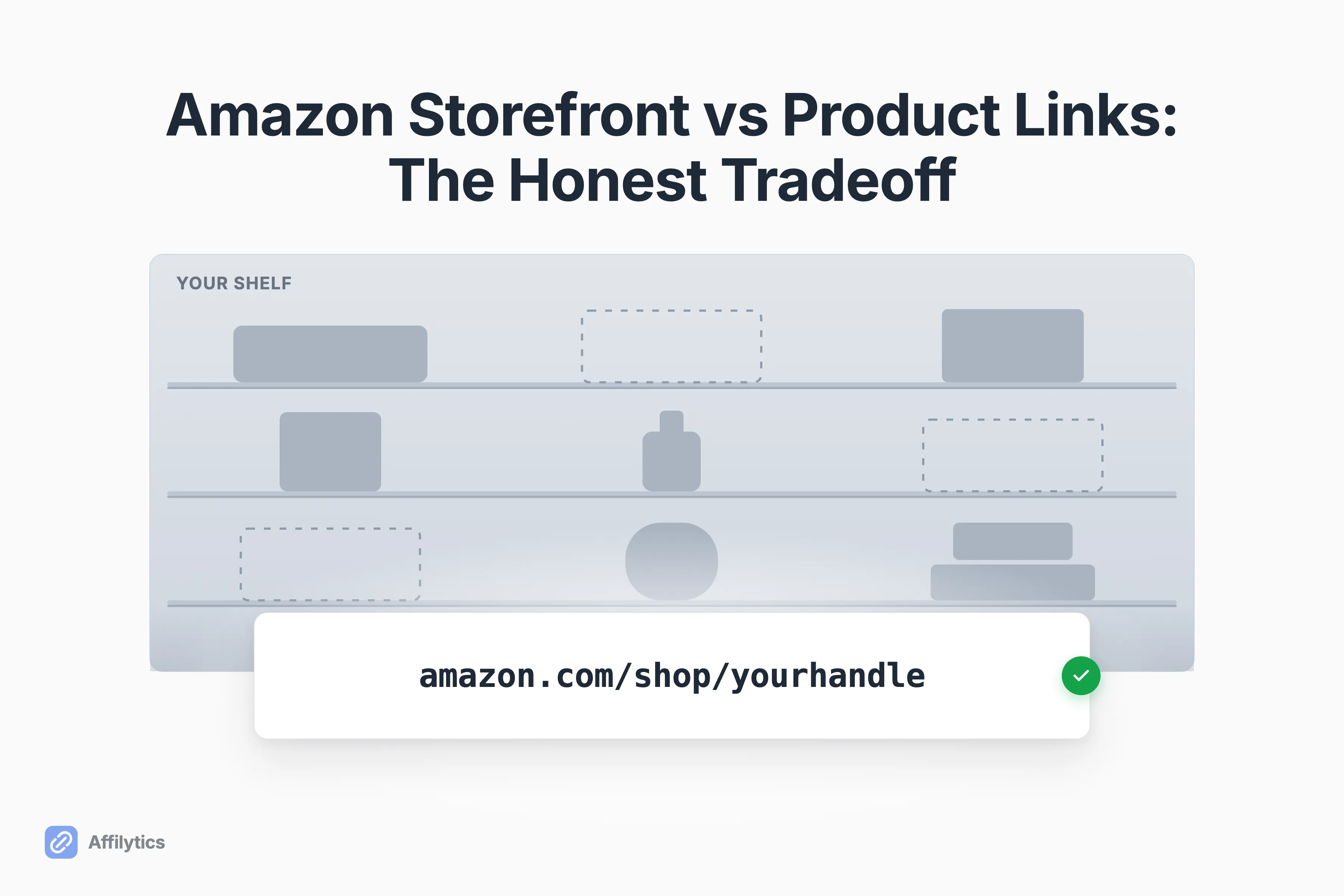
Somewhere in your last twenty posts is an Amazon product link pointing at something Amazon no longer sells. If you have already moved to storefront links to stop chasing that problem, the good news is that the link will never break again. The bad news is the same sentence.
We built Affilytics to route affiliate clicks to the shopper’s own Amazon and to keep checking whether the links behind them still work, so the difference between a link that is dead and a page that only looks alive is the thing we stare at all day.
Amazon storefront vs product links usually gets settled on convenience, and on convenience the storefront wins outright. Income is a different question with a different answer.
This is a format question rather than a program question, so if you are still deciding which Amazon program the click belongs to, start there. What follows is what each kind of link costs you after the click, across the border, and six months later.
Two Links, Two Different Objects
Section titled “Two Links, Two Different Objects”A storefront is a page Amazon hosts for you at amazon.com/shop/yourhandle, a curated shelf with your name on it. A product link is a URL pointing at one item and carrying your tag. One is a place. The other is a pointer, and most arguments about which is better start by treating them as two flavors of the same thing.
Clear the name first. Amazon also runs a seller-side “Brand Store”, and the two get mixed up often enough that Amazon’s own page has to ask what’s the difference between a Brand Store and an Amazon affiliate storefront. Sellers get the Brand Store. Creators get the affiliate storefront, which is the one this post is about.
| Storefront link | Product link | |
|---|---|---|
| What it is | A page Amazon hosts for you | A URL you paste |
| What it points at | Your whole shelf | One item |
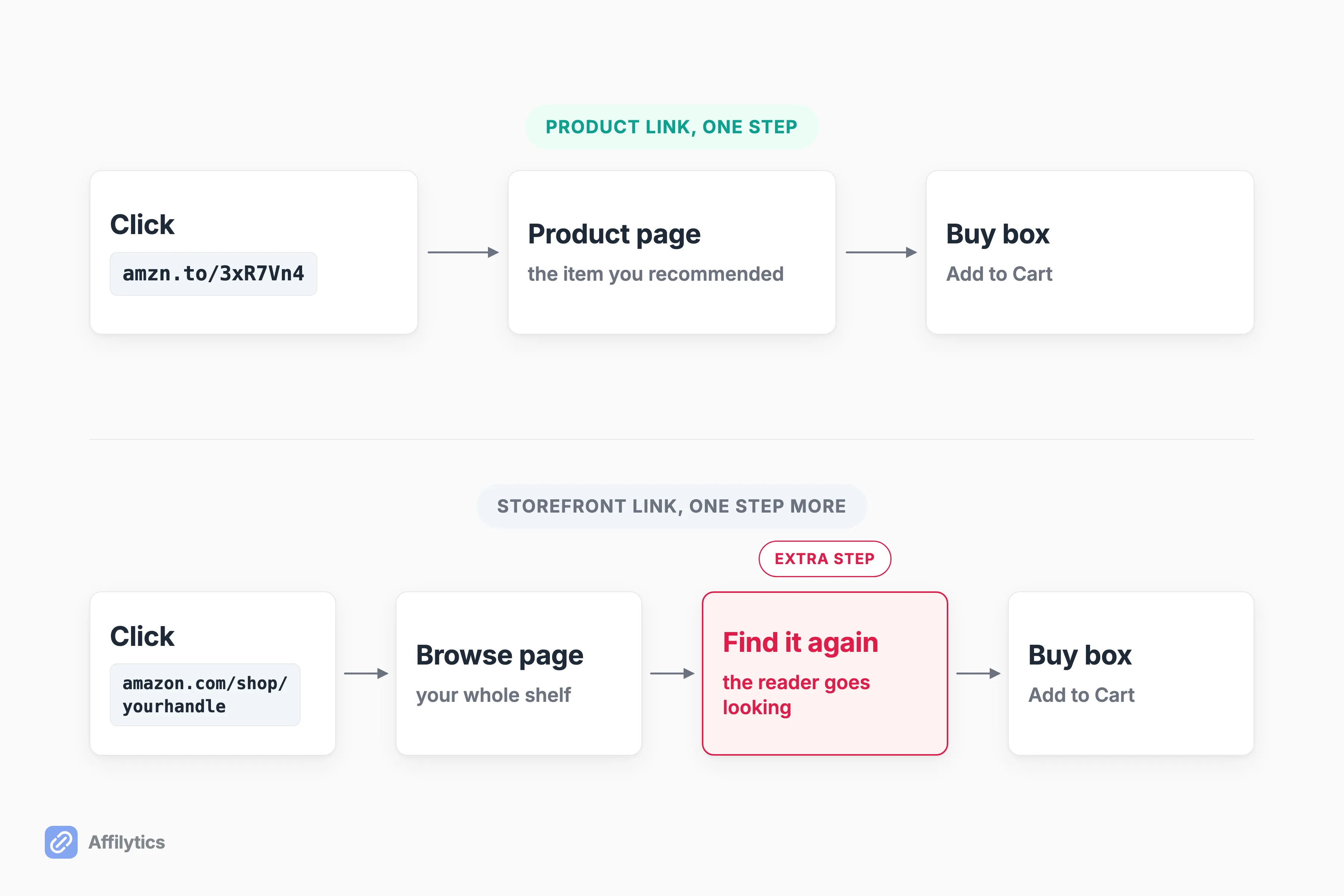
| What the click lands on | A browse page, with the item still to find | The buy box for that item |
| When the product goes away | The page loads perfectly, one item lighter | The link fails visibly |
| Marketplaces it reaches | The one Amazon it was built on | Any Amazon, if you rewrite it |
| What you can change later | The shelf behind it | The destination itself |
That third row is the whole conversion argument, and it needs no percentage attached to it. A product link puts the buy button under the reader’s thumb. A storefront asks them to go looking first, and some share of them won’t bother.
Does that make a storefront click a wasted click?
No, and this is what the anti-storefront take gets wrong. Amazon credits you for any qualifying items placed in a customer’s Shopping Cart within 24 hours of that shopper arriving through your link, whether or not it’s the thing you pointed at. One creator on r/Amazon_Influencer, u/newtrollacct, put the upside plainly: “Plus, using the associate link you get credit for everything they check out.” A storefront click trades intent for basket. You gave up the item you actually recommended in exchange for credit on whatever they buy next, and for a “shop my kit” post that is often the better half of the trade.
The Country Your Storefront Cannot Reach
Section titled “The Country Your Storefront Cannot Reach”A storefront exists on one Amazon and nowhere else. A product link is a string, and a string can be rewritten.
So what does a shopper in Germany see when they open your storefront?
Nothing of yours. Amazon runs the Influencer Program in four marketplaces, which is the whole list, so there is no German version of your shelf to load. A product link can be routed instead: an Affilytics smart link is one URL with country rules attached, so a shopper on their own country’s Amazon lands where they can actually buy. You create that link and swap it in yourself. Nothing converts the links you have already published.
A click you can’t serve earns nothing, which is why I walked through the full mechanic in why a storefront cannot follow a shopper to their own Amazon.
Why “Storefronts Rot Less” Is Only Half True
Section titled “Why “Storefronts Rot Less” Is Only Half True”“My storefront link never breaks” is a claim about the URL. The URL is fine. The shelf behind it isn’t, and nothing tells you when it empties.
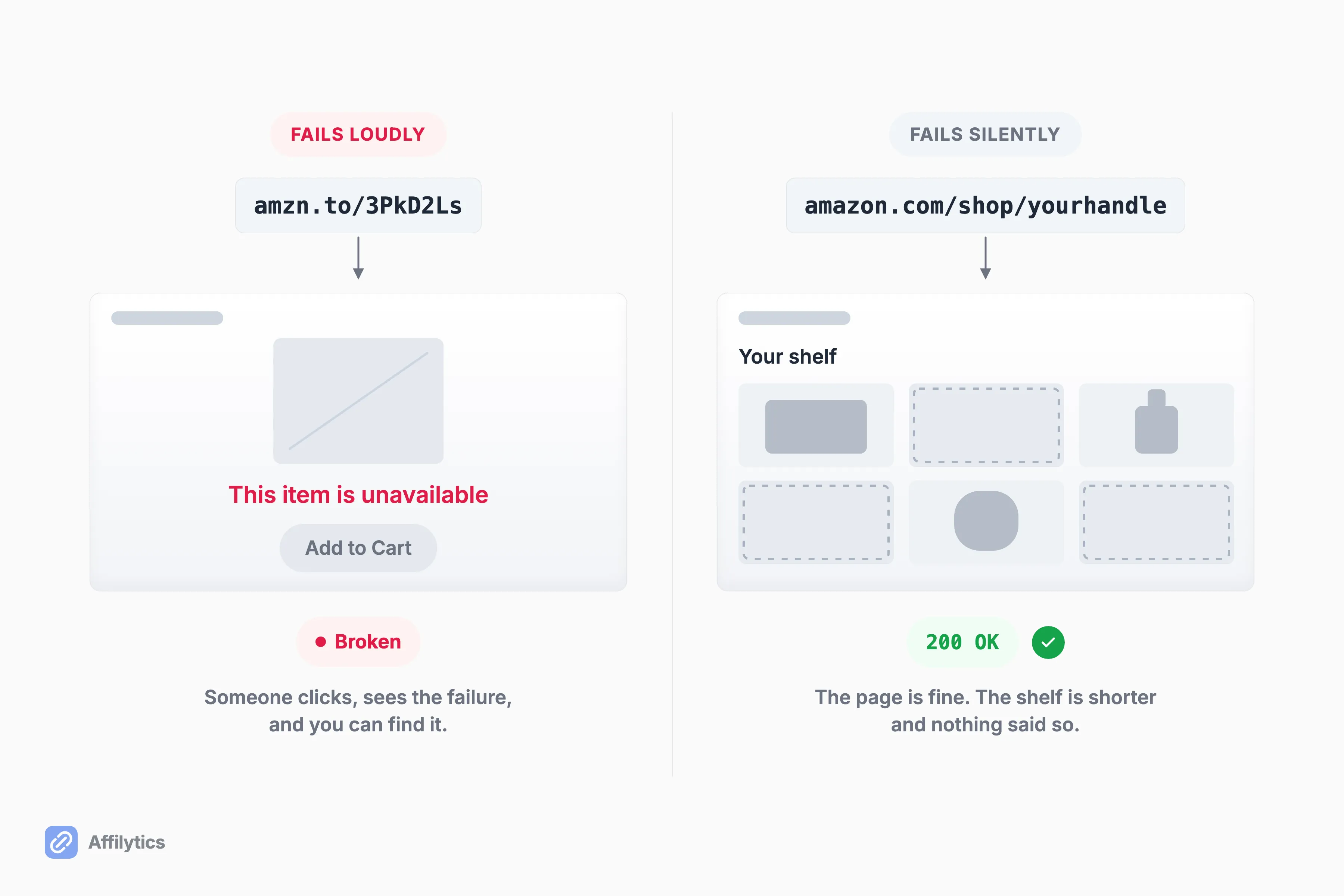
Both formats rot. They just fail differently:
- A product link fails loudly. Someone clicks, hits a page saying the item is unavailable, and the failure is at least detectable.
- A storefront fails silently. Items go out of stock or get delisted, the page returns a perfectly healthy response with the same load time as always, and the shopper simply sees a shorter shelf.
So what did the storefront actually buy you?
Not immunity. Visibility. You haven’t stopped losing sales, you’ve just stopped being able to see it. That’s worth saying carefully, because the saving is real: you aren’t editing dozens of URLs the week a product gets discontinued, and anyone who has done that on a five-year-old blog knows exactly what it’s worth. Our position that Amazon links do not expire, they rot applies to both formats. Only one of them announces it.
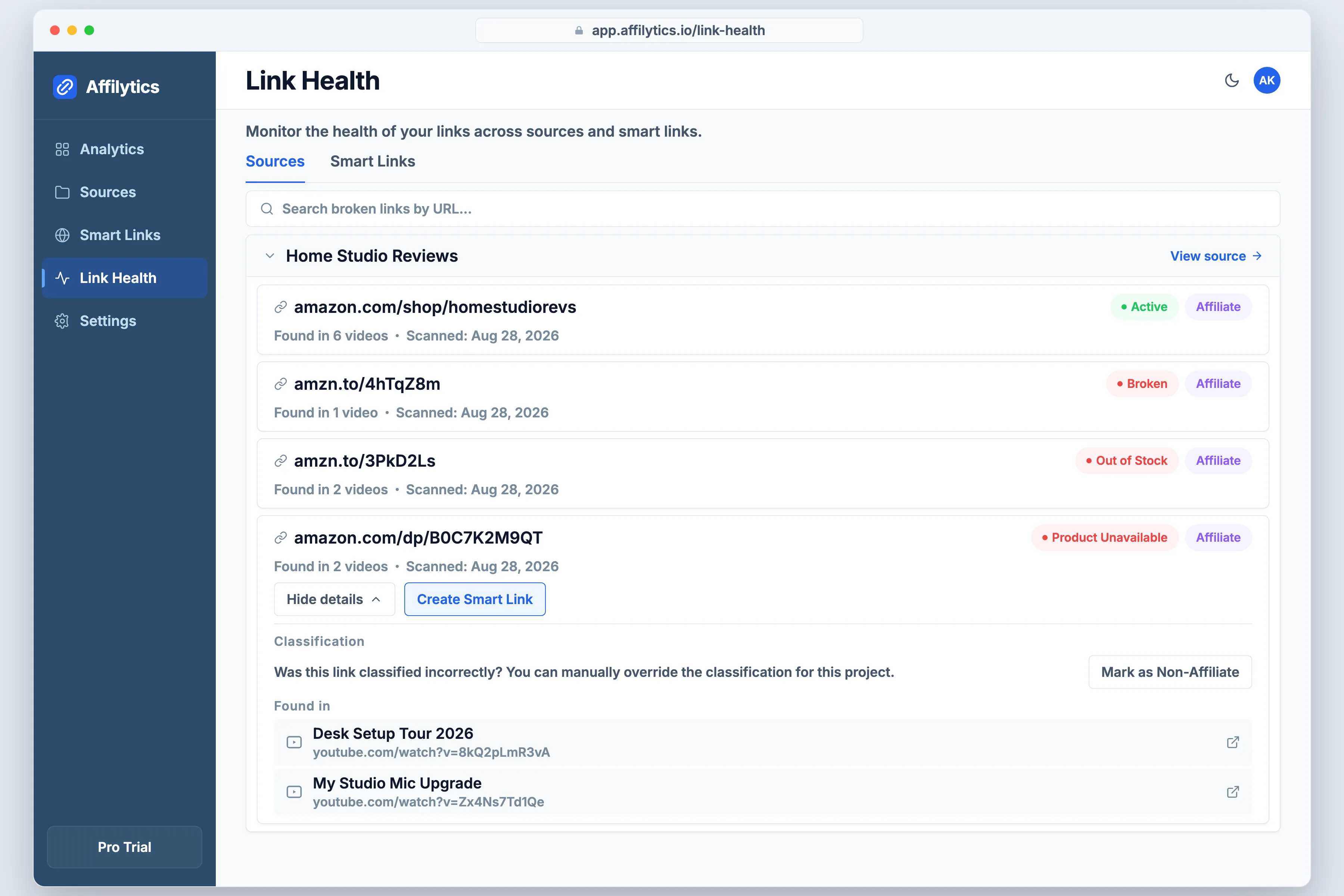
There is a harder layer under this. An operator maintaining roughly 950 links per marketplace across three Amazon storefronts described it exactly: “Missing and blocked look identical. Amazon serves the same small error page whether the product no longer exists or you have been soft blocked.”
Checking links at any volume runs straight into that wall, and it’s the distinction we build for. Affilytics separates a product page that is genuinely gone from a page where the bot-blocking layer that big retailers run in front of their sites simply refused to answer, so a blocked check never reaches you dressed up as a dead product.
The Orders You See And The Commission You Do Not
Section titled “The Orders You See And The Commission You Do Not”Read enough threads about missing Amazon commission and you notice the titles before the content. “Have I done something wrong?” “Am I doing something wrong?” The creator has already decided the fault is theirs.
Two of those threads, from different creators. “I had 5 orders but no commission received,” wrote u/Available_Algae1622, who had checked every link and found them all working. And from u/Main_Masterpiece_893: “I know for a fact people have made purchases either using my affiliate links or through my storefront but nothing at all is showing in my reporting.”
Is the reporting broken?
Usually not. Three ordinary rules account for most of it:
- Your own circle doesn’t count. As one commenter answered: “It usually means that Amazon has determined that those orders came from you, your family, or your friends.”
- Commission follows shipped orders, not placed ones. An order that hasn’t shipped is an order you haven’t been paid for yet.
- Inside that 24-hour window, the credit attaches to whatever they actually bought. Which may be nothing you recommended, and may sit in a category that pays less than the one you talked about.
Here is the part specific to this post. With a product link you at least know which recommendation a click belongs to. With a storefront, a click is a click on your whole shelf, so when the money doesn’t arrive you can’t tell which recommendation failed to convert, which item went out of stock, or whether the sale was simply excluded. Same missing money, less to work with. If you are stuck there, clicks that never turn into commission walks the diagnosis end to end.
So Which Link Goes Where
Section titled “So Which Link Goes Where”Amazon storefront vs product links comes down to three tests, in the order that actually decides it.
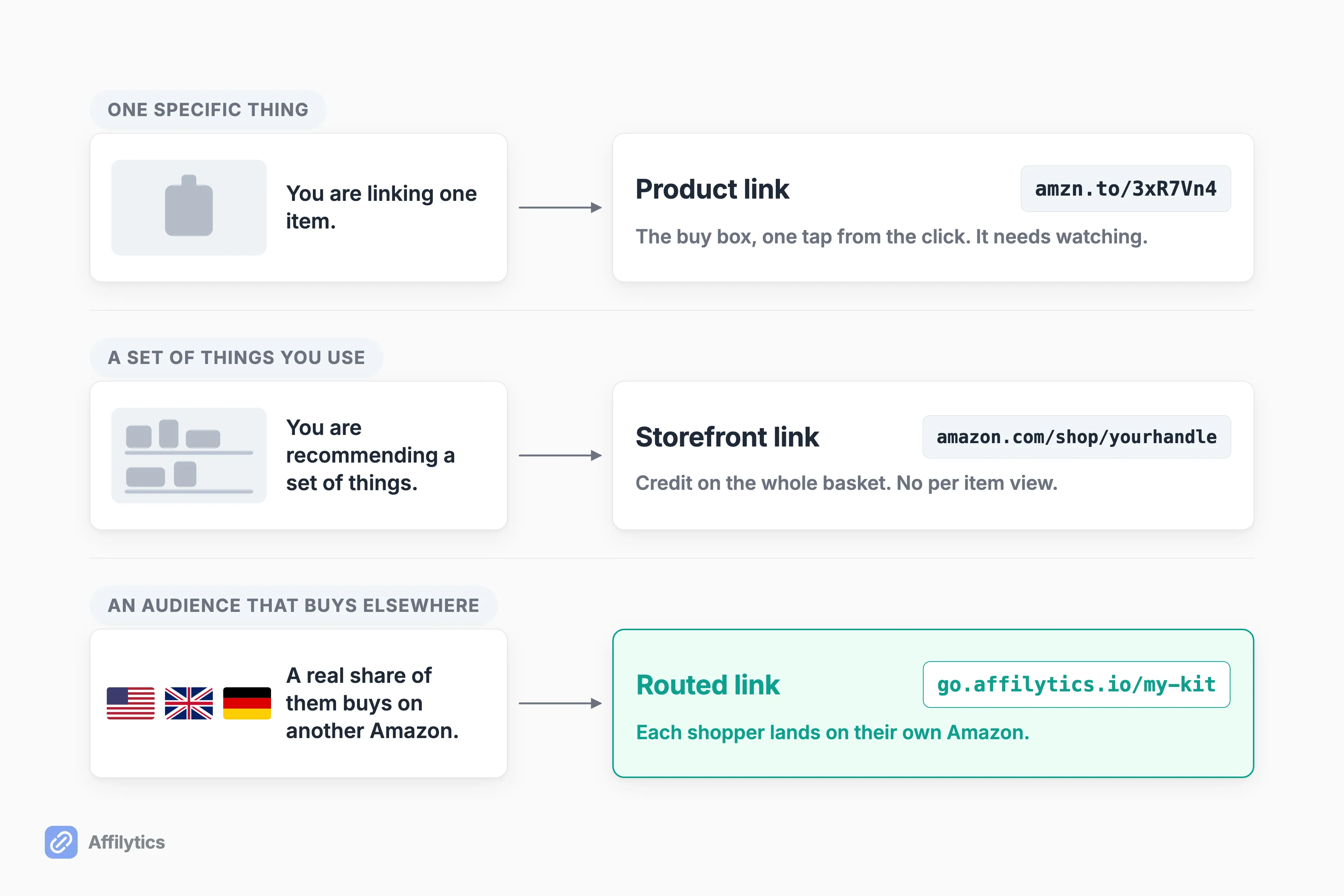
- Where does your audience actually shop? Check the country split before anything else. If a real share of your readers buys on another Amazon, a storefront-only strategy caps what you can earn from them no matter how tidy it is.
- Are you linking one specific thing? Use a product link, and accept that it needs watching. That is the price of putting the buy button one tap from the click.
- Are you recommending yourself rather than a product? A roundup of everything you use, a bio link, a “shop my kit” video. The storefront is the right object there, and losing per-item attribution is a fair price for it.
Is there a case where the storefront just wins outright?
Yes, and it’s the one where the platform decides for you. Pinterest shipped Amazon Storefront linking on 10 June 2026, letting creators connect their Amazon Storefront directly to their Pinterest account so the affiliate link is applied automatically whenever they tag an eligible product. That is Pinterest-specific today. But when a platform does the linking for you, the format it supports is the format you use.
Start With What Your Links Are Already Doing
Section titled “Start With What Your Links Are Already Doing”You don’t have to decide this permanently, and you shouldn’t decide it blind. The two things worth knowing before you pick are where your clicks already come from and which of your published links are still alive.
Create your free account and you get two weeks with everything unlocked, no credit card, starting with a scan that reads the affiliate links already sitting in your channel or your site.
Do Amazon storefront links still earn commission?
Section titled “Do Amazon storefront links still earn commission?”Yes. A storefront link carries your tag and cookies the shopper the same way a product link does. What changes is that the credit attaches to whatever they buy, not to the item you recommended.
Do Amazon storefront links work in other countries?
Section titled “Do Amazon storefront links work in other countries?”No. A storefront is a page on one Amazon marketplace, and the Influencer Program runs in only four of them. An overseas shopper has no version of your storefront to land on, not a worse one. A product link can be routed instead.
Why do I see orders in my Amazon reporting but no commission?
Section titled “Why do I see orders in my Amazon reporting but no commission?”Usually one of three ordinary rules, not a fault of yours. Purchases by you, your family, or your friends are excluded. Commission follows shipped orders, not placed ones. And credit attaches to whatever the shopper actually bought.
Do Amazon storefront links expire or break?
Section titled “Do Amazon storefront links expire or break?”The URL does not, and that is the catch. Products on the shelf go out of stock or get delisted while the page keeps loading perfectly, so nothing signals the loss.
Should I put my storefront or a product link in a video description?
Section titled “Should I put my storefront or a product link in a video description?”A product link when the video is about one product, so the buy button sits one tap from the click. The storefront when the video covers a set of things you use. Route the link either way if a real share of your audience shops on another Amazon.