
How Much Do Amazon Affiliates Make? The Honest Math
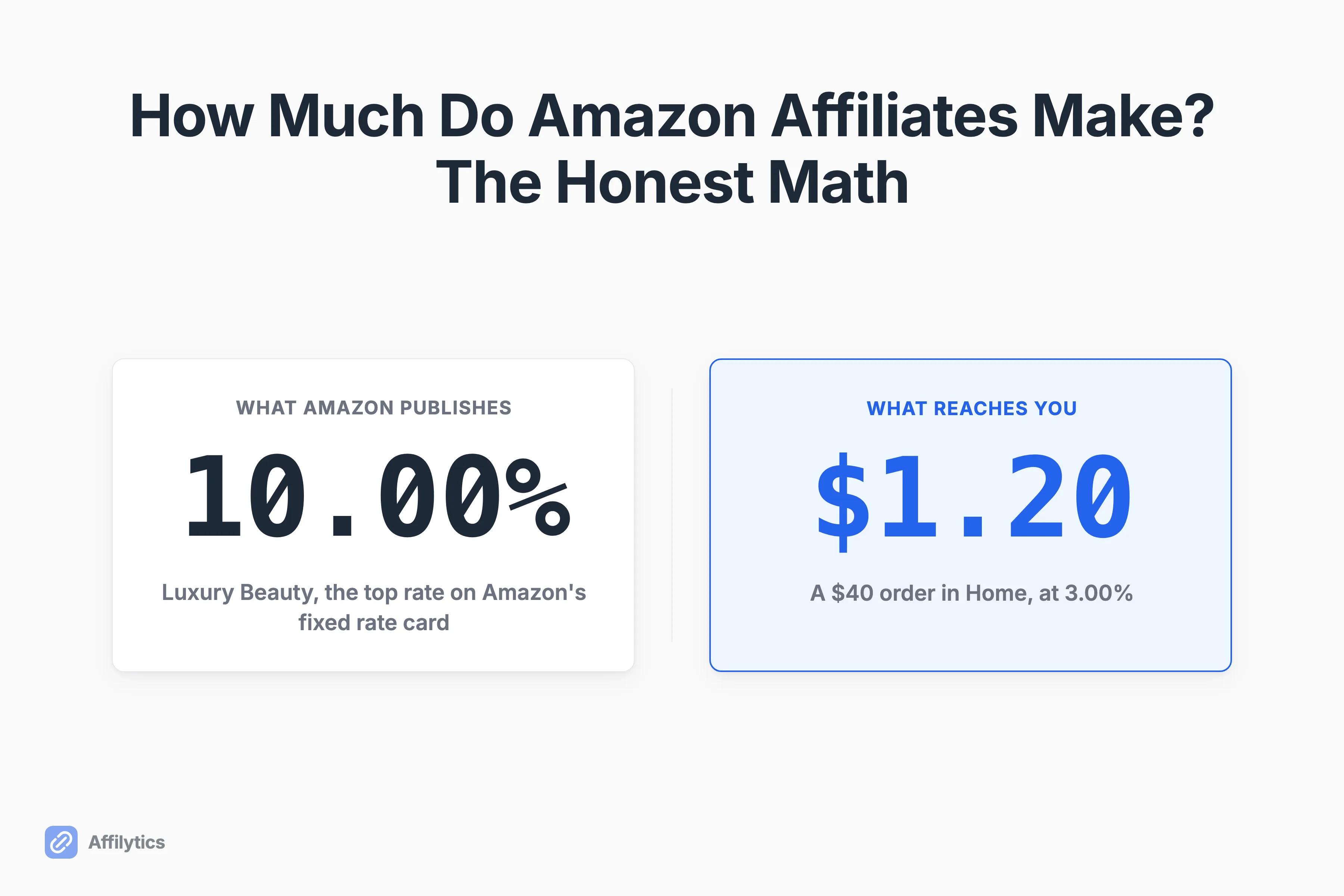
The honest answer to the question “how much do Amazon affiliates make” is that most of the numbers published for it are wrong, including some of the ones ranking above this page. Here is a real spread instead: u/bball2014 in r/PartneredYoutube reports $50 to $100 a month from Amazon against 1.6 million channel views in a year, and u/mrstickball in the same thread reports $200 to $300 a month. @2whazzuup posted on X in August 2026 that he finished a year at $7,972, with $3,000 in bonuses counted separately.
We build Affilytics, which routes clicks to the reader’s own regional Amazon store and checks whether a creator’s affiliate links still work, so we spend our days inside the mechanics that decide whether a click ever becomes a commission.
Those same mechanics are why so many creators end up staring at clicks that never turn into sales with no idea which part of the chain swallowed the money.
This guide covers what Amazon actually pays by category, the arithmetic that turns that rate into your own number, the four places that number leaks before it reaches you, and what real creators report earning.
Why Nobody Can Honestly Tell You the Average
Section titled “Why Nobody Can Honestly Tell You the Average”I wanted to open this post with an average. I went looking for one, and every candidate I picked up came apart in my hands.
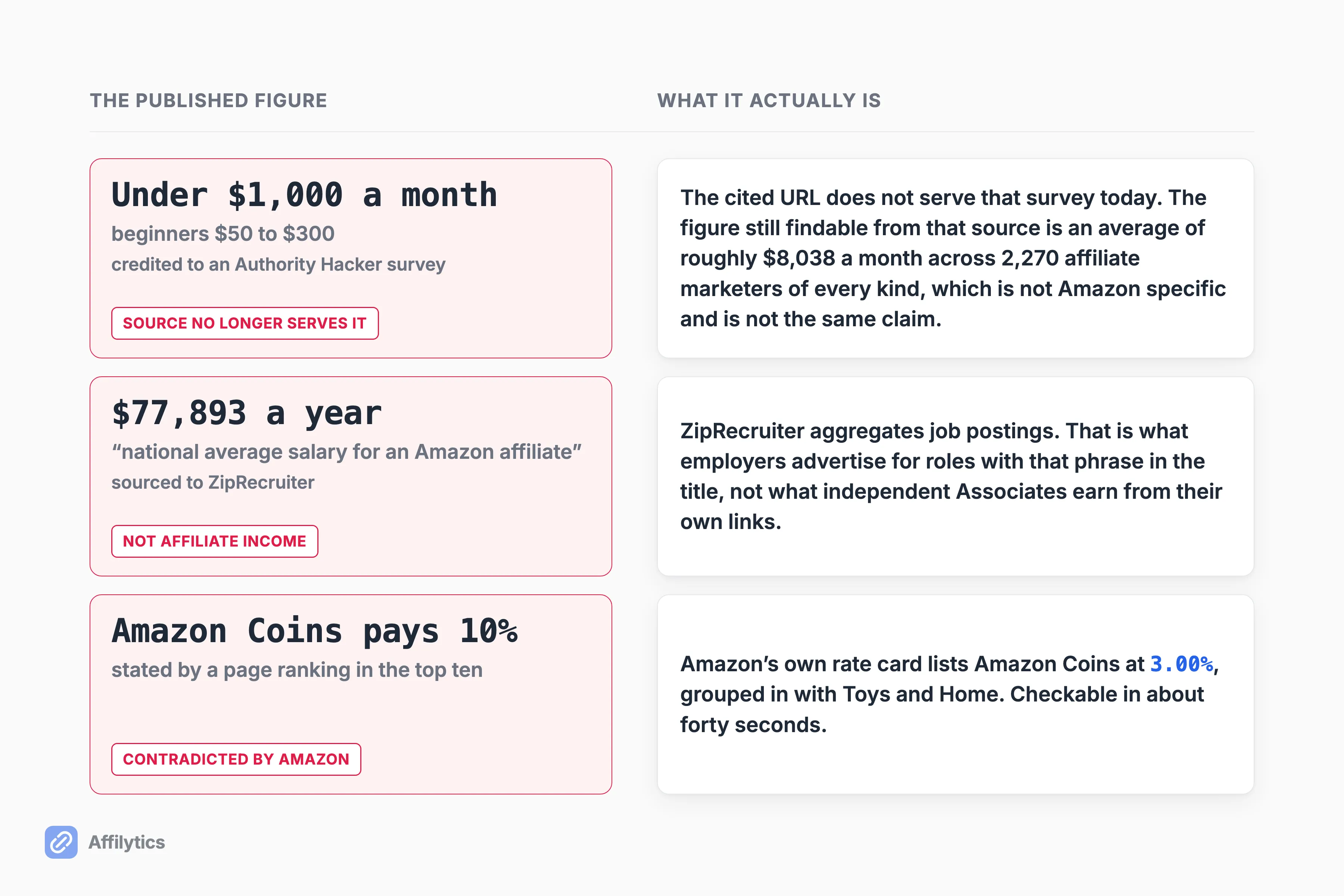
Three examples, all of them findable on the first page for this exact question:
- A survey figure with no survey behind it anymore. The most repeated line in this niche is that most Amazon affiliates earn under $1,000 a month, with beginners somewhere between $50 and $300. It gets credited to an Authority Hacker survey. Open that URL today and it does not serve that survey at all. The figure that is still findable from that source is an average of roughly $8,038 a month across 2,270 affiliate marketers of every kind, which is not Amazon-specific, is not remotely the same claim, and is not a number to carry away either.
- A salary that is not affiliate income. Another widely quoted number puts the national average salary for an Amazon affiliate at $77,893 a year, sourced to ZipRecruiter. ZipRecruiter aggregates job postings. That figure is what employers advertise for roles with that phrase in the title, not what independent Associates earn from their own links.
- A rate that is simply wrong. One page ranking in the top ten for this term states that Amazon Coins pays 10%. Amazon’s own rate card lists Amazon Coins at 3.00%, grouped in with Toys and Home. That one is not a judgment call. It is checkable in about forty seconds.
So why does every article publish a number anyway?
Because a number is what gets clicked. The trouble with “how much do Amazon affiliates make” is that it has an answer shape rather than an answer: an average built from strangers with different traffic, different niches, and different product categories tells you nothing useful about your own next month.
What does transfer is the mechanism. The rate Amazon publishes, the arithmetic that turns it into dollars, and the specific places those dollars go missing on the way to you. That is the rest of this post.
What Amazon Actually Pays You
Section titled “What Amazon Actually Pays You”Amazon pays creators through two different systems, and the articles ranking for this question rarely keep them apart. The first is a percentage of the item price. The second is a flat dollar bounty for a sign-up.
The percentages are set by product category, and they run from 0.00% to 10.00%. This is the full fixed commission table by category as Amazon publishes it, and it is worth checking against what you were earning a year ago, because the Amazon commission cuts of 2026 moved several of these rows without an announcement:
| Product category | Fixed rate |
|---|---|
| Luxury Beauty, Luxury Stores Beauty, Amazon Explore | 10.00% |
| Digital Music, Physical Music, Handmade, Digital Videos | 5.00% |
| Physical Books, Kitchen, Automotive | 4.50% |
| Amazon Fire tablets, Kindle devices, Apparel, Fire TV, Echo, Ring, Watches, Jewelry, Luggage, Shoes, Handbags | 4.00% |
| Toys, Furniture, Home, Home Improvement, Lawn & Garden, Pet Products, Headphones, Beauty, Musical Instruments, Outdoors, Tools, Sports, Baby, Amazon Coins | 3.00% |
| PC, PC Components, DVD & Blu-Ray | 2.50% |
| Televisions, Digital Video Games | 2.00% |
| Amazon Fresh, Physical Video Games & Consoles, Grocery, Health & Personal Care | 1.00% |
| Gift Cards, Wireless Service Plans, Alcoholic Beverages, Vehicles, Pet Prescription Medications | 0.00% |
| All Other Categories | 4.00% |
Now look at where the things creators actually review land. Home, tools, toys, sports, pet products, outdoors, headphones: all 3.00%. Televisions are 2.00%. PC components are 2.50%. Grocery and health sit at 1.00%. The 10.00% headline that shows up in every “become an Amazon affiliate” pitch belongs to Luxury Beauty.
So what does “up to 10%” mean for a gear reviewer?
For most of them, nothing at all. If your channel is tools and home gear, your rate is 3.00%, and that ceiling is not something you reach by trying harder. You reach it by changing what you review. We keep the full category rate table in its own post, including how the rates differ between marketplaces. If you are weighing the Influencer Program instead, the bar for getting in is its own question, and we covered Amazon Influencer Program requirements separately.
Bounties work on a completely different logic. They are flat, they do not scale with basket size, and they pay per qualifying sign-up:
- Prime Free Trial: $3.00
- Prime Video Free Trial: $2.00
- Prime for Young Adults trial or paid membership: $30.00
- Amazon Fresh first purchase bonus: $1.00
- Pet Food & Supplies first purchase bonus: $3.00
One Prime for Young Adults sign-up at $30.00 pays more than a $900 furniture order does at 3.00%. That is why the two systems have to be counted separately. Fold them into a single “earnings” number and you lose the ability to tell which half of your content is doing which job.
The Math That Turns a Rate Into Your Number
Section titled “The Math That Turns a Rate Into Your Number”The category rate is the last multiplication in a chain, not the first. Here is the whole chain, in the order the money actually moves.
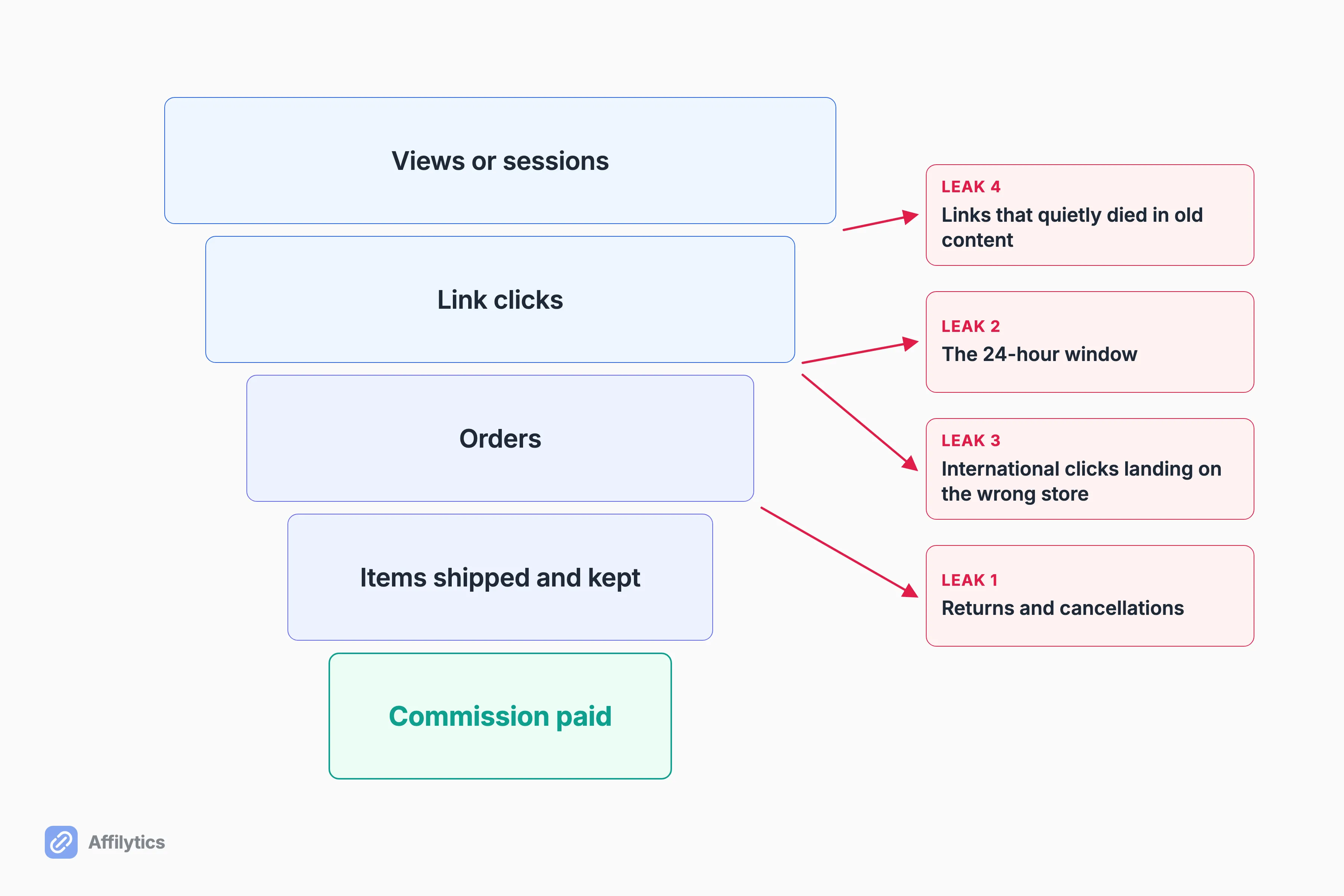
- Views or sessions. How many people see the content the link sits in.
- Link clicks. What share of them click an affiliate link at all.
- Orders. What share of those clicks end in a purchase inside the tracking window.
- Items shipped and kept. Amazon pays on what ships and stays sold, not on what gets ordered.
- Category rate. The percentage from the table above, applied to the item price.
Every step multiplies the one before it, which is why a small change near the top moves the final number far more than anything you do at the bottom.
Let me run one all the way through. Every input below except the commission rate is a number I am choosing for the example. None of them are measurements, and yours will be different.
- Say a video gets 50,000 views.
- Say 2 of every 100 viewers click an affiliate link. That is 1,000 clicks.
- Say 5 of every 100 clicks end in an order. That is 50 orders.
- Say the average item is a $40 home-category product, which Amazon pays at 3.00%.
Fifty orders at $40 is $2,000 in tracked sales. At 3.00%, that is about $60, and then some of it never ships or comes back, so the number that gets paid lands a bit under that.
Call it sixty dollars, roughly, on fifty thousand views.
I am not going to hand you that to the cent, because to the cent would be a lie. All four of those inputs were chosen, not measured, and a model built on chosen inputs gives you a shape, not a forecast.
So which input should you push on?
Not the ones you cannot move. Conversion is mostly Amazon’s business, and order value is mostly the product’s. The two inputs a creator genuinely controls are traffic and category rate, and the second one is badly underrated: reviewing a $400 kitchen appliance at 4.50% instead of a $400 television at 2.00% more than doubles what the same sale is worth to you.
Leak 1, You Are Paid on Shipped, Not Ordered
Section titled “Leak 1, You Are Paid on Shipped, Not Ordered”Here is a real month, posted by u/SpeedyGoneGarbage in r/Affiliatemarketing: 211 clicks, 46 ordered items, $4,106.19 in ordered revenue, $35.94 in total revenue, and $1.32 in total earnings. His own summary was “One dollar on $4000 worth of sales!!”
Amazon’s operating policies are specific about what earns. Commission is contingent on the product being “shipped to, streamed or downloaded by, and paid for by the customer”, and any order “where a cancellation, return, or refund has been initiated” is disqualified outright.
I do not know what happened in that particular month, and nobody in the thread does either. A commenter, u/nysora, offered the right move, which was a diagnostic rather than a conclusion: “Are ‘Ordered items’ actually ‘Shipped items’? Amazon only pays on shipped and not returned.”
So which column are you actually reading?
- Ordered items and ordered revenue is what customers pushed through checkout after clicking your link. It is a leading indicator, and it is the biggest number on the page.
- Shipped items is the subset that actually left a warehouse and stayed sold.
- Total earnings is what Amazon owes you.
Only the last one is money. The columns get confused constantly, and the confusion runs in one direction: people quote the big number and feel robbed by the small one. Ordered revenue was never yours to begin with.
The useful habit is to stop reading ordered revenue as a performance number at all and start reading the gap between the columns as a property of your niche. Whether the things you review are the kind that get sent back is a question your own shipped-versus-ordered gap answers. If you review categories where returns are normal, your paid number will always sit further below your ordered number than another creator’s does, and no amount of better writing changes that. Model it, do not resent it.
Leak 2, The 24-Hour Window
Section titled “Leak 2, The 24-Hour Window”A click opens a tracking session. Amazon’s program policies say that session ends at the first of several events, one of which is when “24 hours elapse from that click”. That is the entire window.
So the reader who watched your review on Tuesday, thought about it for a week, and bought the thing on Sunday? Not yours. Nothing about that purchase traces back to you, no matter how directly your video caused it.
Is that a failure of your content?
No, and this is the leak creators most often mistake for a personal problem. The window is doing exactly what it was designed to do, which means the fix is structural rather than “write better”. You want more clicks happening closer to the moment someone is ready to buy:
- A link in the first two lines of a description beats one buried under a wall of text and hashtags.
- A link placed next to the specific product, at the moment you name it, beats a block of links dumped at the end.
- Content aimed at people already deciding (comparisons, “best X for Y”, “is X worth it”) converts inside a day far better than discovery content does.
The window also hits your most valuable recommendations hardest. Nobody deliberates over a $15 cable, and plenty of people deliberate for a fortnight over a $900 camera, which means the items with the biggest commission attached are exactly the ones most likely to be bought on day nine by someone who genuinely found them through you.
We went deeper on how the 24-hour window actually behaves, including the cart-expiry rule that keeps getting misquoted as a 90-day cookie.
Leak 3, International Clicks Landing on the Wrong Store
Section titled “Leak 3, International Clicks Landing on the Wrong Store”A reader in Melbourne clicks your amazon.com link. Whether that click can ever be credited on the Australian store depends on something you either set up months ago or never set up at all.
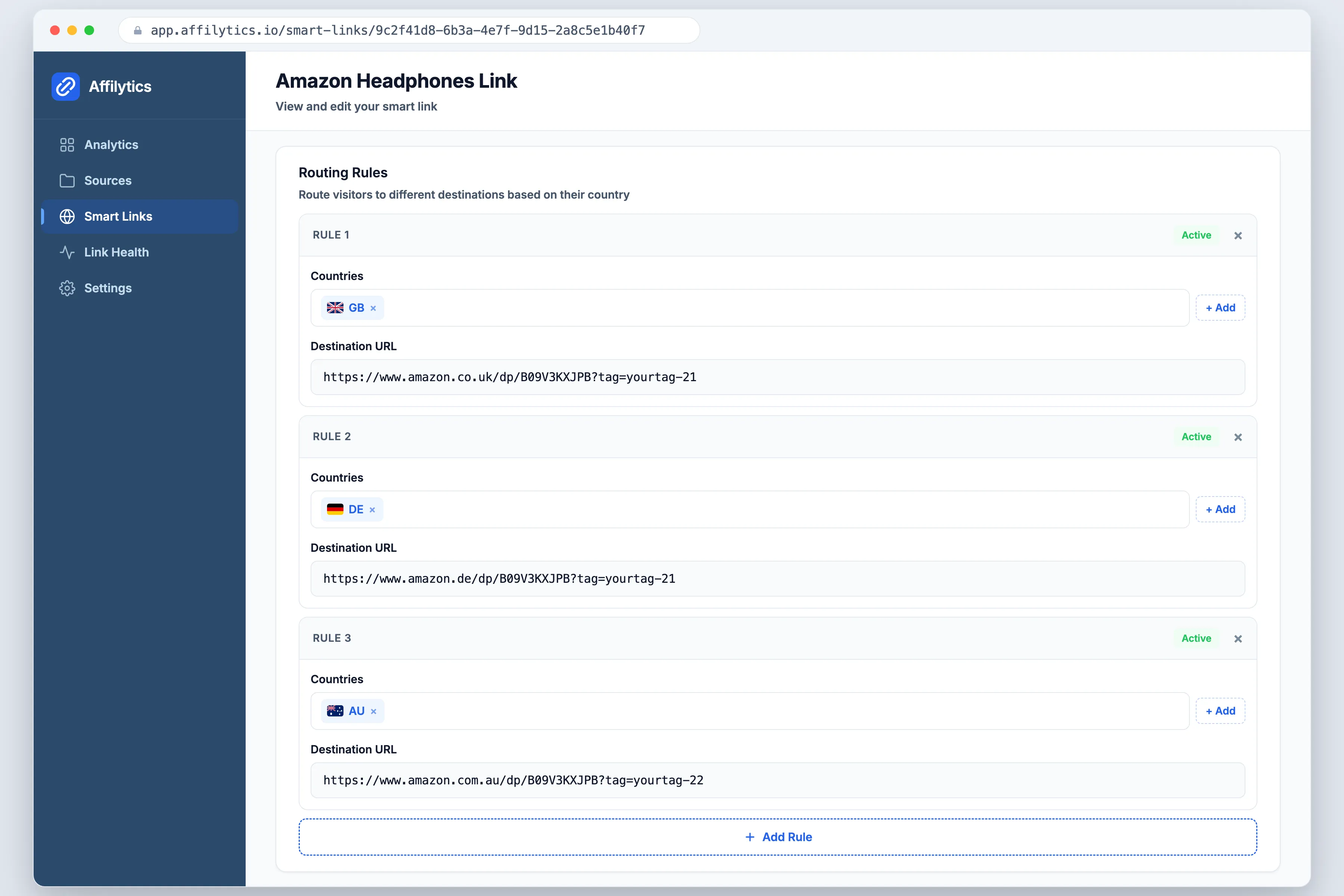
Amazon runs its regional programs separately, and one store ID does not cover all of them. Amazon’s own documentation is blunt about the split: past the marketplaces a single store ID reaches, “you will need an Amazon Associates account in each country” for which you want to monetize the traffic.
- Covered by a single store ID: Canada, United Kingdom, Spain, Germany, France, Italy.
- Needs its own Associates account: Japan, Singapore, Netherlands, Saudi Arabia, Poland, Sweden, Australia.
So a creator with real traffic from Japan or Australia and no account in either place is not earning on it. That is not a penalty or a bug. There is simply no program relationship for those clicks to be credited against.
How much of your audience is that?
More than most creators assume. YouTube’s own figures make the point better than any estimate of mine could: over 88% of watch time on content produced by channels in the UK comes from outside of the UK, on YouTube’s first party data for 2023. That is one country and one platform, so it is not your number. Your channel or site analytics already knows what your number is. Go and look before you decide this section is not about you.
This is the leak we built the product around. An Affilytics smart link resolves each click by looking up the visitor’s country, then sends them to their own regional Amazon store, so a UK click can land on amazon.co.uk with a UK tag rather than on a US page carrying a tag that store does not recognize.
We broke down what international traffic is actually worth in its own post, including the separate ways a cross-border click can fail before it ever reaches a checkout.
Leak 4, Links That Quietly Died in Old Content
Section titled “Leak 4, Links That Quietly Died in Old Content”u/afterbyrner ran a niche site making $3,000 to $5,000 a month in Amazon commission. He changed his WordPress theme. Amazon revenue dropped hard while his traffic stayed flat.
The cause was not Amazon. It was an AdSense auto-ads block he had accidentally re-enabled along with the theme change, pulling visitors off the page before they ever reached an affiliate link. His words when he finally found it: “Painful lesson learned I guess.”
In the same thread, u/vovr described a different flavor of the same failure: “Turned out my amazon links were unclickable on smartphones. There was some z-index issue on lower resolutions.”
What would have told either of them?
Nothing on the Associates dashboard. Traffic looked normal. Clicks fell, and falling clicks look identical to a slow week until you go looking for a cause. Old content is where this hides best, because a two-year-old post that still ranks keeps pulling views long after anyone last opened it in an editor.
Both causes lived inside the site, not inside Amazon, and both were the kind of thing a single mobile tap on your own oldest earning post would have caught. That is the honest test for this leak: open the top five posts or videos you earned from last year, on a phone, and click your own links.
Checking the rest of the library is the unglamorous fix, and what matters is that it separates the failure modes. There is a link that is plain dead, and then there is a link where the page loads perfectly and the tracking tag does not survive the hops between the click and the store. We call the second one attribution lost, and to a human spot-check the two look identical, because both of them end on a working Amazon product page. Amazon links do not expire, they rot, which is a different problem with a different fix.
What Creators Actually Report
Section titled “What Creators Actually Report”Here is every individual earnings report I could attribute to a named person, with the audience size attached wherever they gave one.
- u/bball2014 (r/PartneredYoutube): “$50-100.00 per month from Amazon pretty consistently. 1.6 million channel views in the last 365 days.”
- u/PwnCall (r/PartneredYoutube): “about 100k views a month and make roughly $50-$150 per month off Amazon links.”
- u/mrstickball (r/PartneredYoutube): “about $200-300 a month from Amazon affiliates.”
- @2whazzuup (X, posted August 2026): “$387 for the month. $7,972 for the year (excluding $3,000 in bonuses).” Note that he keeps bonuses separate from commission, which is the split from earlier in this post showing up in a working creator’s own reporting.
- @HeyGazmir (X), on his first commission: “That $1.29 cheque is framed on my wall and I see it every night.”
- Hugo Guerreiro, founder of The Men Hero: “In November [2021], we made $963.69 from Amazon Associates.” That is a 2021 figure.
The one that should recalibrate you is the first. A channel with 1.6 million views over a year produced $50 to $100 a month from Amazon.
Should you average those six?
No, and doing it would be exactly the mistake this post opened by criticizing. Six people in different niches, on different platforms, in different years, at wildly different traffic levels are not a sample. They are six anecdotes, and their value is the spread and the shape, never a midpoint.
The other pattern worth taking is where Amazon sits in the mix. u/avrona: “Roughly 20% of our income is from Amazon Associate, though being in tech probably helps.” u/redbeardrex was more precise: “My income is 50% Adsense, 25% sponsors, and 25% Affiliates. Of that 25%, 20% is Amazon.” Work his numbers out and Amazon is 5% of what he earns. The creators who talk about the program most calmly are the ones for whom it is one slice.
How to Work Out Your Own Number This Week
Section titled “How to Work Out Your Own Number This Week”You can do this in an hour, with your dashboard and the table from earlier in this post. No tool required.
- Pull last month’s real figures. Open the Associates dashboard and write down four: clicks, ordered items, shipped items, and total earnings. Ignore ordered revenue completely.
- Find your actual rate. Look up your dominant product category on Amazon’s rate card. If most of what you link is home, tools, toys or sports, you are at 3.00% and you should plan around that number, not around 10%.
- Run the chain backwards. Divide total earnings by clicks. That is what one click from your audience is really worth right now, and it is the honest baseline for any “what if I doubled traffic” daydream.
- Measure your shipped-versus-ordered gap. Ordered items minus shipped items, as a share. If that gap is wide and stays wide, your niche has a returns problem and your model has to account for it.
- Check the four leaks against yourself. Where do your clicks come from geographically, how close to the buying moment are your links placed, and when did you last open your oldest earning post to see whether its links still work?
Which of the five do people skip?
The last one, every time. It is the only step that means going back into old content, and old content is exactly where the money quietly stops. Doing this by hand once a year is realistic. Doing it monthly across two hundred posts is not, which is the whole argument for catching silent commission loss with something that watches while you write.
The Only Average That Matters Is Yours
Section titled “The Only Average That Matters Is Yours”You now have the math and the four leaks. The one input you cannot pull by hand at any real scale is which of your existing links are still earning and where your clicks are genuinely coming from, and those two answers move the model more than any assumption inside it.
Create your free Affilytics account and you get two full weeks with everything unlocked, no credit card. Point it at a channel or a site and read your own numbers instead of somebody else’s average.
How much do Amazon affiliates make per sale?
Section titled “How much do Amazon affiliates make per sale?”There is no single per-sale figure, because commission is a percentage of the item price set by product category. A $40 home item at 3.00% pays about $1.20. That same $40 order in Grocery pays 1.00%, roughly 40 cents, and in Physical Books it pays 4.50%, roughly $1.80. Look up your own categories on Amazon’s rate card instead of trusting a per-sale average.
How much do Amazon affiliates make per click?
Section titled “How much do Amazon affiliates make per click?”Amazon pays nothing per click. It pays on completed orders that ship and are not returned, placed inside the 24-hour window that opens when someone clicks your link. As the creator @zeo_ex put it on X, “Amazon Associates pays you for driving sales, not for having a website.” Creators do work out their own earnings per click after the fact, but that is an output of last month, not a rate Amazon offers.
How much do Amazon affiliates make a month?
Section titled “How much do Amazon affiliates make a month?”It depends almost entirely on traffic and category, and the honest answer is a spread of individual reports rather than an average. In r/PartneredYoutube, u/bball2014 reports $50 to $100 a month against 1.6 million channel views in a year, u/PwnCall reports $50 to $150 a month on about 100k monthly views, and u/mrstickball reports $200 to $300 a month. Those are three people, not a benchmark, and averaging them would produce a number that describes nobody.
What percentage do Amazon affiliates get?
Section titled “What percentage do Amazon affiliates get?”Between 0.00% and 10.00%, set by product category. Luxury Beauty sits at the top at 10.00%. Most everyday creator categories (home, toys, tools, sports, pet products, outdoors, headphones, beauty) sit at 3.00%, televisions at 2.00%, grocery and health at 1.00%, and anything not otherwise listed falls under All Other Categories at 4.00%. Gift cards, alcohol, vehicles and wireless plans pay 0.00%.
Can you make a living from Amazon Associates alone?
Section titled “Can you make a living from Amazon Associates alone?”For most creators it is one slice of an income mix rather than the whole thing. In r/PartneredYoutube, u/avrona says roughly 20% of their income is from Amazon Associates, and u/redbeardrex breaks his down as 50% AdSense, 25% sponsors and 25% affiliates, of which a fifth is Amazon. People do earn real money from the program, but the ones who talk about it calmly treat it as one stream among several rather than a salary replacement.