
5 Best Amazon Affiliate WordPress Plugins for 2026
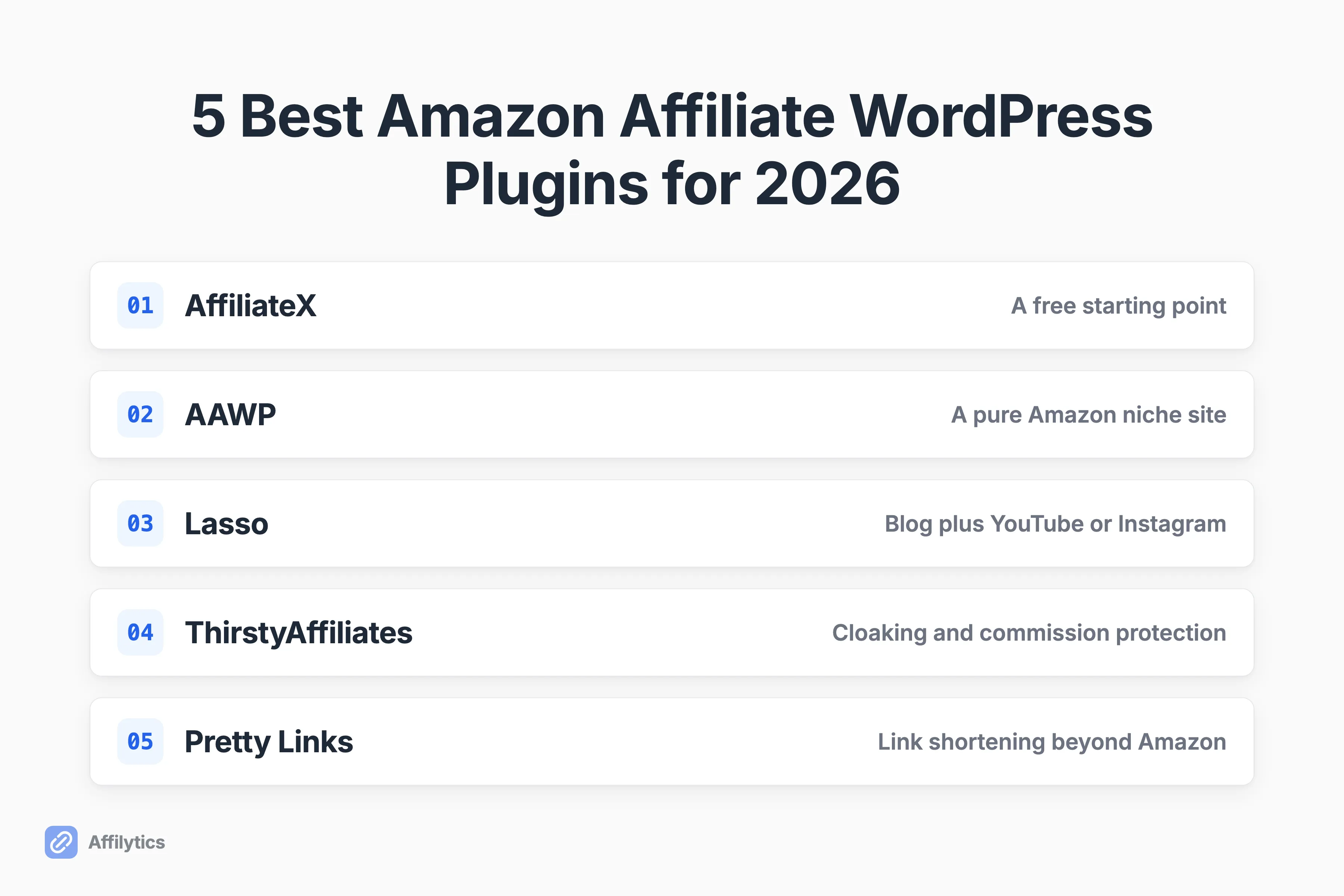
One of the guides still sitting on page one for Amazon affiliate WordPress plugins recommends a plugin whose last public release landed in March 2024. That is the whole problem with this category right now: the lists keep ranking, the plugins quietly stop shipping, and nothing in your WordPress admin tells you which is which.
We build affiliate link monitoring at Affilytics, so we spend our days on what happens to a link months after it went live. That makes us read a plugin list differently. Not by what it renders, but by whether it is still alive and what it can still see.
Almost every buying decision in this category is about rendering. Almost none of it is about what happens to affiliate links after you publish them, which is where the money quietly goes.
Below: five plugins worth installing, what each one costs, the two-minute check that tells you whether a plugin has been abandoned, and the one job none of them do.
What are the best Amazon affiliate WordPress plugins?
Section titled “What are the best Amazon affiliate WordPress plugins?”This list is five, not nineteen. Every pick is one whose pricing and features we checked on its own live pages inside the last two weeks, and anything we could not verify that recently did not make the cut. One disclosure before the picks, because the biggest editorial list on this keyword does not make one: we sell affiliate link monitoring, not a display plugin. Nothing here is a product we make money from, and we do not link to any of them.
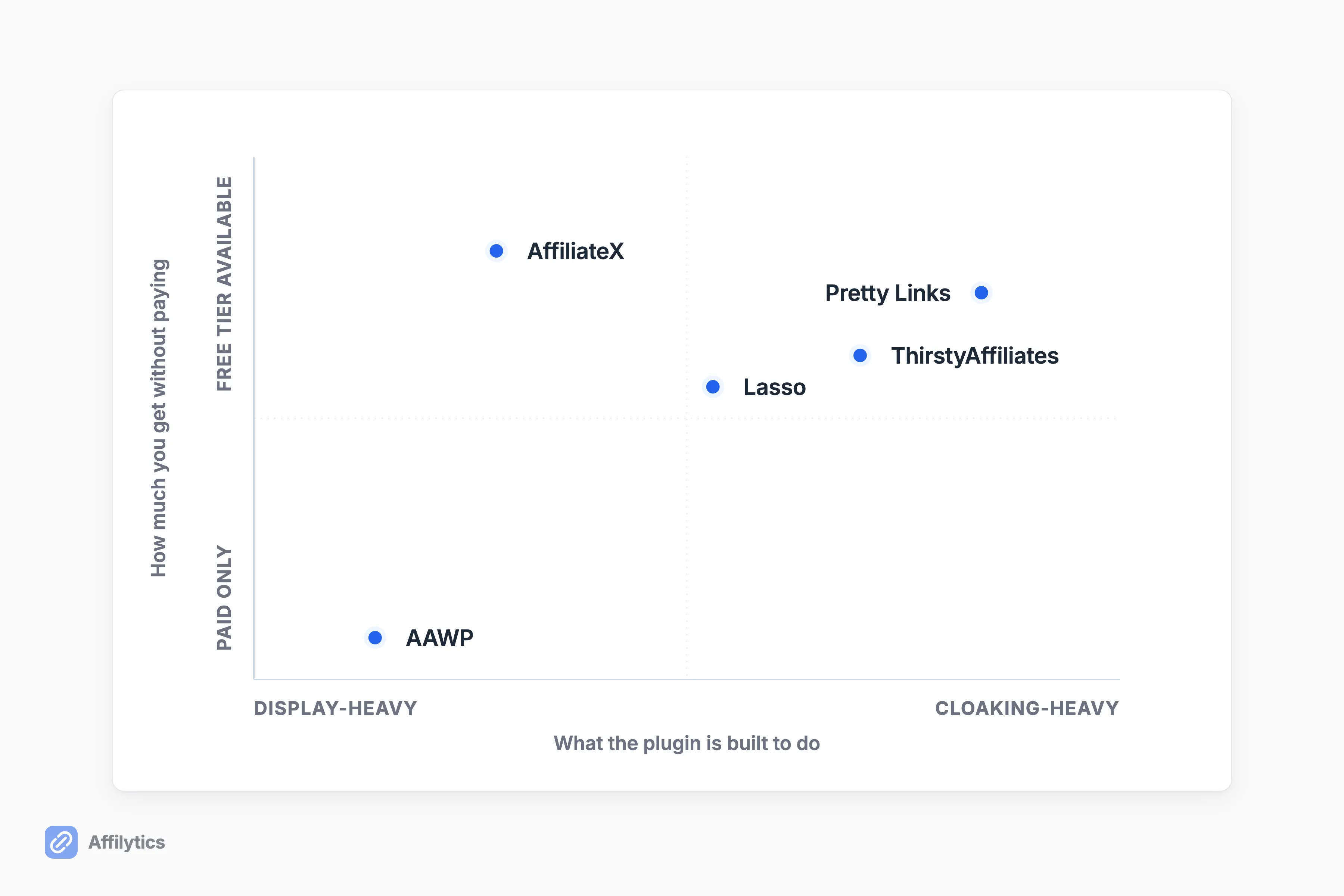
| Plugin | Best for | Free version | Starting price | Geo-routing | Link checking |
|---|---|---|---|---|---|
| AffiliateX | A free starting point | Yes, 10 blocks + templates | $55/year, 1 site (Pro, excl. tax) | Yes, tier not disclosed | Yes, Broken Link Checker (Pro) |
| AAWP | A pure Amazon niche site | No | EUR 79/year, 1 site (excl. tax) | Yes, every tier | No |
| Lasso | Blog plus YouTube or Instagram | Yes, Lasso Lite | $16/month billed $192/year, 1 property | Yes, Pro tier and up | Yes, Link Health Alerts (Creator and up) |
| ThirstyAffiliates | Cloaking and commission protection | Yes, on wordpress.org | $99.60/year promotional, 1 site | Yes, Basic tier and up | Yes, Automatic 404 Checker |
| Pretty Links | Link shortening beyond Amazon | Yes, on wordpress.org | $99.60/year promotional, 1 site | Yes, all three tiers | Yes, LinkHealth |
AffiliateX, best free starting point
Section titled “AffiliateX, best free starting point”If you have not spent anything on this yet, start here. The free plugin on wordpress.org gives you 10 blocks plus templates, an analytics dashboard, and it works in both the block editor and Elementor. Enough to build a real comparison post and see whether product blocks move your numbers before you spend anything.
It is also the most recently updated of the four picks whose release history we could check: version 2.3.6, last updated eight hours before we looked, tested up to WordPress 7.0.2, with 10,000+ active installations on its directory listing.
The catch is where the line sits. Broken Link Checker, Email Reports, Amazon API Integration, Zero API, the eBay and AliExpress integrations and Dynamic Listing are all Pro-only. Pro is annual, excludes tax, and currently carries a standing 20% discount against list:
- 1 site: $55 a year, or $159 lifetime
- 3 sites: $135 a year, or $399 lifetime
- 10 sites: $319 a year, or $1,599 lifetime
No trial, because the free plugin is the trial. A 14-day money-back guarantee behind the paid tiers.
One more boundary: AffiliateX covers Amazon, eBay and AliExpress. No ShareASale, Impact, CJ, Awin, Rakuten or PartnerStack.
AAWP, best for a pure Amazon niche site
Section titled “AAWP, best for a pure Amazon niche site”AAWP is the deepest display toolkit here if Amazon is the only merchant you care about. Product boxes, auto-updating bestseller and new-release lists, comparison tables, data fields, text links, widgets and a Gutenberg block, all with local caching. Geotargeting is in every licence tier rather than gated upward, so a German reader gets forwarded to their own Amazon store once you set a tracking ID per country.
It has also been visibly shipping through Amazon’s data-access mess: creators API v3 support in v5.0.5 in February 2026, a Lasso migration importer in April 2026, and v5.0.8 in June 2026. Its own paid AAWP API is a fallback data source, so boxes keep rendering without official Amazon API access, though AAWP itself says lists such as bestsellers are “not yet available when using the AAWP API”.
Pricing is EUR 79 a year for one site, EUR 129 for three, EUR 199 for five and EUR 299 for ten, all excluding tax, auto-renewing at the same listed price. Lifetime licences are new, EUR 299 to EUR 899. No free tier, no free trial, only a 30-day money-back guarantee.
Renewal cost is the complaint you will find in the wild. One user’s report on r/Wordpress: “I’ve also been using the AAWP plugin on three WordPress sites for years, but this is the last year. I won’t be renewing because the price has tripled since last year, going from €50 to €150 (including VAT).” Read that as one person’s experience rather than a documented price history. What we can verify is the current end of it: the 3-site licence at EUR 129 excluding tax lands near EUR 153 once German VAT is on it.
One more thing to price in: AAWP tracks clicks on the boxes it renders, and checks nothing about where they land.
Lasso, best if WordPress is not your only surface
Section titled “Lasso, best if WordPress is not your only surface”Lasso is the only pick here that is not a WordPress plugin first. It runs on WordPress, YouTube, Instagram, HTML embeds on any site, and its own Lasso Pages link-in-bio product. Its pricing page answers the question directly: “Is Lasso only for WordPress? No.”
That is the reason to pick it: if you review a product on the blog and cover it again on a channel, one link layer covers both. Its Link Health Alerts cover broken-link and out-of-stock detection from the Creator tier up, and out-of-stock is not something anyone else on this list advertises. Affiliate+, its brokered brand-deal marketplace, pays on a 14-day attribution window rather than Amazon’s 24-hour cookie.
Pricing is per property, and Lasso defines that plainly: “One property equals one website or one YouTube channel.”
- Creator: $19 a month, or $16 a month billed at $192 a year, 1 property. First tier with broken link alerts.
- Pro: $29 a month, or $24 a month billed at $288 a year, 3 properties. First tier with international link localization.
- Studio: $59 a month, or $46 a month billed at $552 a year, 5 properties. Only tier with API access and team permissions.
A standing seasonal promo takes 60% off the first year, and year two renews at the regular annual rate. Two things to weigh: geo-routing sits behind Pro, and free Lasso Lite locks alerts, analytics, localization, team support and the API, so treat it as a display tier rather than a working free plan.
ThirstyAffiliates, best for cloaking and commission protection
Section titled “ThirstyAffiliates, best for cloaking and commission protection”ThirstyAffiliates is not trying to build you a product box. The whole pitch is cloaking and commission protection: “Cloak long ugly affiliate links / Protect your commissions from theft / Insert affiliate links into blog posts easily.” Smart uncloaking keeps the link tidy but resolves to the underlying Amazon URL on click, so Associates attribution still works. That distinction matters more than it sounds, and it is worth reading cloaking affiliate links the right way before you turn any of this on.
Two things it does better than its price band suggests. Geographic Redirects are in the entry Basic tier rather than gated upward. And it markets an Automatic 404 Checker: “Never miss another affiliate link 404 error with proactive link checking.”
The free plugin on wordpress.org is real and well maintained: version 3.12.0 when we checked, 30,000+ active installations, tested up to WordPress 7.0.2. Paid is annual-only at $99.60, $149.60 and $199.60 for 1, 5 and 10 sites, against full prices of $249, $374 and $499. That gap is the sting. Promotional pricing is about 60% off, all annual renewals are at full price, and Basic renews at about 2.5 times its first-year rate. There is a 14-day refund guarantee and no formal trial.
Pick it if your links matter more than your product boxes and you want geo-redirects without paying up a tier.
One disclosure the editorial lists on this keyword do not make: ThirstyAffiliates and Pretty Links share a corporate parent, Caseproof, LLC, the company behind MemberPress. They sit at 2 and 3 in the highest-ranking list for this search, which carries no common-ownership note anywhere on the page. If that changes how you read the two, our ThirstyAffiliates vs Pretty Links comparison works through what the shared parent does and does not mean once you look at the price ladder.
Pretty Links, best for link shortening and branding beyond Amazon
Section titled “Pretty Links, best for link shortening and branding beyond Amazon”Pretty Links has the largest verified install base here: version 4.0.11 when we checked, updated the day before, 200,000+ active installations, tested up to WordPress 7.0.2. Free plugin on wordpress.org, same as its sibling.
Pick it when your affiliate life is bigger than Amazon. It is a cloaker and shortener built for branded links, which is what you want if Impact, ShareASale and Amazon are all running out of the same blog. Geographic Redirects run in all three tiers from Beginner up. It ships LinkHealth, continuous broken-link monitoring with alerts. PrettyPay adds branded one-click checkout if you also sell your own digital products.
What will it not do? Build you an Amazon comparison table. It is a link manager, not a product-display tool, so if auto-updating price boxes are why you came here, AAWP or AffiliateX is your pick. If the annual licence is the part you would rather avoid, we lined up the free alternatives to Pretty Links by the job each one does.
The price ladder mirrors ThirstyAffiliates, the site allowances do not. $99.60, $149.60 and $199.60 a year promotional buys 1, 2 and 5 sites here, against ThirstyAffiliates’ 1, 5 and 10, renewing at $249, $374 and $499. There is a 14-day money-back guarantee and no formal trial: same 60%-off-then-full-price structure, same renewal date to diary.
What you need before any of these plugins works
Section titled “What you need before any of these plugins works”You need two things before any plugin on that list does anything useful: an Amazon Associates account, and a way for the plugin to get product data.
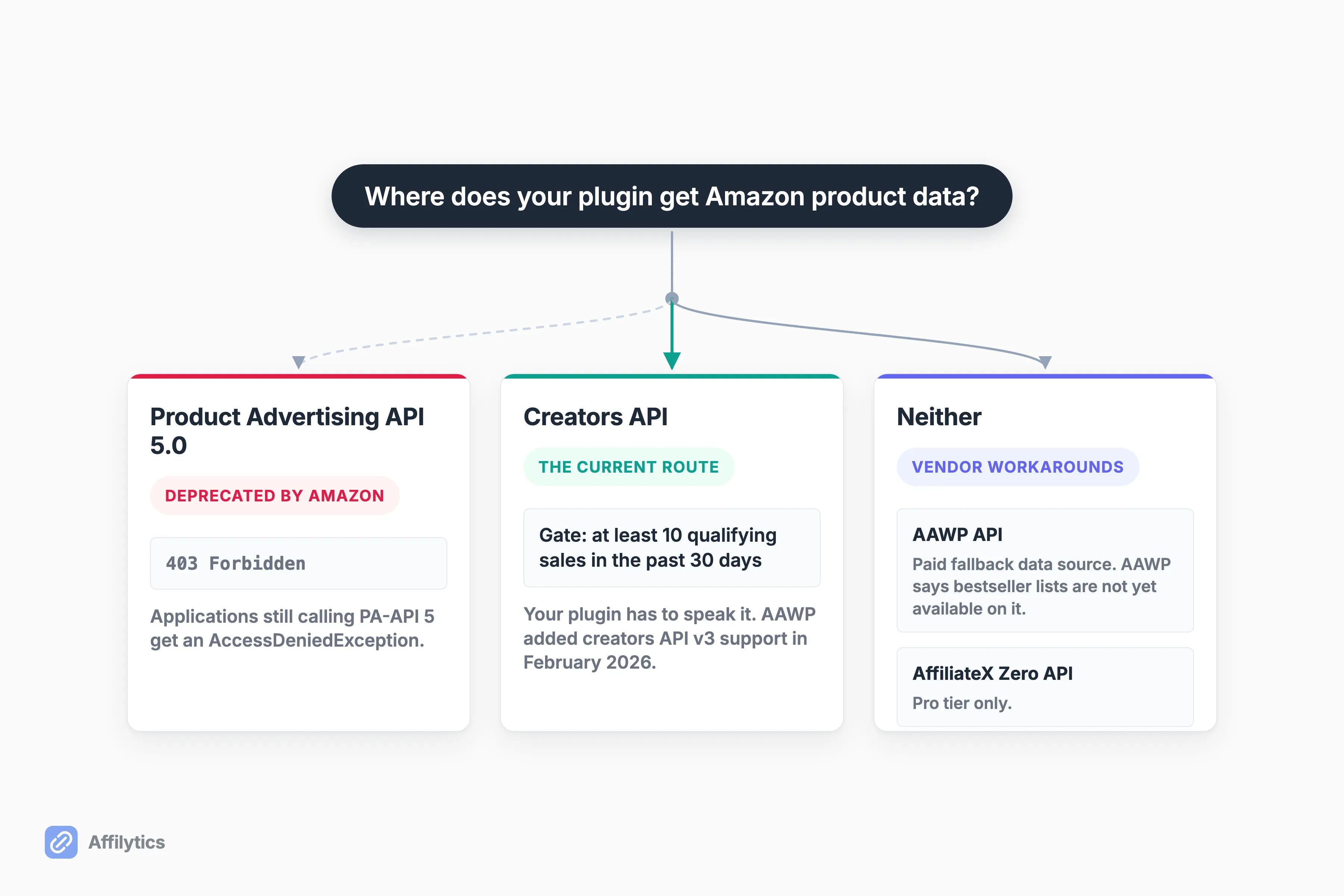
The first is the easy half. You sign up for Amazon Associates, get approved, and you have a tracking ID to put in the plugin’s settings. The second half is where creators are stuck right now.
Here is how it reads from the inside, from r/Wordpress: “However when I added the plugin and other similar plugins they all required a product api. I made the required sales to have it but Amazon says it no longer exists since they moved to the Creators API which I also have. However it seems like these plugins don’t allow for the creators api use and only use the old one.”
That is not a misunderstanding on their part. Amazon’s own developer notice says the Product Advertising API 5.0 has been deprecated and is being replaced by the Creators API, and applications still calling the old endpoint now get back a 403. So a plugin that only knows how to ask the old way does not degrade gracefully. It just stops. Vendor behaviour tracks that: AAWP added creators API v3 support in February 2026, and three separate listings on wordpress.org’s amazon-affiliate tag page now lead their description copy with Creators API support or a no-API-required mode.
There is also a qualification gate in front of the data itself. Amazon asks you to have at least 10 qualifying sales within the past 30 days before you can reach the product catalogue through the Creators API. Read that back slowly if you are starting out: the product data that makes these plugins worth paying for is gated behind sales you cannot make yet.
So which data source does the plugin you are about to buy actually speak?
Two of the five sell a workaround precisely because that question has no clean answer. AAWP’s paid AAWP API and AffiliateX’s Zero API both exist because a real slice of this audience cannot get Amazon API access at all. So check which data source a plugin supports before you pay, not after your boxes go blank. Blank boxes are usually when your plugin asks for credentials Amazon will not issue rather than a plugin that broke.
How to tell if an Amazon affiliate plugin has been abandoned
Section titled “How to tell if an Amazon affiliate plugin has been abandoned”Open the plugin’s page on wordpress.org and read two fields. Two minutes, start to finish.
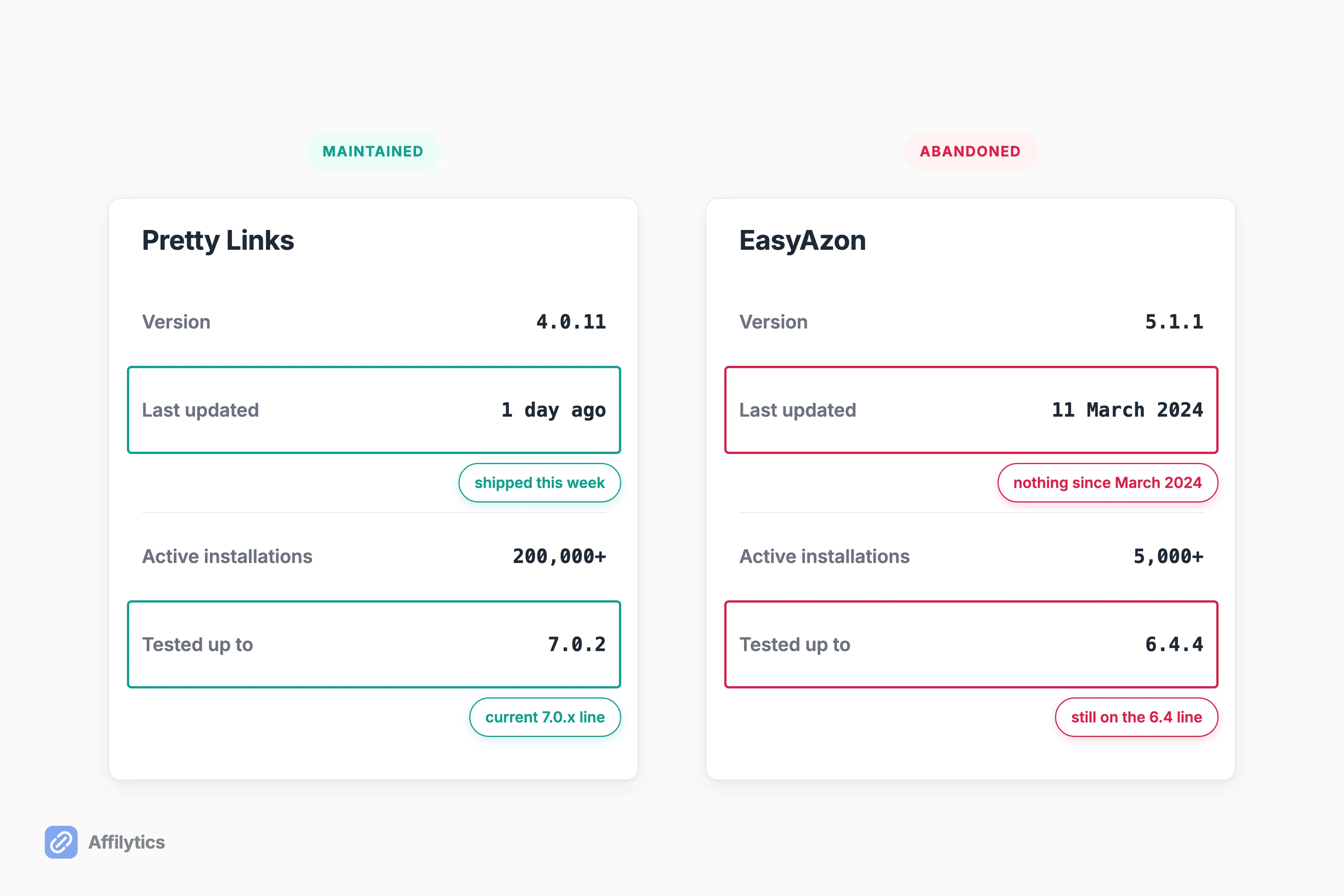
- Last updated. When the author last shipped anything.
- Tested up to. The last WordPress version they confirmed against.
Then compare the second against the current WordPress line. A plugin tested only against WordPress 4.4 while the current line is 7.0 has not been touched in years, whatever its install count says.
Run it on a plugin the roundups still recommend. EasyAzon: its last release was March 2024, version 5.1.1, tested to WordPress 6.4.4. Or Amazon Affiliate Link Globalizer, a free geo-redirect plugin tested only to WordPress 4.4.34.
Two fields, and then what? An abandoned plugin stops getting security patches and stops being tested against the WordPress line you are actually running, so every core update becomes a gamble on whether your boxes still render. EasyAzon makes the point better than any warning I could write: the last thing it ever shipped was a fix for a broken-access-control hole. Install it today and you get that fix and never the next one.
Now run it on two of the picks above. ThirstyAffiliates was last updated two months ago, tested up to WordPress 7.0.2. Pretty Links was updated the day before we checked, 200,000+ active installations, also tested to 7.0.2. Same two fields, completely different answer.
The free end of this category is thinner than it looks, too. On wordpress.org’s amazon-affiliate tag page, 12 of the 20 page-one entries sit at 500 active installs or fewer. That is not a market with nineteen good options in it.
One honest caveat: this check does not work for hosted tools. Lasso has no wordpress.org listing at all, so for anything sold as a SaaS you are reading changelogs and release notes instead of directory metadata. Same question, different evidence.
And the check only tells you the plugin is alive. It says nothing about the product boxes that quietly go stale inside a plugin that is shipping updates perfectly happily.
The one thing none of these plugins does
Section titled “The one thing none of these plugins does”Credit first. Four of the five check links.
AffiliateX Pro ships a Broken Link Checker with scheduled daily, weekly or monthly scans and email alerts. Lasso’s Link Health Alerts cover broken and out-of-stock from Creator up. ThirstyAffiliates markets an Automatic 404 Checker. Pretty Links ships LinkHealth. AAWP is the only one of the five with nothing of the kind.
So what does four of them checking links actually get you?
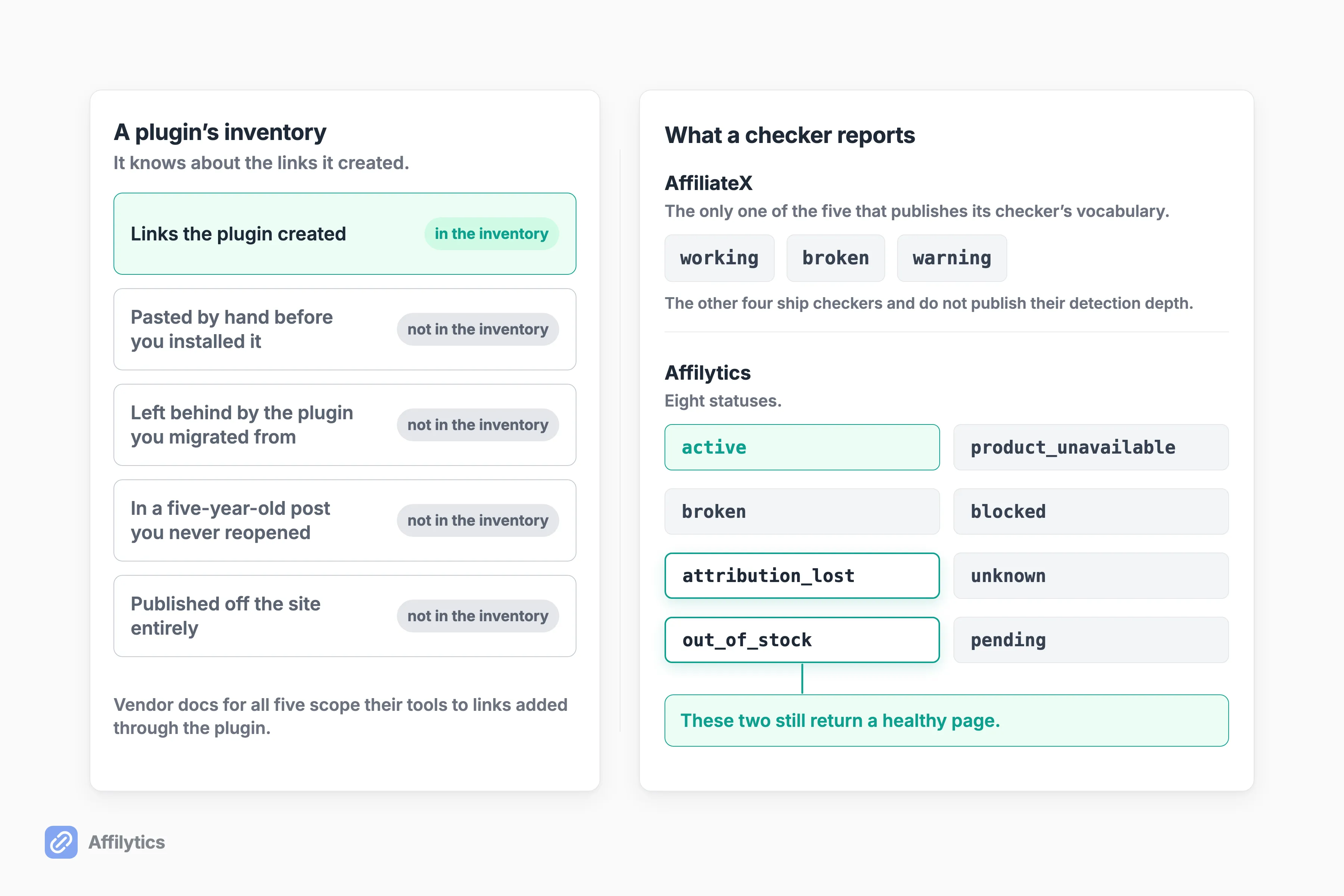
Less than it sounds, because of the one claim that holds across all five: a plugin only knows about the links it created. AAWP manages only products added through AAWP. Lasso manages links you add through Lasso. ThirstyAffiliates and Pretty Links both assume you already pasted the link into WordPress. AffiliateX scopes itself to the single WordPress site it runs on.
Which leaves out, in a normal blog:
- Links you pasted by hand before you installed anything
- Links left behind by the plugin you migrated away from
- Links in a five-year-old post you have not opened since
- Anything you published off the site entirely
None of that is in the plugin’s inventory, so the plugin never checks it. And if your blog is not on WordPress at all, the inventory is empty from the start, which is why affiliate links on Squarespace are the same job with no plugin layer to inherit.
The second gap is narrower and worth stating precisely. AffiliateX is the only one of the five that publishes what its checker reports: working, broken or warning. The other three do not disclose their detection depth at all, and undisclosed is not the same as absent. What is fair to say: nobody on this list documents detection of the failure that actually costs money, which is a link that returns a healthy 200 and still earns nothing because the tag got stripped in a redirect, the product got pulled, or the item went out of stock.
That distinction is the entire reason our own health checker carries eight statuses rather than a working / broken / warning split: active, broken, attribution_lost, out_of_stock, product_unavailable, blocked, unknown, pending. “Broken” and “still loads fine but lost your tag” are different problems with different fixes.
The discovery half we answer by not starting from a plugin’s inventory at all. We crawl the site itself, sitemap-aware, including cloaked redirect paths like /go/ and /recommends/, and we scan YouTube channel descriptions the same way, so we find the links no plugin ever created. Nothing to install, and it runs alongside whichever pick above you keep.
On geo-routing the delta is smaller than you would expect. All five picks market some form of it, so the difference is not that we have it. Theirs forwards the visitor to a local Amazon storefront or redirects inside WordPress. Ours routes to any destination, not only Amazon storefronts.
Which brings me back to a creator on r/Affiliatemarketing: “From last 2-3 months I am not getting any affiliate income despite more than 100s of clicks per month as amazon affiliate. […] I seriously feel something fishy happening at amazon end.” They had a WordPress site, a cloaking plugin they had run across all their old links, traffic “from all over the world mainly US and India”, and complete click instrumentation. They had zero instrumentation on where those clicks landed. Every plugin here would have measured their problem perfectly and explained none of it. If that sounds familiar, the next move is to check every affiliate link on your site rather than to keep staring at the click count.
Pick a plugin, then watch the links it never created
Section titled “Pick a plugin, then watch the links it never created”Install whichever of the five Amazon affiliate WordPress plugins fits how you publish. Then point something at the links you already have, including the ones no plugin ever touched, so you find out the day one of them stops paying instead of three quarters later.
Create your free account and you get two full weeks with everything unlocked, no credit card. Affilytics is not a WordPress plugin and there is nothing to install, so it sits on top of whatever you picked above rather than replacing it.
Do I need an Amazon API key to use an Amazon affiliate plugin?
Section titled “Do I need an Amazon API key to use an Amazon affiliate plugin?”Mostly yes, if you want prices and images that update themselves. That is what the API feeds. Amazon does not hand API access to every new Associate straight away, which is why two of the five sell a workaround: AAWP’s own paid AAWP API as a fallback data source, and AffiliateX Pro’s Zero API mode. If you only want cloaked text links rather than auto-updating product boxes, you need no API access at all.
Is there a free Amazon affiliate WordPress plugin worth using?
Section titled “Is there a free Amazon affiliate WordPress plugin worth using?”Yes. AffiliateX’s free tier on wordpress.org is genuinely usable: 10 blocks plus templates, an analytics dashboard, and both block-editor and Elementor compatibility. ThirstyAffiliates and Pretty Links also ship free plugins on wordpress.org. The pattern to expect is that the paid tier holds the Amazon API features and the link checking in all three, so free gets you rendering and cloaking rather than data and monitoring.
How do I know if an Amazon affiliate plugin is still being maintained?
Section titled “How do I know if an Amazon affiliate plugin is still being maintained?”Open the plugin’s page on wordpress.org and read two fields: Last updated and Tested up to. A plugin last updated years ago, or tested only against a WordPress version several major releases behind the current line, has been left behind whatever its install count says. The check takes two minutes. It does not work for hosted tools with no wordpress.org listing, such as Lasso, where you are reading the changelog and release notes instead.
Why did my Amazon affiliate plugin stop pulling product data?
Section titled “Why did my Amazon affiliate plugin stop pulling product data?”The symptom creators report across r/Wordpress is a plugin asking for Amazon product API credentials Amazon will no longer issue them, while the creator holds Creators API access the plugin does not accept. Vendors corroborate it: AAWP added creators API v3 support in February 2026, and several wordpress.org listings now lead with Creators API support or a no-API-required mode. Check which data source a plugin speaks before you pay.
Do these plugins tell me when an affiliate link stops earning?
Section titled “Do these plugins tell me when an affiliate link stops earning?”Four of the five ship something: AffiliateX Pro’s Broken Link Checker, Lasso’s Link Health Alerts, ThirstyAffiliates’ Automatic 404 Checker and Pretty Links’ LinkHealth. AAWP does none. But all four start from the links the plugin created, so hand-pasted links and links published elsewhere are out of scope. None documents detection of the expensive failure: a link that still loads a healthy page and has quietly stopped paying you.