
Selling Your Site or Channel? Audit the Affiliate Links
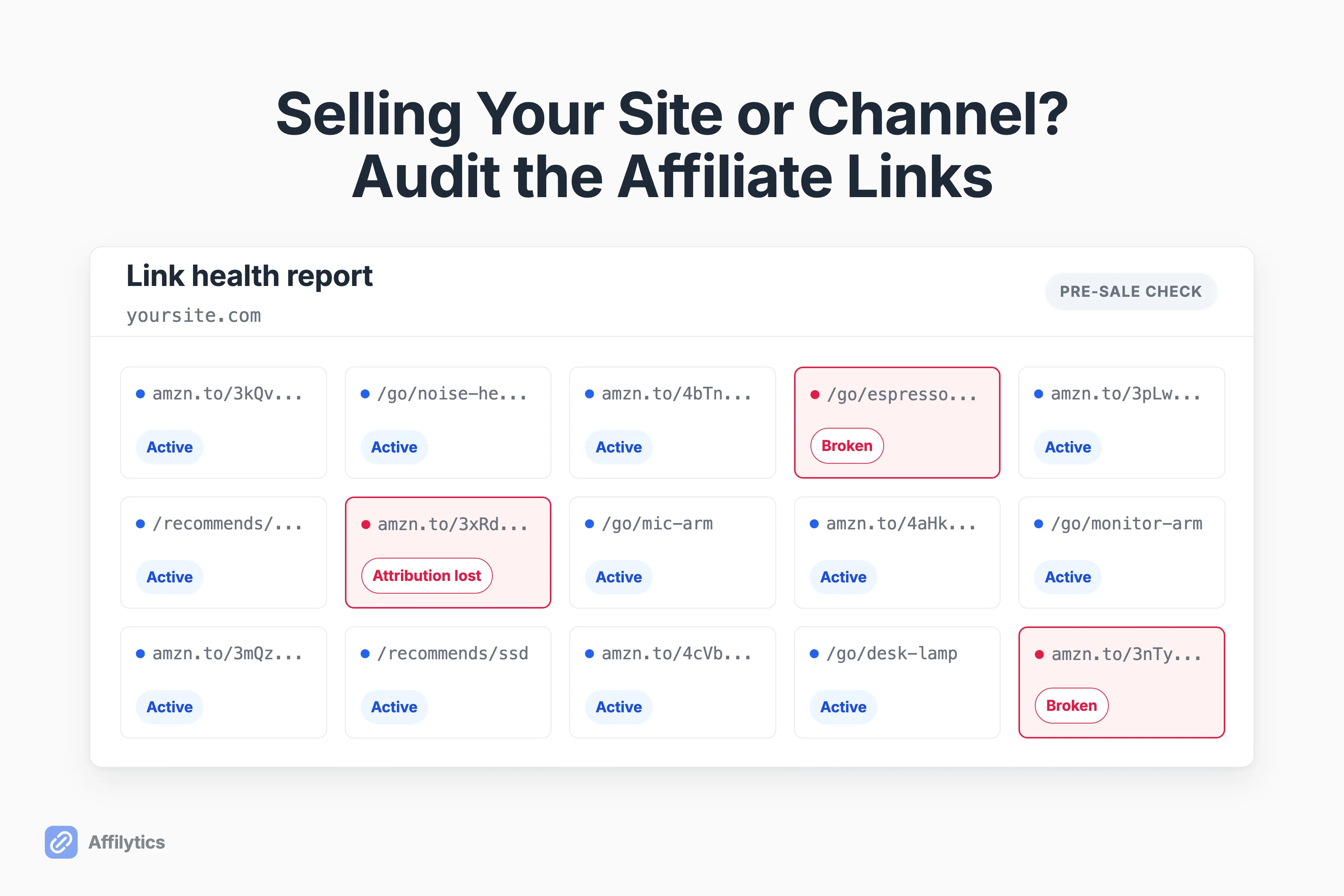
A pre-sale affiliate link audit is the cheapest work you will ever do on a site or channel you are about to sell, because the person buying it is going to click your links whether you checked them or not. They will start with the ones on your best-earning page.
We built the tool that routes a creator’s affiliate links to the right regional storefront for every visitor and watches whether each link already published on a site or channel still works, so the failure modes below are the ones we deal with every day.
None of this is dramatic while it happens. Links quietly rot in old content, the clicks keep arriving, and nothing tells you the money stopped.
This guide covers what a buyer actually inspects, why a dead link costs you more at sale than it does in a normal month, the audit to run before you list, and how to keep the asset clean while the deal is still open.
What buyers actually check in due diligence (and what they skip)
Section titled “What buyers actually check in due diligence (and what they skip)”Ask the people who buy content sites what they validate and you get a short list, over and over. Mushfiq Sarker, who does website due diligence for a living, writes it out as four items: traffic sources, backlinks, revenues, and site or domain history. That is one person’s framing rather than an industry standard, but every checklist I read while writing this landed in the same neighborhood.
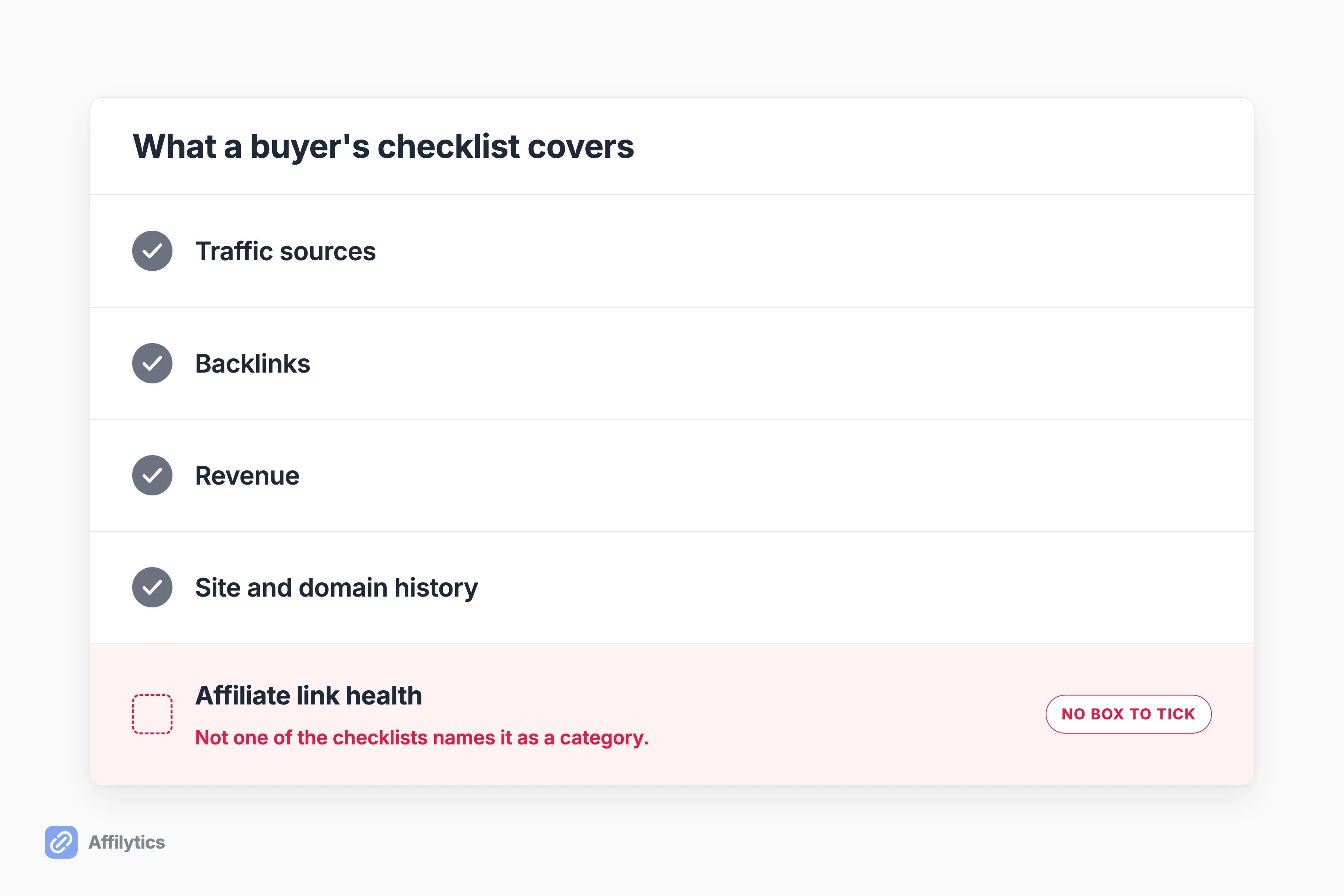
Those four are on the list for good reasons:
- Traffic can be bought
- Backlinks can be rented
- Revenue can be screenshotted
- A domain can have a history its current owner would rather not discuss
Each one is a check on whether the story you are telling about the asset is true.
So what happens to the one thing nobody put on the list?
Not one of the checklists I read treats affiliate link health as its own category. Not the broker guides, not the marketplace guides, not the practitioner threads or the replies under them. Your links are the machinery that produces the revenue line every buyer scrutinizes, and as a category they get inspected zero times.
Empire Flippers gets closest. Its due diligence guide tells buyers to walk the site’s flow and click the ad and affiliate links to confirm they land where they should, then draws the conclusion that matters: “If the site is ‘broken,’ then the chance that the data is being accurately represented is low.” That is a marketplace telling buyers, in writing, that broken links are grounds to distrust the earnings report.
Why a dead affiliate link costs more when you’re selling
Section titled “Why a dead affiliate link costs more when you’re selling”Here is the arithmetic that makes this worth an afternoon. A content site does not sell for what it earned last month, it sells for a multiple of what it earns per month. Flippa’s own valuation guide puts affiliate sites at 30x to 45x monthly net profit on mainstream marketplaces, with a 3x to 6x multiple on seller’s discretionary earnings for smaller sites. Those are Flippa’s published ranges, not a law of nature, but the shape holds wherever you list.
Run that backwards. A link that quietly stopped earning is not a one-month problem when you are selling. It is that leak multiplied by whatever number your buyer applies to it.
So should you rush to fix everything the week before you list?
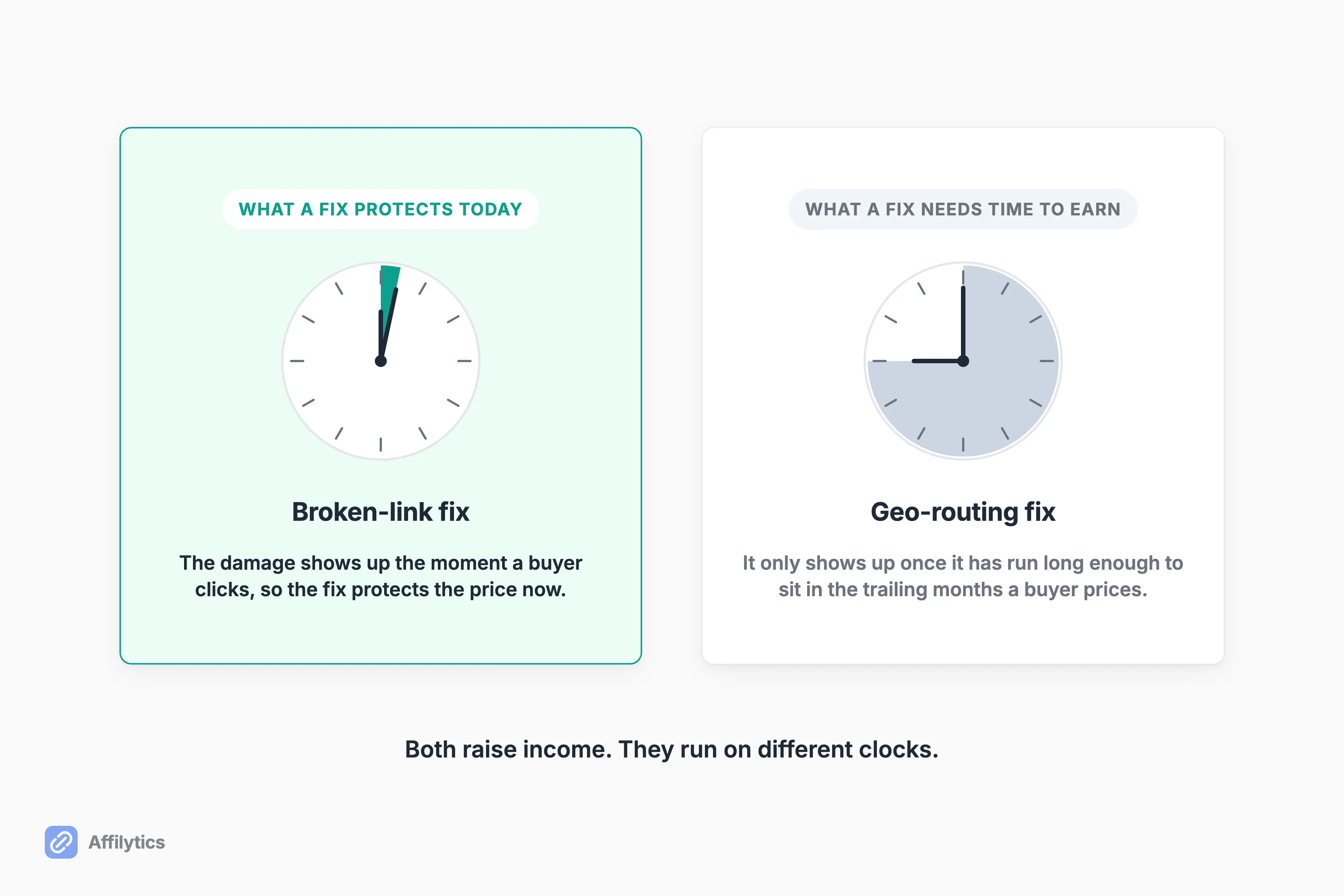
Two different clocks, and the honest answer depends on which one you are on. A broken-link fix protects the price immediately, because the damage shows up the moment a buyer clicks. A geo-routing fix pays only if it has been running long enough to appear in the trailing months a buyer actually prices.
That second one is worth starting early precisely because it is slow. Most creators have a 30% to 50% international audience without realizing it, and an Associates tag only earns commission on the Amazon site it was issued for. A reader in London clicking your amazon.com link lands on the wrong storefront and either buys nothing or buys and credits nobody. Those are international clicks that never earned you anything, and they have been sitting in your traffic the whole time.
Geo-routing closes that gap: one link that sends each visitor to their own country’s storefront. Building those links and swapping them into your content is manual work you do yourself, link by link, which is exactly why it belongs at the start of a sale process rather than in the last week of one.
The pre-sale affiliate link audit: your checklist before listing
Section titled “The pre-sale affiliate link audit: your checklist before listing”The pre-sale affiliate link audit is narrow on purpose. You are not re-auditing your content, your backlinks, or your financials. You are checking one thing: whether the links that produce your revenue still do the job.
| What to check | What the failure looks like |
|---|---|
| Every link resolves and reaches a live product page | A dead page, or a quiet redirect to a generic category page that earns nothing |
| The affiliate tag survives every hop of the redirect | The link works fine, the tag got stripped on the way, and the sale credits nobody |
| Cloaked redirects still redirect | ThirstyAffiliates and Pretty Links redirects can break after a plugin update with no visible error on the page |
| The product still exists and is in stock | The page loads, so nothing looks wrong, but there is no buy button on it |
| The program is still running | The merchant left the network months ago and the link has been decorative since |
| The tag is the one you meant to use | An old tracking ID, or a tag belonging to another site you own |
How do you actually run this across a couple of hundred posts or a few hundred video descriptions?
You start with a list. You cannot audit what you have never written down, so build a full inventory of every affiliate link you have published first. If you are selling a channel, the surface is video descriptions, so check every link across a whole channel at once rather than opening a tab for every one of them.
This is where an automated scan beats a manual click-through. Paste a channel URL or a site URL and Affilytics finds the affiliate links already published there, including the cloaked redirect paths WordPress link plugins use, then keeps checking each one. One honest limit: the crawler reads static HTML, so a blog that builds its pages with JavaScript gets flagged rather than read.
The buyer’s version of this list already exists, written from the other side of the table. Walking live listings on r/juststart, u/msar123 logged unlinked product images and untracked plain buttons as easy wins for the next owner: “Product images in Comparison Tables are not linked to Amazon. This easy fix will lead to increased revenue.” Read that as the seller. Every easy win a buyer spots is income you were not collecting, and it gets priced into the offer.
The same poster wrote up his own pre-listing prep, and it stops short in an instructive way. Get the analytics and affiliate tags straight before listing, he tells sellers, because “These are easy fixes that will ensure quick due diligence by the buyer. It also ensures trust in your deal from the buyer’s perspective.” He is right. He just stops at how the tags are set up and never reaches whether the links still work.
A broken link and a faked number look identical from outside
Section titled “A broken link and a faked number look identical from outside”From the buyer’s chair, a hygiene failure and a fabricated number produce the same signal: earnings that do not line up with the traffic. The buyer cannot tell which one they are looking at. You can, but only if you checked first.
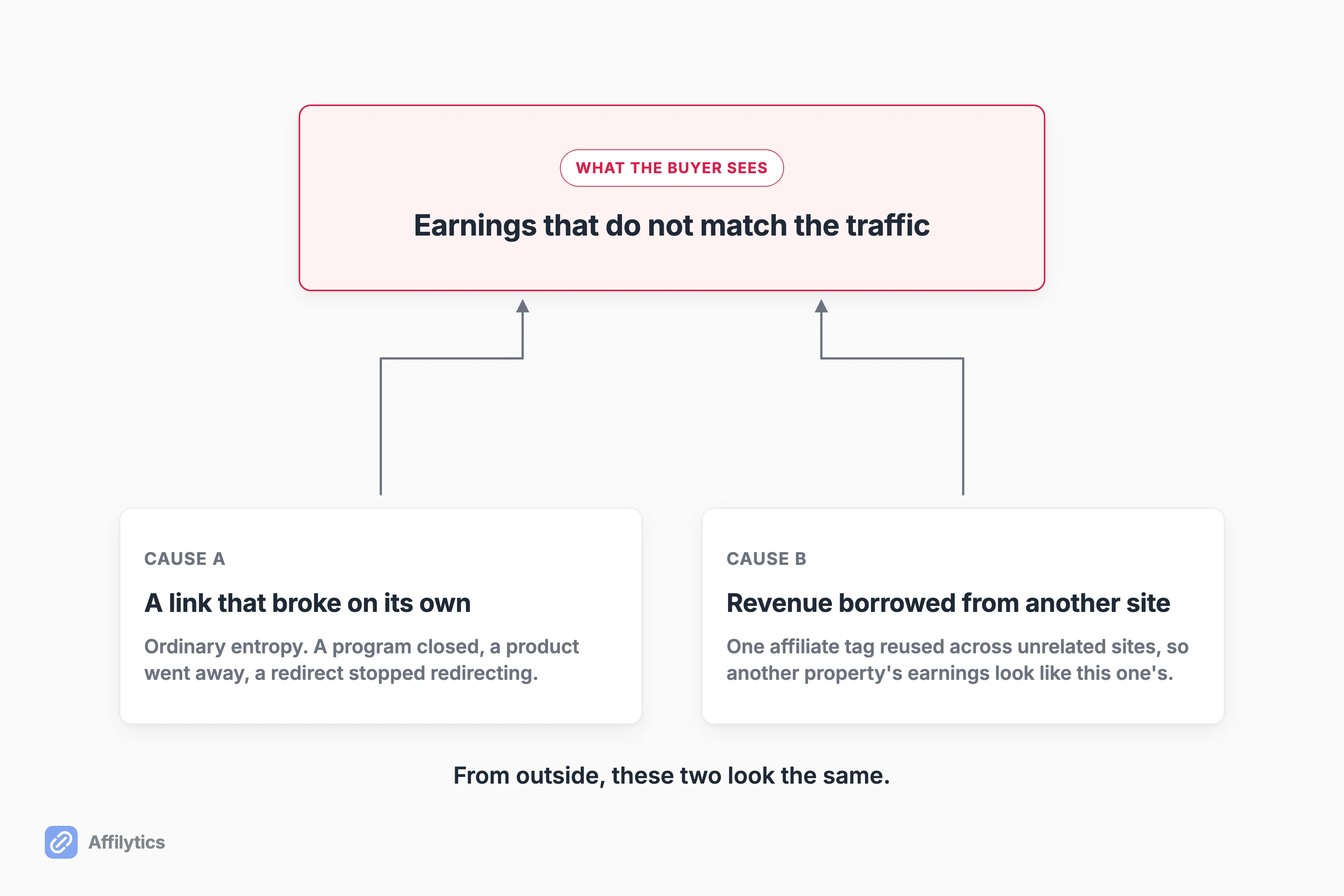
Three very different things sit behind that one flag:
- A link that broke on its own
- Revenue borrowed from another site through a shared tag
- A false alarm from a checker that cannot read the page
Buyers hunt for the second cause specifically. Empire Flippers files cross-site affiliate ID reuse under making sure earnings actually came from the site being sold, and tells buyers to watch out for multiple websites running the same code. Mushfiq Sarker, whose four-item list opened this post, describes the same pattern inside a deal he worked, where the seller had used the same affiliate ID across multiple unrelated sites so a stronger property’s earnings appeared to belong to the one on the market. That deal collapsed on the spot. One deal and one account, but a marketplace has the same pattern on its own watch list. Empire Flippers also lists fake-lead inflation, earnings spiking with no matching spike in traffic, as something its buyers are taught to spot.
Most sellers whose numbers look odd are not lying. A tracking tag from a site you sold two years ago is still sitting in an old post. A program shut down and the link kept collecting clicks. That is ordinary entropy, and it is exactly why the suspicion stings: you can end up looking like the other thing without having done anything wrong.
So why not run a free link checker and hand the buyer the output?
Because a crude checker will hand you a false alarm, and a false alarm you cannot explain is worse than silence. Big retailers run a bot-blocking layer in front of their site that refuses any request that does not look like a real browser, and a naive checker reads that refusal as a dead link. Now you are the seller with a list of broken links and no explanation for any of them. A checker that cannot tell a blocked page from a dead one makes your position worse, not better.
That is why our checks go out through a stealth HTTP client with TLS fingerprinting, which is a long way of saying the request looks like a real browser to the server it hits. When a retailer refuses it anyway, the link comes back marked blocked, not broken.
Keeping the asset clean through the due diligence window
Section titled “Keeping the asset clean through the due diligence window”A sale is not a day. It is a window, and the asset has to hold up for the whole thing.
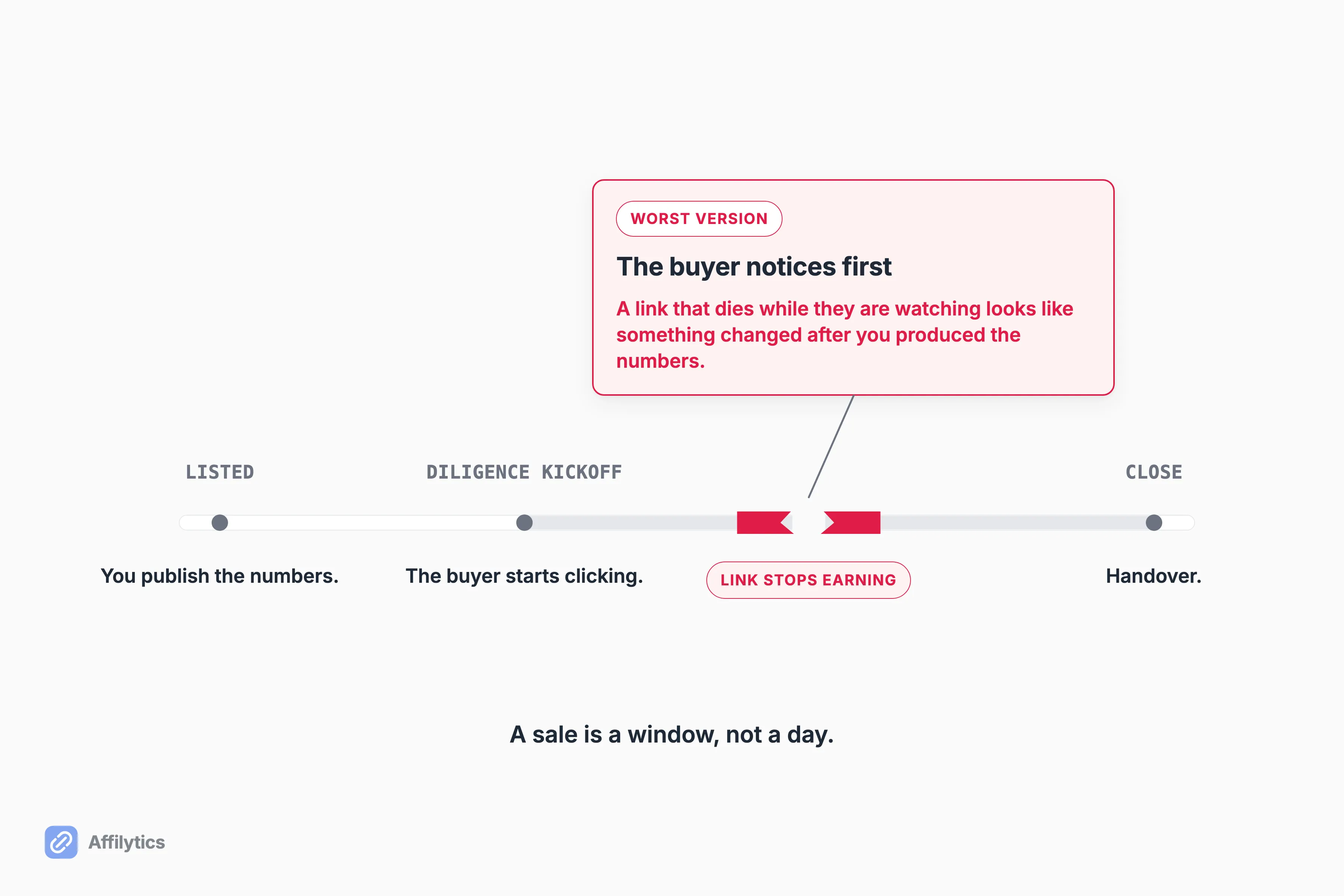
Empire Flippers says its own pre-listing vetting takes one to three weeks of investigating the business and talking to the seller, and that is before a buyer starts their independent diligence. One seller published the full timeline of a content-site sale that ran 108 days from first contact to close, with a distinct due diligence kickoff call about a month in. That is one deal, not a benchmark. It is still a long stretch for nothing to break.
What happens if a link dies in week six?
Worse things than if it had been dead in week one. A link that was already broken when the buyer arrived is a fact about the asset, and you can explain it in a sentence. A link that breaks while the buyer is watching looks like something changed after you produced the numbers, and that is a much harder conversation, especially when the buyer noticed first.
So the one-time audit turns into continuous link monitoring for the length of the deal: checks on a schedule, alerts that fire when a check detects the change rather than in a weekly digest, and a confirmation gate that wants several consecutive bad checks before it flags anything, so a merchant having a rough hour does not send you an alarm you then have to walk back.
Three things worth watching for the whole window:
- The links on the pages and videos that produce most of the revenue
- Anything you fixed during the pre-listing audit, because a fix that quietly reverts is the worst-looking failure of all
- Any new content you publish while the deal is open, which is the easiest place to introduce a dead link nobody is looking at
Buying instead of selling? The link check no checklist includes
Section titled “Buying instead of selling? The link check no checklist includes”If you are on the other side of this table, the same gap is your advantage. Nobody’s checklist tells you to inspect the link layer, so almost nobody does, and it is close to the cheapest verification available to you.
- Click the money links yourself, on the pages or videos producing most of the revenue. Not a screenshot of them working. Actually click them.
- Ask for product-level affiliate data instead of dashboard totals. Sarker puts it flatly: always request product-level affiliate data, because screenshots alone will not catch cross-site revenue inflation.
- Check that the affiliate tag on the site matches the account the earnings reports came from.
Is any of this worth your time when the rest of the deal looks clean?
The downside of skipping a check is real on your side too. The same practitioner describes a buyer who skipped hiring anyone for diligence on an SBA-financed content portfolio, then watched earnings fall under $10K a month while the bank pushed to liquidate the assets. That is one buyer and one account, and the diligence he skipped was the broad kind rather than a link check. The lesson still travels: the check you skip is the one that turns out to have mattered.
One thing worth saying because it costs me nothing. A broken link you find during diligence is usually something you negotiate on, not a reason to walk away. Links are among the cheapest things on a content site to fix, and a seller who did not know is far more common than a seller who hid it. Price it in, fix it in your first week, and get on with owning the thing.
Run the buyer’s check first
Section titled “Run the buyer’s check first”You get two full weeks of everything unlocked with no credit card, which is more time than you need to scan a channel or a site and see every link that quietly stopped doing its job.
Create your free account, paste the URL, and read your own link report before someone with an incentive to discount your asset writes their version of it.
How long before selling should I audit my affiliate links?
Section titled “How long before selling should I audit my affiliate links?”Anything that changes what you earn needs a head start, because a buyer prices the trailing months rather than the fix you made last week. Geo-routing is the clearest case: it only reaches the numbers after it has run for a while. The link-health pass is different. It protects the price rather than raising it, so it is worth running the week before you list and again while the deal is open.
Will a buyer really check every affiliate link?
Section titled “Will a buyer really check every affiliate link?”Not every one by hand on a large site. They will click the money links on the pages or videos that produce most of the revenue, and marketplace guidance tells them to treat a broken flow as a reason to doubt the whole earnings report. Empire Flippers says it plainly in its own due diligence guide: if the site is broken, the chance the data is being accurately represented is low.
Do broken affiliate links actually lower the sale price?
Section titled “Do broken affiliate links actually lower the sale price?”In two ways. They suppress the monthly income the multiple gets applied to, and they give the buyer a reason to question every other number in the report. The second effect is usually the more expensive one, because a discount on trust applies to the entire deal rather than only to the pages with dead links.
What if my links are broken because the merchant blocks bots, not because they are dead?
Section titled “What if my links are broken because the merchant blocks bots, not because they are dead?”That is a real and common false alarm. Big retailers run a bot-blocking layer in front of their site that refuses anything not shaped like a real browser, and a crude checker reads that refusal as a dead link. A proper check separates a blocked page from a dead one before anyone reports a number to a buyer.