
Amazon Affiliate Commission Rates by Country in 2026
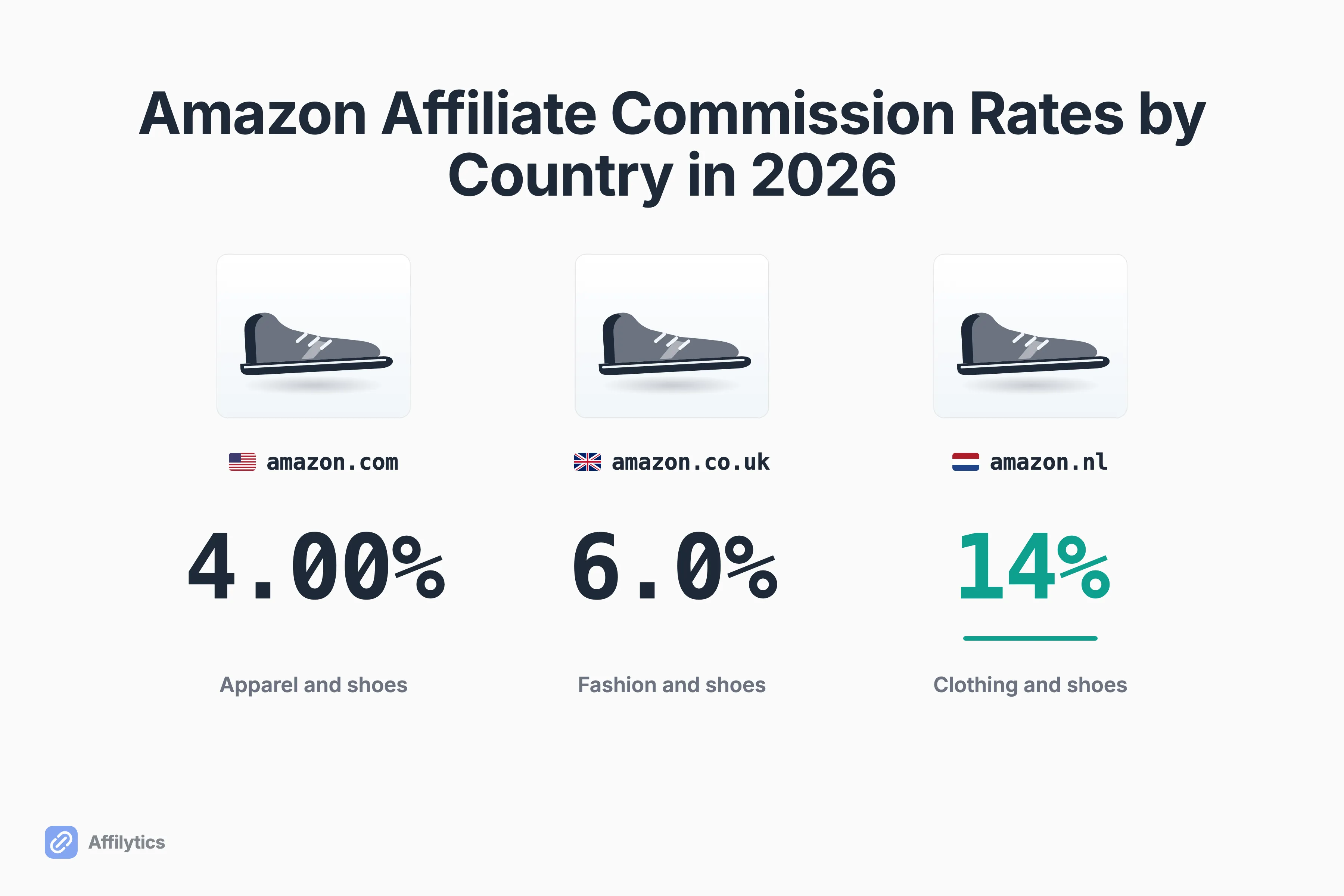
The same pair of running shoes pays you 4% if your reader buys on amazon.com, 6% on amazon.co.uk, and 14% on amazon.nl. Nothing about your link tells you which storefront just took the sale.
Amazon affiliate commission rates are set per marketplace, and we read those cards constantly because we build Affilytics, which sends a reader to their own country’s Amazon store instead of whichever one you happened to link.
Before you decide whether any of that matters to you, it helps to know what your international clicks are actually worth.
Below is the current US table, the same table for eleven other Amazon marketplaces, the caps and exclusions that quietly change what you actually get paid, and what you can do about the spread.
Amazon Affiliate Commission Rates in the US (2026)
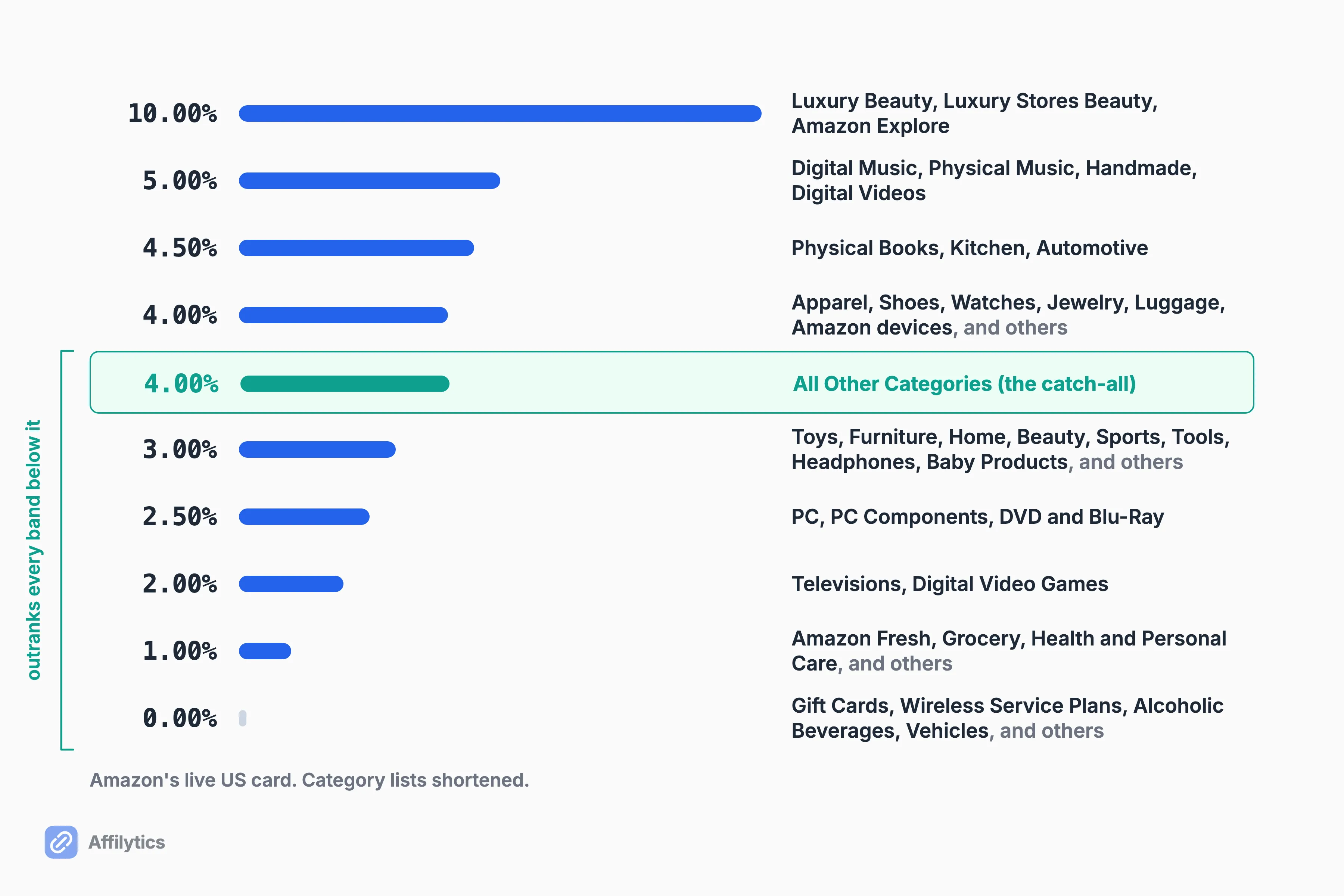
Section titled “Amazon Affiliate Commission Rates in the US (2026)”Here is Amazon’s current US card, top band down to zero. Every row comes from the US standard commission rate table on Amazon’s own site.
| Commission rate | US categories |
|---|---|
| 10.00% | Luxury Beauty, Luxury Stores Beauty, Amazon Explore |
| 5.00% | Digital Music, Physical Music, Handmade, Digital Videos |
| 4.50% | Physical Books, Kitchen, Automotive |
| 4.00% | Apparel, Shoes, Watches, Jewelry, Luggage, Handbags & Accessories, Amazon Fashion private label, Amazon devices (Fire Tablet, Kindle, Fire TV, Echo, Ring) |
| 4.00% | All Other Categories (the catch-all) |
| 3.00% | Toys, Furniture, Home, Home Improvement, Lawn & Garden, Pets Products, Headphones, Beauty, Musical Instruments, Business & Industrial Supplies, Outdoors, Tools, Sports, Baby Products |
| 2.50% | PC, PC Components, DVD & Blu-Ray |
| 2.00% | Televisions, Digital Video Games |
| 1.00% | Amazon Fresh, Grocery, Health & Personal Care, Physical Video Games & Consoles |
| 0.00% | Gift Cards, Wireless Service Plans, Alcoholic Beverages, Kindle subscription products, Vehicles, Pet Prescription Medications, restaurant food delivery, Amazon Appstore, Prime Now, Amazon Pay Places |
Look at where the catch-all sits. All Other Categories pays 4.00%, which is more than toys, furniture, home, beauty, sports, tools, headphones, computers and televisions. Most people assume the default is the floor, and it is not. It is also the same number Walmart publishes as its ceiling, which is worth knowing if you run both: how Walmart’s 4% ceiling compares.
So what does that mean for you?
If Amazon has never named your product’s category, you are probably in better shape than the creator reviewing televisions at 2.00%.
One more thing worth noticing: this is a live help page, not a schedule with a version number. It changes when Amazon decides it changes. Amazon does at least publish one, which is more than some rivals manage: Target publishes no per-category schedule a creator can read, so compare against its published EPC rather than a rate table.
The Rates Are Different in Every Marketplace We Checked
Section titled “The Rates Are Different in Every Marketplace We Checked”Here is the part no other rates guide shows you. Same six categories a creator actually promotes, twelve Amazon marketplaces, one table.
| Category | US | UK | DE | IT | ES | NL | CA | AU | JP | IN | MX | BR |
|---|---|---|---|---|---|---|---|---|---|---|---|---|
| Clothing and shoes | 4.00% | 6.0% | 6.0% | 6.0% | 6.0% | 14% | 6.00% | 10.00% | 8.00% | 10% | 10.00% | 11% / 7% |
| Books | 4.50% | 5.0% | 5.0% | 5.0% | 5.0% | 10% | 4.00% | 8.00% | 3.00% | 5.9% | 10.00% | 10% |
| Home and kitchen | 3.00% / 4.50% | 5.0% | 5.0% | 5.0% | 5.0% | 10% | 6.00% / 4.00% | 10.00% | 3.00% | 5% | 8.00% | 8% |
| Beauty | 3.00% | 4.0% | 4.0% | 4.0% | 4.0% | 10% | 6.00% | 8.00% | 5.00% | 10% | 10.00% | 13% |
| Consumer electronics | 2.00–2.50% | 2.5% / 3.0% | 2.5% / 3.0% | 2.5% / 3.0% | 2.5% / 3.0% | 6% | 1.00–5.00% | 2.00–5.00% | 2.00% | 3.5% | 5.00–7.00% | 8% |
| All other categories | 4.00% | 3.0% | 3.0% | 3.0% | 3.0% | 6% | 2.00% | 2.00% | 2.00% | 5% | 8.00% | 7% |
A few notes so the cells are not misleading. Brazil splits clothing (11%) from shoes (7%), so that cell carries both. The US and Canada put home and kitchen in different bands, home first and kitchen second. Consumer electronics is the messiest row of all, because most cards break computers, televisions and mobile electronics apart, so those cells show the lowest and highest band that applies. On the UK, German, Italian and Spanish card, Amazon names only mobile electronics, large appliances and Fire TV devices (2.5%); it doesn’t name computers or televisions at all, so they fall to the 3.0% catch-all. India excludes mobile handsets from this row; they get their own treatment further down.
Scope, stated plainly: we verified twelve marketplaces against Amazon’s own program pages, and those twelve are the only ones in this post. France, Ireland, Sweden, Poland and Belgium are named on the UK rate card as sibling tables under the same European appendix, but we did not check them, so no numbers for them appear anywhere here. Every other Amazon marketplace is out of scope entirely.
The catch-all row is the cleanest way to see the spread. It runs from a 2.00% catch-all in Canada, Australia and Japan up to 8.00% in Mexico, with the US at 4.00% and the UK, Germany, Italy and Spain sharing 3.00%. Australia sits at the other end of its own card, paying 10.00% on clothing, home and kitchen while its catch-all stays at 2.00%. If Britain is the marketplace you care about most, we cover UK commission rates in detail, including where that card’s 6.0% top band actually applies and why Amazon’s own pages advertise higher numbers.
Which of these columns actually applies to you?
The one for the store where your reader completes the purchase, not the one you happened to link and not the one you signed up for. That distinction is the entire reason this table is worth reading.
Amazon publishes six of these cards (Germany, Italy, Spain, Japan, Mexico and Brazil) in their own language. We read them there and translated the category names, which is why a label like “home” may map to a slightly different bundle of products than the US card uses.
Worth pairing this with which countries have an Amazon Associates program, because a rate you cannot sign up for is not income. Amazon Influencers earn against these same category rates, so if that is the route you are taking, start with what it takes to qualify as an Amazon Influencer.
Why the Same Product Pays a Different Rate Abroad
Section titled “Why the Same Product Pays a Different Rate Abroad”There is no global Amazon commission rate. Each marketplace publishes its own standard commission card, and Amazon sets each one independently of the others.
That makes patterns tempting. The UK, Germany, Italy and Spain cards are identical, band for band, right down to the 3.0% catch-all, which makes “Europe pays like the UK” feel like a safe shortcut.
Then you open the Dutch card. Amazon Netherlands pays 14% on clothing and shoes against the bloc’s 6.0%, 10% on books against 5.0%, and a 6% catch-all against 3.0%. Roughly double, on the same continent, one country over.
The Netherlands is not the only card that refuses to behave. Canada pays 9.00% on pet food and supplies while its catch-all sits at 2.00%, tied for the lowest of the twelve, so a Canadian pet blogger and a Canadian generalist are effectively running different businesses on the same program.
None of it follows a formula you can guess at from your home card. Some marketplaces run high bands nearly everywhere, some pay well in one aisle and almost nothing in the next, and Amazon does not publish a rule that connects them.
Experienced affiliates get caught by this too. @roi_hacks posted on X, genuinely startled, after finding a Canadian rate several times what the same aisle pays at home, and asking whether it was fake. That reaction is the normal one.
So what happens when a Dutch reader clicks your amazon.com link?
They land on the US store, where your 4.00% apparel rate applies to a purchase they may never complete, because the product ships from the wrong country at the wrong price in the wrong language.
That is the quiet version of the problem. Nobody sends you an alert when a foreign click bounces; the sale simply never appears. It is the same mechanic behind earning commission on cross-border Amazon sales, just seen from the rates side instead of the tracking side.
The Fine Print That Changes What You Actually Earn
Section titled “The Fine Print That Changes What You Actually Earn”A percentage is not a promise. Every card carries caps and exclusions that decide what actually lands in your account, and they differ by marketplace. If you want to see what the rates add up to once those deductions are applied, we worked through how much Amazon affiliates actually make in a separate post.
Here are the ones most likely to bite a working creator:
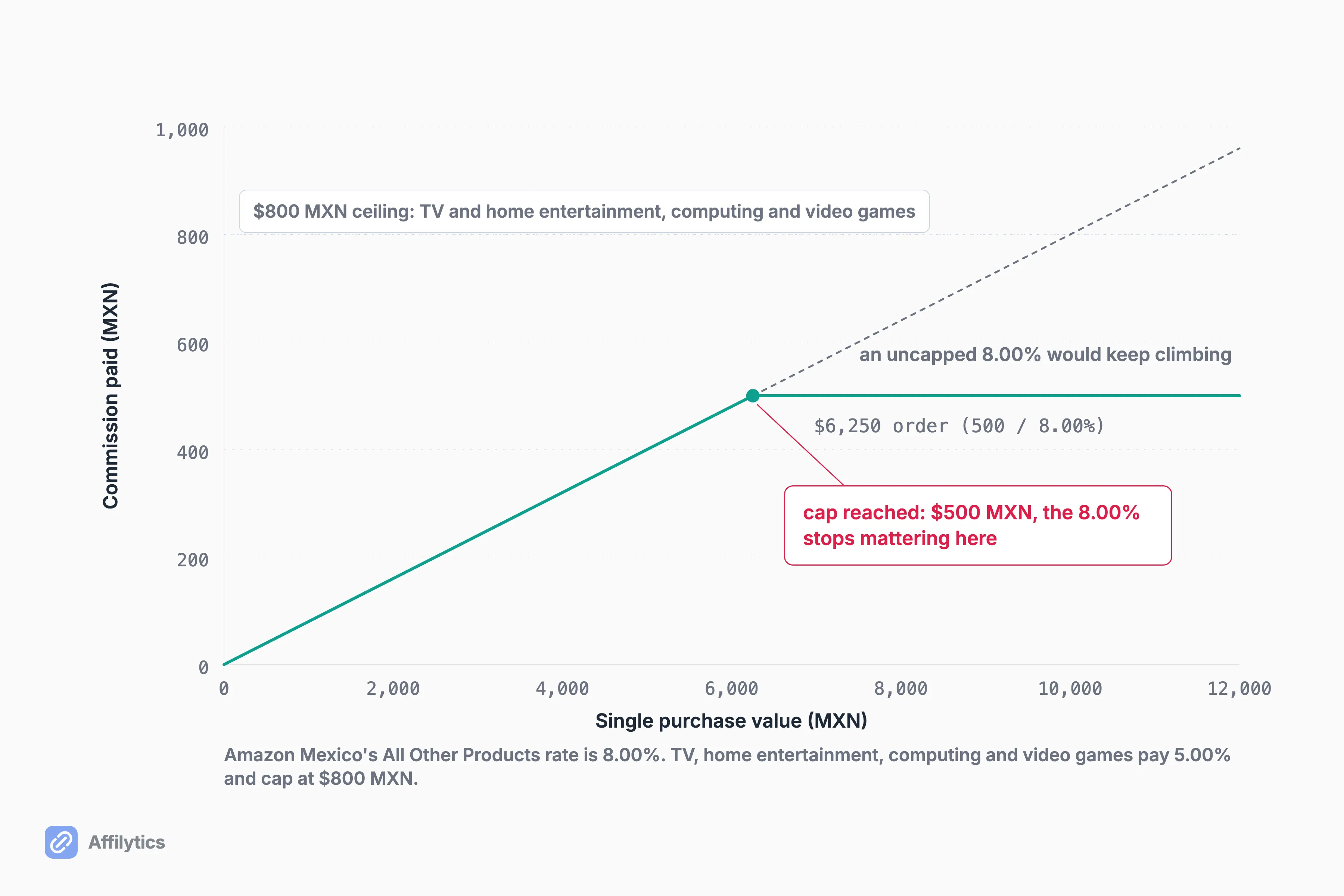
- Mexico caps every single purchase. Amazon Mexico caps the commission on a single purchase at $800 MXN for TV and home entertainment plus computing and video games, and $500 MXN for everything else, no matter what the percentage says. On a big-ticket sale, the headline 8.00% stops meaning anything past a certain order value.
- India excludes phones by model name. The card lists mobile phones at 1%, then zero-rates a long list of named handset models, every iPhone among them, with a further named list paying 0.5%. Apple products more broadly (MacBooks, Apple Watch, iPads, PC accessories) also pay 0%.
- The US caps fine art. Fine Art commission tops out at $200 per product regardless of what the piece sold for.
- Zero-rate categories are everywhere. Gift cards pay nothing on nearly every card. In the US, so do alcoholic beverages and wireless service plans. In Australia, health and personal care pays 0.00%.
- The same aisle can pay nothing in one country and well in another. Canada zero-rates grocery and gourmet food entirely. The US pays 1.00% on grocery. The Netherlands folds groceries into its 10% band. Same shopping basket, three completely different outcomes.
Does that mean a category can pay you literally nothing on a real sale you drove?
Yes. Not “a low rate”, not “a reduced rate”. Zero.
The lesson is not to memorize the exclusions. It is that a headline percentage is the start of the calculation, never the end of it, and the exceptions live on the same page as the table almost nobody scrolls past.
There is one tell in the India card that says a lot about all twelve. The India card dates its table headers by month, which is Amazon quietly admitting these are versioned documents rather than fixed schedules.
Which Category Is My Product Actually In?
Section titled “Which Category Is My Product Actually In?”This is where the tables stop being enough. Amazon publishes rates per category, decides the classification, and the card does not list every product that exists.
Here is a real creator hitting exactly that wall on r/Affiliatemarketing:
“I’ve read that grocery categories often have really low commission rates (sometimes around 1%). Has anyone here actually earned affiliate income from Whole Foods grocery orders?”
The thread drew six replies and never produced an answer. Not because the community was unhelpful, but because nobody could self-serve it.
What can we actually say? The US card lists Grocery at 1.00% and Amazon Fresh at 1.00%, and a Whole Foods grocery order most plausibly maps to one of those two rows. That is our inference from Amazon’s published category list. It is not something Amazon confirms for Whole Foods specifically, and we are not going to pretend otherwise.
Two things make this lookup harder than it looks. A single order can straddle bands, so a cart holding a book, a toy and a jar of face cream is three different rows on the US card and no single percentage describes it. And Amazon publishes the category names in that country’s language on six of the cards we read, which makes “which row am I in” a translation problem before it is a rates problem.
So how do you get a real answer for your own products?
Your earnings report. It shows the category Amazon actually assigned after the sale closed, which is the only place the classification is a fact rather than a guess.
The practical habit takes about ten minutes, once:
- Open your earnings report and find your three or four highest-volume products.
- Write down the category Amazon assigned to each one, in Amazon’s own wording.
- Match those categories against the card for the marketplace the sale happened in, and stop guessing from the product page.
Amazon Has Cut These Rates Before
Section titled “Amazon Has Cut These Rates Before”None of these numbers are permanent, and there is a well-documented precedent. In 2020 Amazon cut rates broadly across whole category groups with very little notice, and creators posted the fallout in real time. It happened again in 2026 with even less notice, which is what Amazon’s 2026 commission cuts works through.
“My earnings have dropped from $35/day (on average) to $9. This is ridiculous.”
That is u/blulemming on r/juststart, posting in the days after the cut landed. The site did not change. The rate table underneath it did.
I am not printing the 2020 percentages here, because they are six years stale and several guides still repeat them as though they were current. The event is the point, not the numbers.
Here is the honest counterpoint, from u/aleqqqs in the same thread, arguing against leaving:
“But you’ll probably see conversions drop heavily, as people don’t like the hassle of registering to a new site, deciding if its trustworthy, entering payment info, etc. That’s the one big reason to stick with amazon.”
That is the trade nobody escapes. A merchant paying several times Amazon’s rate still converts worse than a store your reader already has a saved card and a saved address on, and a higher rate on a sale that never happens is worth zero.
What is striking is what creators are not arguing about. The affiliate subreddits carry years of threads about the 2020 rate cuts and almost nothing about how differently the marketplaces pay. The cut everyone remembers is loud. The spread nobody mentions is permanent.
So what do you do with a table that can move?
Treat every table in this post the way we do:
- Bookmark Amazon’s card for each marketplace you signed up for, and open the live page before you plan around a number.
- Do not hardcode a rate into a spreadsheet, a content calendar, or a video script. It will outlive the number.
- Watch category groups, not averages. The 2020 cuts landed on whole groups at once, not evenly across the card.
The mechanics are the durable part, including how long Amazon’s affiliate cookie lasts. Those change far less often than the percentages do.
What to Do About the Country Spread
Section titled “What to Do About the Country Spread”You cannot change Amazon’s rates and you cannot choose which countries your audience lives in. There is exactly one variable here you control: which storefront a click lands on.
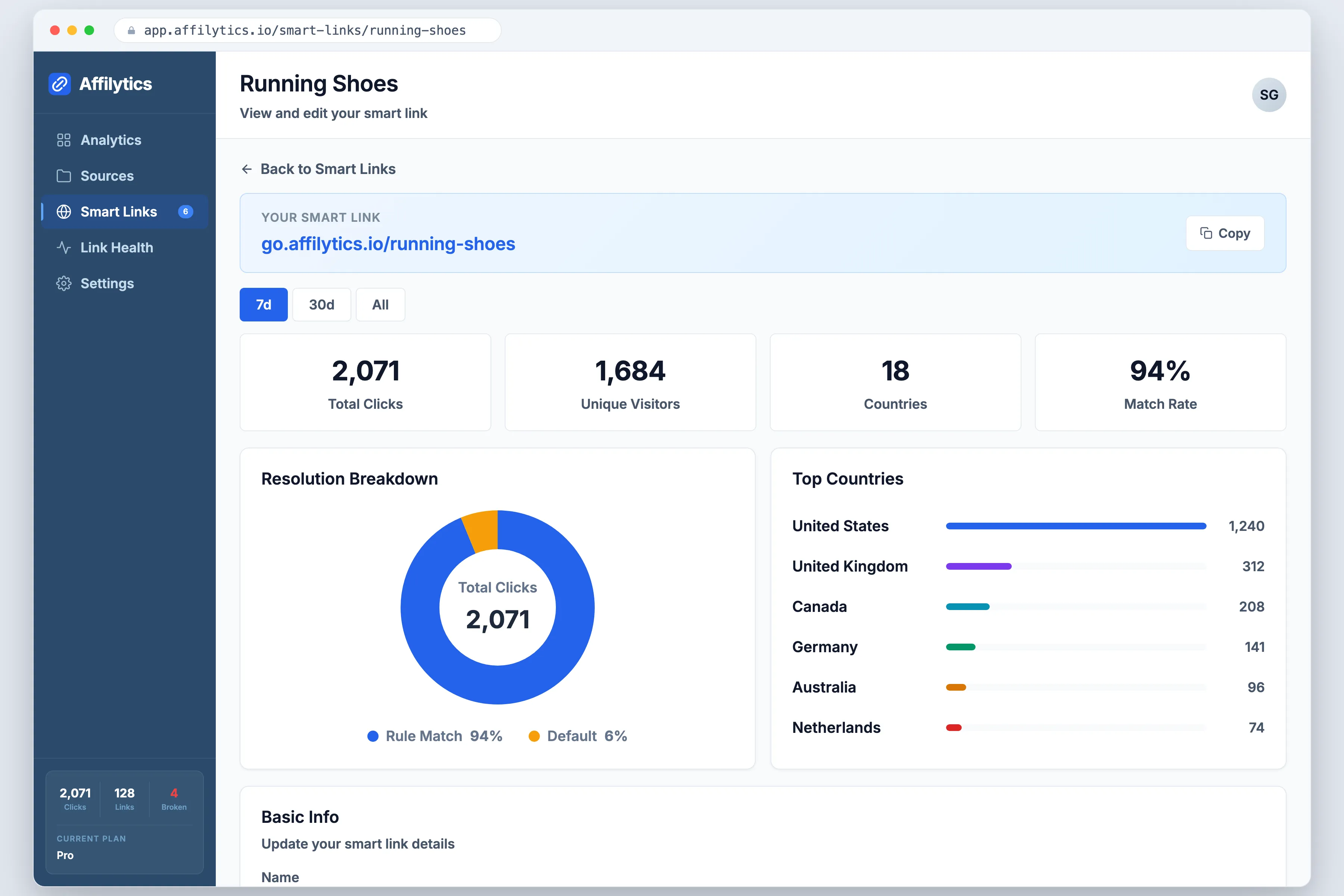
That matters more than it sounds, because the international share is rarely small. A US-based creator typically sees a meaningful minority of clicks from the UK, Canada, Australia and further afield, and every one of those hitting a plain amazon.com link is a rate you never got the chance to earn.
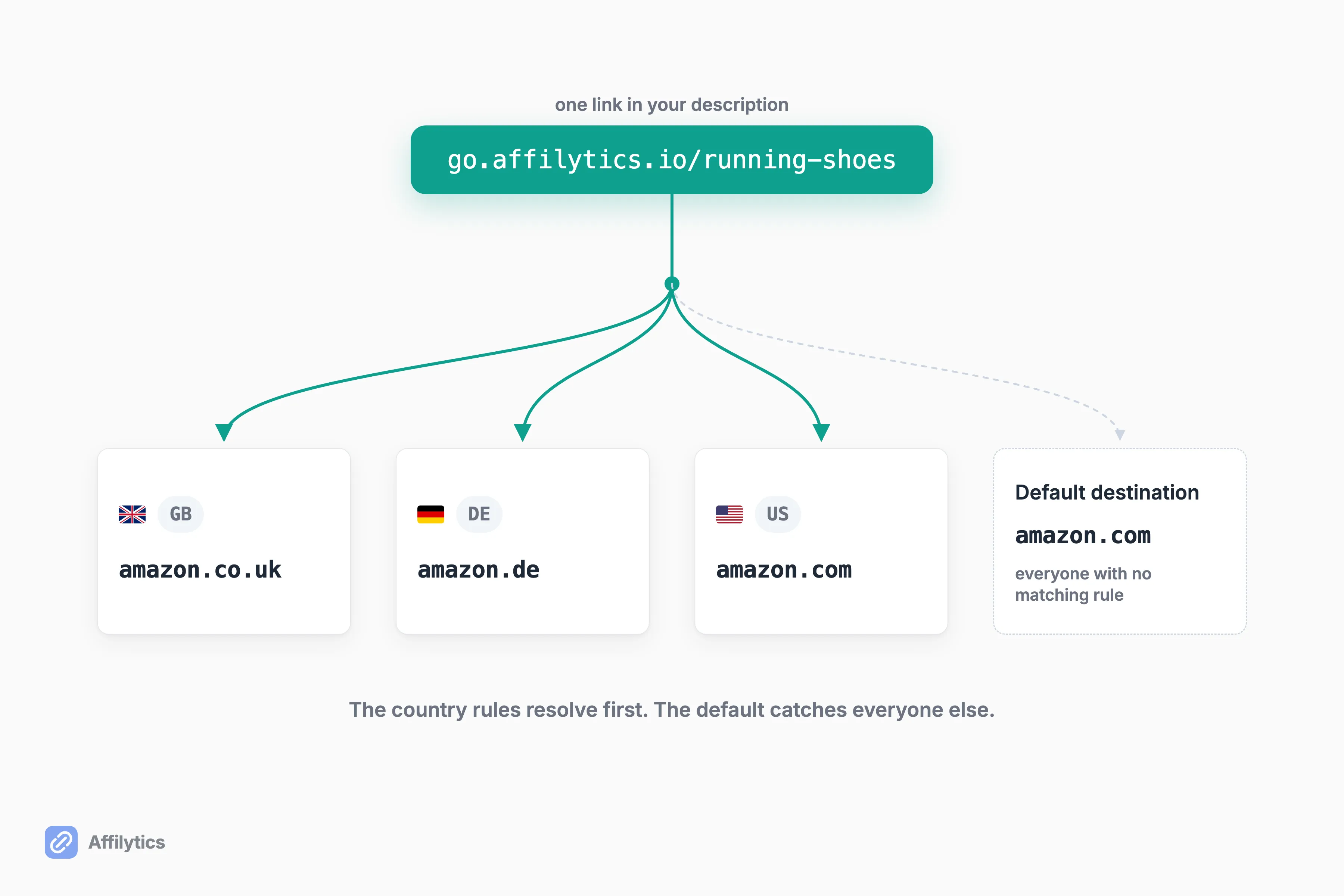
An Affilytics smart link resolves the visitor’s country from their IP and sends them to that country’s storefront, with a default destination catching everyone the rules do not cover. That is the mechanism in one sentence, and how affiliate geo-routing works walks the full redirect path if you want the detail.
It is a manual step, and that is worth saying plainly. You create the link, set the destination per country, and swap it into your descriptions or posts. Nothing rewrites the links already sitting in your back catalogue for you.
Before you change anything, though, measure. The country breakdown of every click is visible on the free plan, so you can see your own exposure first and decide whether the spread is worth acting on at all.
One ceiling you should know about up front: routing a click to amazon.de does not create a German Associates account for you. You need an account in each marketplace you want to earn from, and no tool, ours included, can conjure one. Routing is what makes those accounts worth having. And if you are weighing the two Amazon programs while you are here, the rate card is the wrong lever to pull: whether the Influencer program pays any differently has a short answer, and it is no.
So is it worth it for you?
If most of your traffic is domestic and your categories sit near the top of your home card, honestly, probably not. If a quarter of your clicks are foreign and you are sending them to a 4.00% store when their own pays 14%, that is a different conversation.
Start With Your Own Click Map
Section titled “Start With Your Own Click Map”Every Affilytics account opens with two weeks fully unlocked, no credit card, so you can see exactly where your clicks come from before you decide anything about routing.
Create your free Affilytics account, look at the country breakdown, and compare it against the table above. The gap either matters for you or it does not, and after ten minutes you will actually know which.
What is the Amazon affiliate commission rate in 2026?
Section titled “What is the Amazon affiliate commission rate in 2026?”In the US, standard rates run from 0% to 10% depending on the category, and anything Amazon has not named separately pays the 4.00% All Other Categories catch-all. There is no single global rate. Every marketplace publishes its own card, so the same product can pay something completely different on another Amazon storefront. Check the live card for your marketplace before you plan around a number.
Which Amazon marketplace pays the highest commission?
Section titled “Which Amazon marketplace pays the highest commission?”Among the twelve marketplaces we checked, the Netherlands and Brazil carry the highest headline bands: 14% on clothing and shoes in the Netherlands, and 13% on beauty, baby and health and personal care in Brazil. Highest depends entirely on the category you promote, and a high rate is worth nothing without buyers in that country.
Do Amazon commission rates differ by country?
Section titled “Do Amazon commission rates differ by country?”Yes. Every marketplace publishes its own commission card and Amazon sets them independently. The UK, Germany, Italy and Spain currently share one identical card. The Netherlands runs its own, at roughly double the bands in comparable categories.
Does Amazon pay commission on grocery or Whole Foods orders?
Section titled “Does Amazon pay commission on grocery or Whole Foods orders?”The US card lists Grocery and Amazon Fresh at 1.00%, so a grocery order most plausibly maps to that band. That mapping is an inference from Amazon’s published category list, not something Amazon confirms for Whole Foods specifically. The reliable answer is your earnings report, which shows the category Amazon actually assigned after the sale.
Can Amazon change its affiliate commission rates?
Section titled “Can Amazon change its affiliate commission rates?”Yes, and it has. Amazon cut rates broadly across category groups in 2020 with little notice, and creators documented the income drop in real time. Treat any published rate table as a snapshot of a live page rather than a fixed schedule.