
Amazon Affiliate Links on X: The Redirect You Don't See
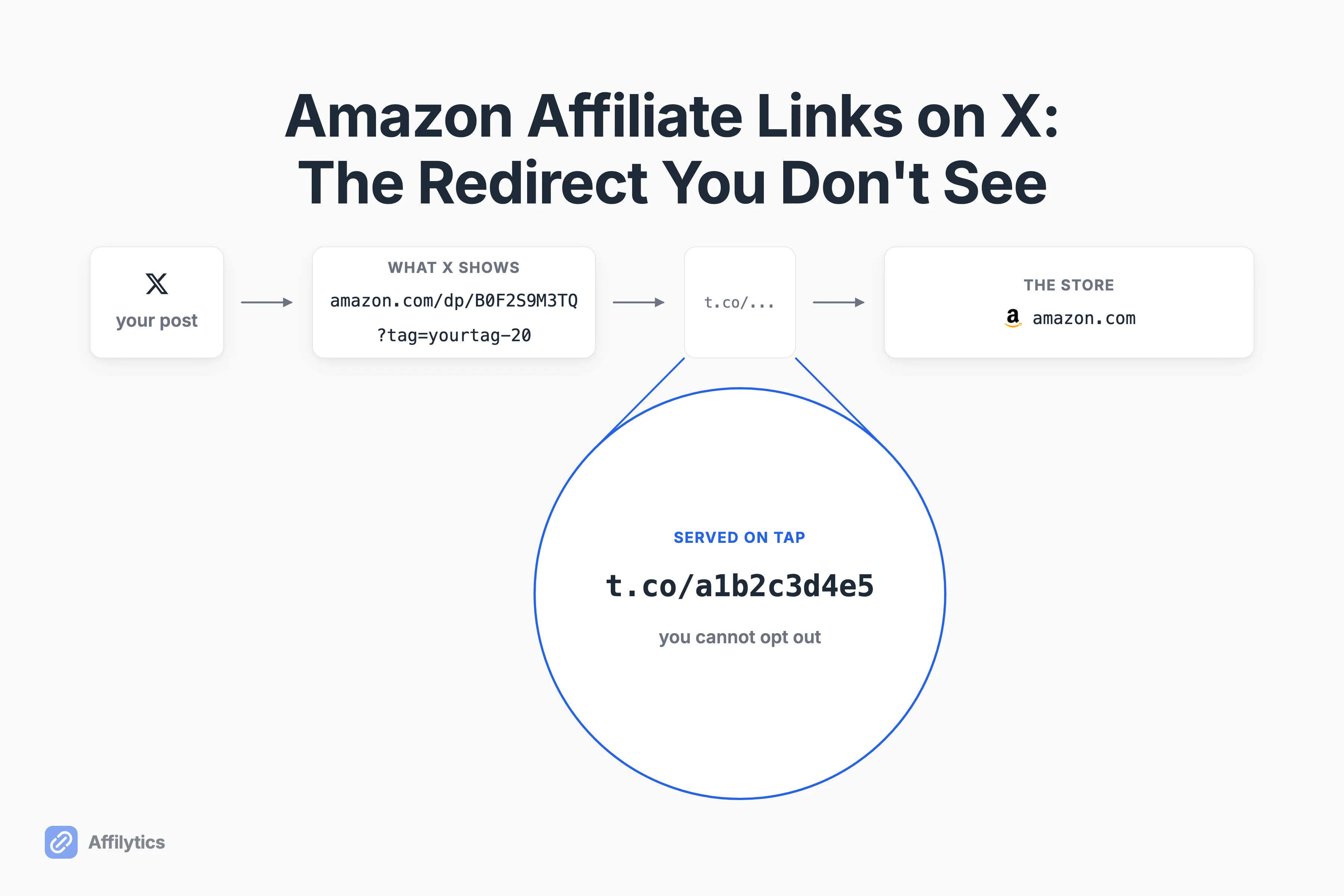
You can post Amazon affiliate links on X (formerly Twitter), and plenty of creators do. What almost nobody realizes: the link your followers tap isn’t the link you pasted, and the difference isn’t cosmetic.
We build the smart links creators put between a post and a store, so a lot of our week goes into watching what platforms do to a link on its way through.
That gap is why the X section of our roundup of what survives on each social platform always needed its own post. X documents how it happens, in public, and almost nobody reads that page.
This guide follows the whole path a tap takes on X: what the platform does to your link, why a plain amazon.com URL costs you more when your audience is global, and the setup that keeps the commission attached.
Yes, You Can Post Amazon Affiliate Links on X
Section titled “Yes, You Can Post Amazon Affiliate Links on X”Start with the permission question. It’s the one most people search first. Amazon’s Operating Agreement lists where Special Links (Amazon’s term for a link carrying your tracking ID) are allowed, and the list includes “social media user-generated content”. A post on X is that.
Two rules actually bind you here.
- Be honest about the destination. Amazon’s Program Policies say you won’t use a link shortening service, button, or hyperlink in a way that makes it “unclear that you are linking to an Amazon Site”. Wrapping a link is fine. Disguising where it goes isn’t.
- Direct messages need permission. The same page allows Special Links in direct messaging from your social accounts only when the recipient opted in. Dropping a tagged link into a stranger’s DMs isn’t covered, and on X that’s a common reflex.
Disclosure is the third obligation, and it is covered to death everywhere else, so one line here: say the link is an affiliate link, in the post itself, where someone scrolling on a phone can see it without tapping anything.
That’s most of the compliance story, and it’s roughly where every other guide on this keyword stops.
So what’s the catch?
What Happens to Your Link the Moment You Post It
Section titled “What Happens to Your Link the Moment You Post It”The catch is that you’re not the last person to touch your link. X’s own help center states that all links posted in posts are shortened using our t.co service, and that when you view the post on x.com, the original URL (or a trimmed version of it) is what gets displayed. Displayed and served are two different things.
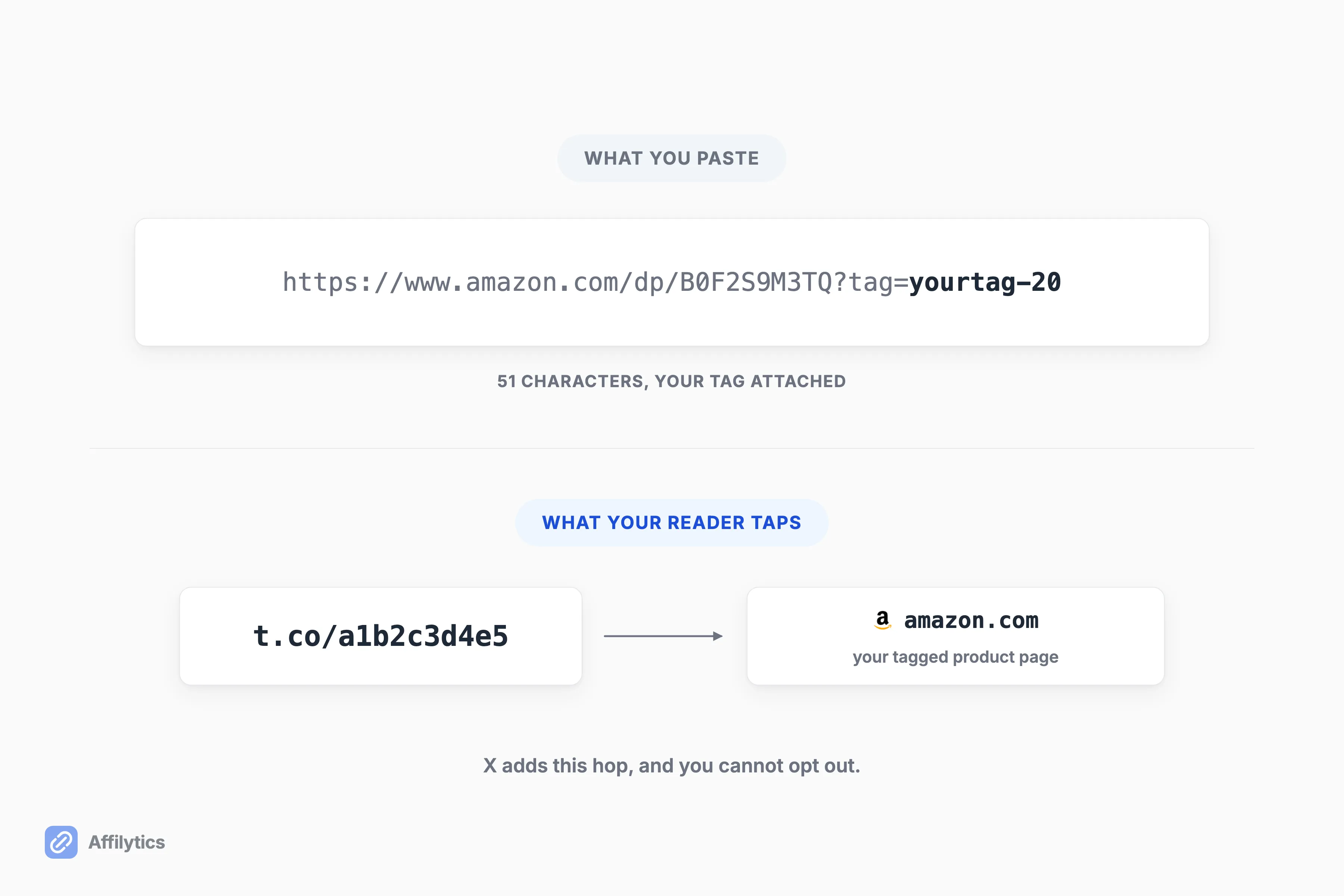
What you pasted as one link is now two: the tap lands on X’s own domain first, and X forwards it on to Amazon. You didn’t add that hop and you can’t remove it. X says so in one sentence: you cannot opt out of link shortening.
Why does X insert itself at all?
Not to hurt you. It’s worth saying why it does it: its link service measures how many times a link has been clicked, which X calls an important quality signal when it decides how relevant a post is compared to similar posts. It also checks every wrapped link against a list of potentially dangerous sites, which is genuinely useful when the alternative is a timeline full of unscreened shortener links.
There’s one line on that same page that the rest of this post depends on. X says you can continue to use a URL shortener of your own, and that tracking metrics from it will continue to work as they did previously. A hop you control still counts the tap underneath X’s hop. That’s the opening, and it’s why the choice of which shorteners keep your tracking intact matters more on X than on a platform that leaves your URL alone.
What creators report after the tap
Section titled “What creators report after the tap”Past that first hop, the ground gets soft. Creators report losing commissions somewhere after the tap, and they disagree about why.
In one r/Amazon_Influencer thread, a creator posted a ChatGPT-sourced explanation blaming the Amazon shopping app and link previews for burning the tracking cookie. Another creator in the same thread offered a different account entirely: the link opens a browser the shopper is not logged into Amazon on, so they go search the product in the app instead and the connection to your link is gone. The highest-scoring reply in that thread rejects the premise altogether and says no loss happens at all.
Which explanation is right?
Nobody in that thread is working from documentation, and neither am I. X documents its link wrapper in real detail and says nothing at all about what renders the destination page afterward, so anyone who tells you they know exactly what happens next is guessing.
What is documented is the clock. The standard Amazon window is the 24-hour window that starts on the tap, not on the post, which is its own reason a link that sits in a timeline for a week still needs to work perfectly on the day someone finally taps it.
Why a Raw amazon.com Link Costs You on X’s International Audience
Section titled “Why a Raw amazon.com Link Costs You on X’s International Audience”This is the part that costs real money, and it has nothing to do with cookies. Here’s the number we work from, and it’s a position we hold, not something we measured: 30 to 50 percent of the people following a creator live outside that creator’s country.
For a US-based creator, the shape usually runs something like this:
- Roughly 60 percent United States
- Roughly 12 percent United Kingdom
- Roughly 8 percent Canada
- Roughly 6 percent Australia
- The remaining 14 percent spread thin across everywhere else
Tech and gaming skew further international still.
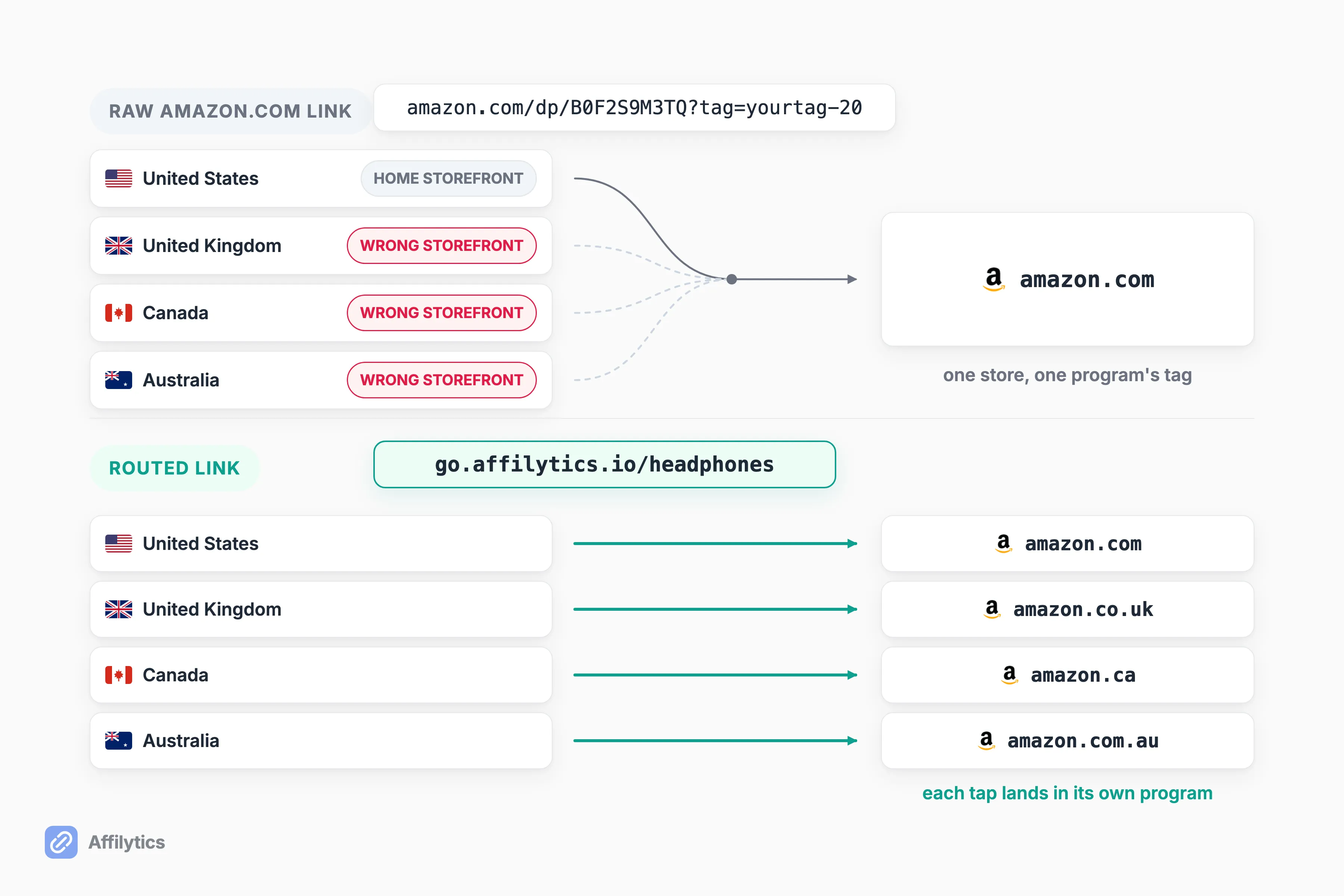
Now do the math on a plain amazon.com/dp/... link. Your UK follower taps it and lands on a US storefront they may not buy from at all. If they do buy, the tag on that link belongs to the US program, not to the UK one. Either way, the tap converted for Amazon and not for you.
It helps to know that Amazon runs a separate program per region, and each one issues its own tracking ID. Amazon’s own OneLink documentation spells out what that means for a redirected shopper: mapping a store ID lets Amazon replace your US tracking ID with your mapped tracking ID for the applicable Amazon Associates program, so the conversion is attributed to that country’s Associates account. Read the other direction, that is the catch. The earnings land in the destination program’s account, so if you have no ID mapped there, a US ID is not what gets credited. Which is why “I have an Amazon link” and “I have an Amazon link that works for the person tapping it” are two different sentences, and the money lives in the gap between them.
X has its own way of widening this. A post that gets reshared keeps collecting taps from wherever it travels, for as long as it travels. You wrote for your followers; the link ends up serving an audience you never picked. The mix on a single link is genuinely out of your hands.
What do you actually do about it, given that you can’t ask people to change countries?
You send each tap somewhere different. Geo-routing resolves the visitor’s country and hands them their own country’s storefront, which is what turns one link into earning from every country instead of one. It’s worth saying this isn’t an Amazon-only trick: the same routing works for any merchant you promote, which matters once your posts stop being all Amazon.
Where to Put the Link: Bio, Post, Reply, or Pinned
Section titled “Where to Put the Link: Bio, Post, Reply, or Pinned”First, kill the most repeated piece of advice on this topic. Shortening a URL to save characters on X saves you nothing, because a URL of any length will be altered to 23 characters, even if the link itself is shorter than 23 characters. Your character count reflects that number, not the URL you typed.
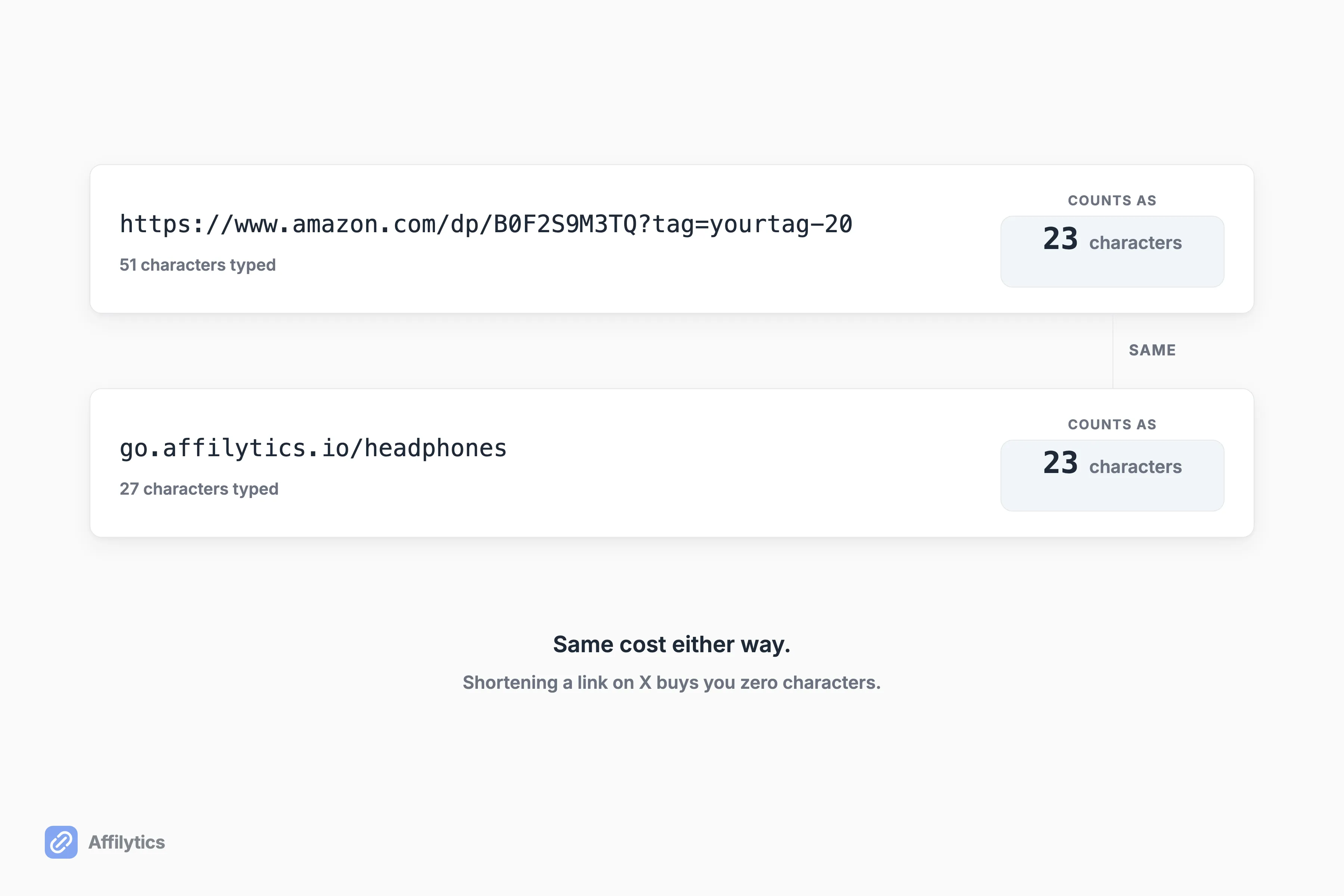
A shortener earns its place on X for exactly one reason: control over where the link points afterward. Not space. Once you accept that, placement becomes a plain trade-off between how long the link lives and how many people see it.
| Placement | How long it lives | What it is good for |
|---|---|---|
| Bio | Until you change it | One evergreen destination, usually a page of many links |
| In the post | As long as the post circulates, which on X is short | The recommendation itself, tied to the thing you just said |
| In a reply | Same as the post, but only for people who open it | Keeping the top post clean while still supplying the link |
| Pinned | Until you unpin it | Your one best-converting recommendation, on repeat |
Bio and pinned are the two placements that keep working while you sleep, and they are the two easiest to leave stale for months. A pinned post sending taps at a product that got discontinued in March is attention you earned and then threw away.
Does putting the link in a reply actually help?
Creators widely believe it does, because they widely believe X suppresses posts containing external links and that Premium buys some leniency. All three reach threads I pulled while researching this asserted it independently, in nearly the same words. X does not document any of it. The one adjacent thing X does publish is that its link service counts clicks as a quality signal for ranking a post, which is a claim about clicks mattering, not about link posts being demoted, and stretching one into the other would be making something up.
Treat the reply trick as a thing worth testing on your own account, not a law. What isn’t a guess is the environment you’re posting into: search “amazon affiliate” on X and you’ll scroll past a lot of income-claim spam with a monthly total attached. A specific, mechanical recommendation reads very differently in that room.
The Setup That Survives Every Hop
Section titled “The Setup That Survives Every Hop”You can’t remove X’s hop. Every one of your Amazon affiliate links on X travels through it. So make the thing on the other side of it something you own and can change without editing a single post.
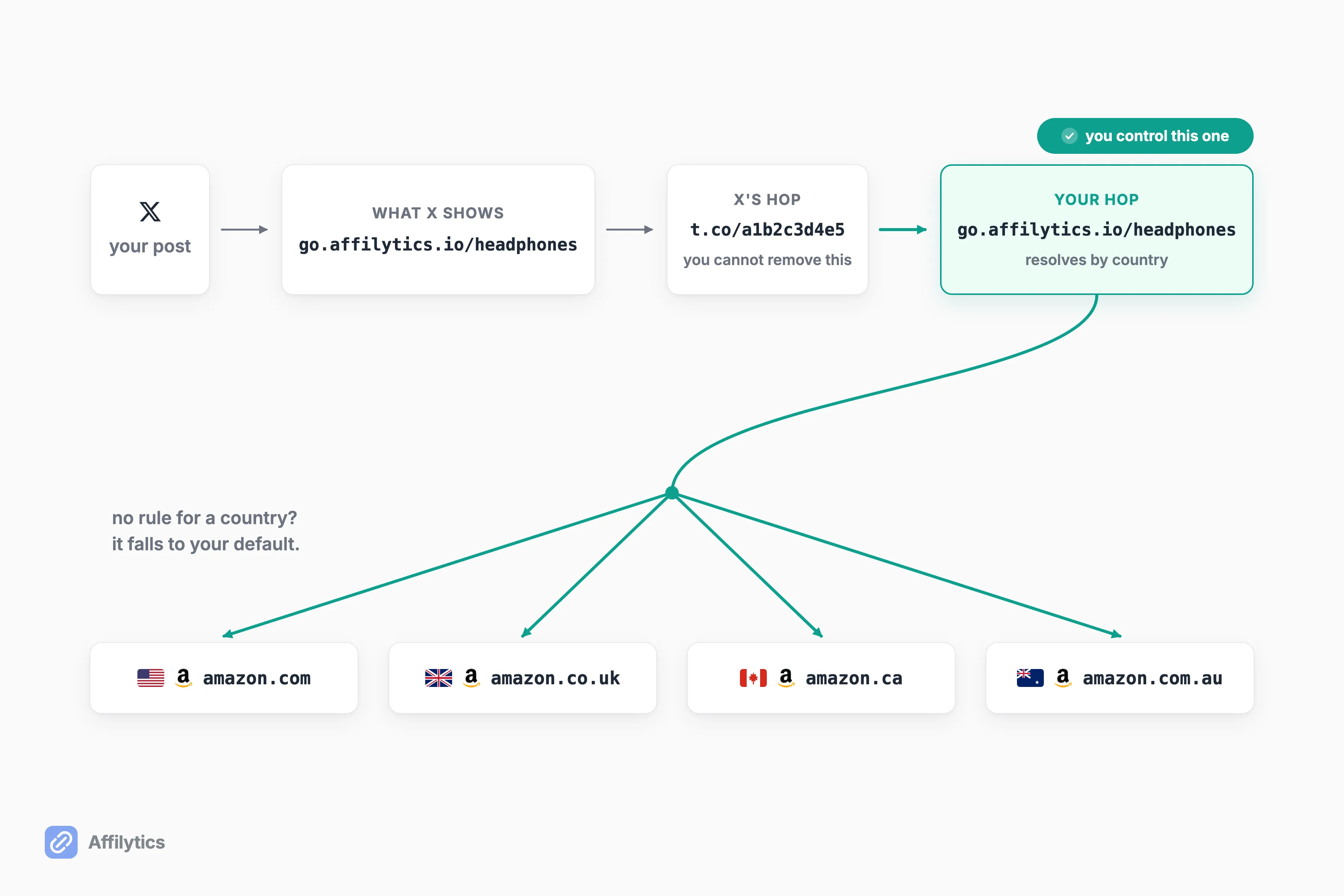
The setup is short:
- One link per product you post about often. Not per post. Per product, so the link accumulates history.
- A country rule for each storefront your audience actually uses. Start with the three or four countries that show up in your analytics, not all of them.
- A default destination for everyone else. Every visitor from a country you didn’t write a rule for still needs somewhere sensible to land.
- Reuse the same link across posts. A reshare from eight months ago keeps working, and a repointed destination fixes every post at once.
Step two is the one worth not overthinking. You don’t need a rule for every storefront Amazon operates. Write rules for the three or four countries that actually show up in your own numbers, let everyone else fall to the default, and add a country the day it earns one.
What does that look like concretely?
A smart link is go.affilytics.io/{slug} with a slug you choose. On a tap, we resolve the visitor’s IP through a GeoIP database, take the first matching country rule by priority, and send them there; no match falls through to the default, which is mandatory for exactly this reason.
Being straight about the work involved: creating that link is a manual step. Scanning a channel or a site finds the affiliate links you already published and keeps checking them, but it never converts them into smart links for you. You make the link and swap it into the post yourself.
The destination gets health-checked on a schedule too, so a product page that dies surfaces as a status you can see instead of quietly eating taps for a month.
If you want the click-by-click version, we wrote up how to create a smart link separately.
Start With One Link
Section titled “Start With One Link”Pick the single product you post about most on X and set one link up for it. Two full weeks with everything unlocked, no credit card, is more than enough time to watch the country breakdown of the taps that one link collects, which is where the international argument stops being theoretical.
Create your free account, route one link, and leave the rest of your posts alone until you’ve seen the numbers.
Can you post Amazon affiliate links on X?
Section titled “Can you post Amazon affiliate links on X?”Yes. Amazon’s Operating Agreement lists social media user-generated content as a place Special Links are allowed, and a post on X is exactly that. Two rules bind you: the link must not be presented in a way that makes it unclear you are linking to an Amazon site, and a tagged link sent in a direct message is only allowed when the recipient opted in to hear from you.
Does X change my affiliate link when I post it?
Section titled “Does X change my affiliate link when I post it?”Yes. X shortens every URL posted on the platform through its own t.co service, and its help pages state plainly that you cannot opt out of link shortening. What you see on screen is the original URL or a trimmed version of it. What actually gets served when someone taps is a t.co address that forwards to your destination.
Do I need a URL shortener for Amazon links on X?
Section titled “Do I need a URL shortener for Amazon links on X?”Not to save space. A URL of any length is counted as exactly 23 characters on X, even one shorter than 23 characters, so shortening buys you nothing on the character limit. A shortener is still worth using when you want control over the destination, because a link you own can be repointed later without editing the post.
Does posting links on X hurt your reach?
Section titled “Does posting links on X hurt your reach?”Creators widely believe it does, and many believe X Premium buys some leniency. X does not document any of it. The one adjacent thing X does publish is that its link service measures how many times a link has been clicked and treats that as a quality signal, which is a statement about clicks counting, not about link posts being demoted. The honest answer names both of those facts instead of picking one.
Why do I get clicks on X but no commissions?
Section titled “Why do I get clicks on X but no commissions?”Two things are documented and worth checking first. The Amazon cookie window starts when someone actually taps your link, not when you post it, so a tap today and a purchase four days later earns you nothing on a standard 24-hour window. And a plain amazon.com link sends an international shopper to a storefront they may not buy from, carrying a tag that belongs to a different regional program. Beyond those two, explanations get speculative fast.