Amazon Affiliate Links on Instagram: Where They Survive
You can put Amazon affiliate links on Instagram in more places than most creators realize, and the place everybody tries first is the one place they do not work at all.
We build Affilytics, which routes affiliate links to the right country storefront and watches every destination for the day it stops working, so most of our time goes into what happens after somebody taps a link rather than where the link sits.
We already covered sharing Amazon links across social platforms platform by platform. This one stays on Instagram and keeps going past the tap.
This guide covers every Instagram surface that can carry a link, why Instagram’s own affiliate tagging is a different system from Amazon Associates, what happens to the click after the tap, the account rule that gets creators rejected, and the setup that survives all of it.
Where a clickable Amazon link can actually live on Instagram
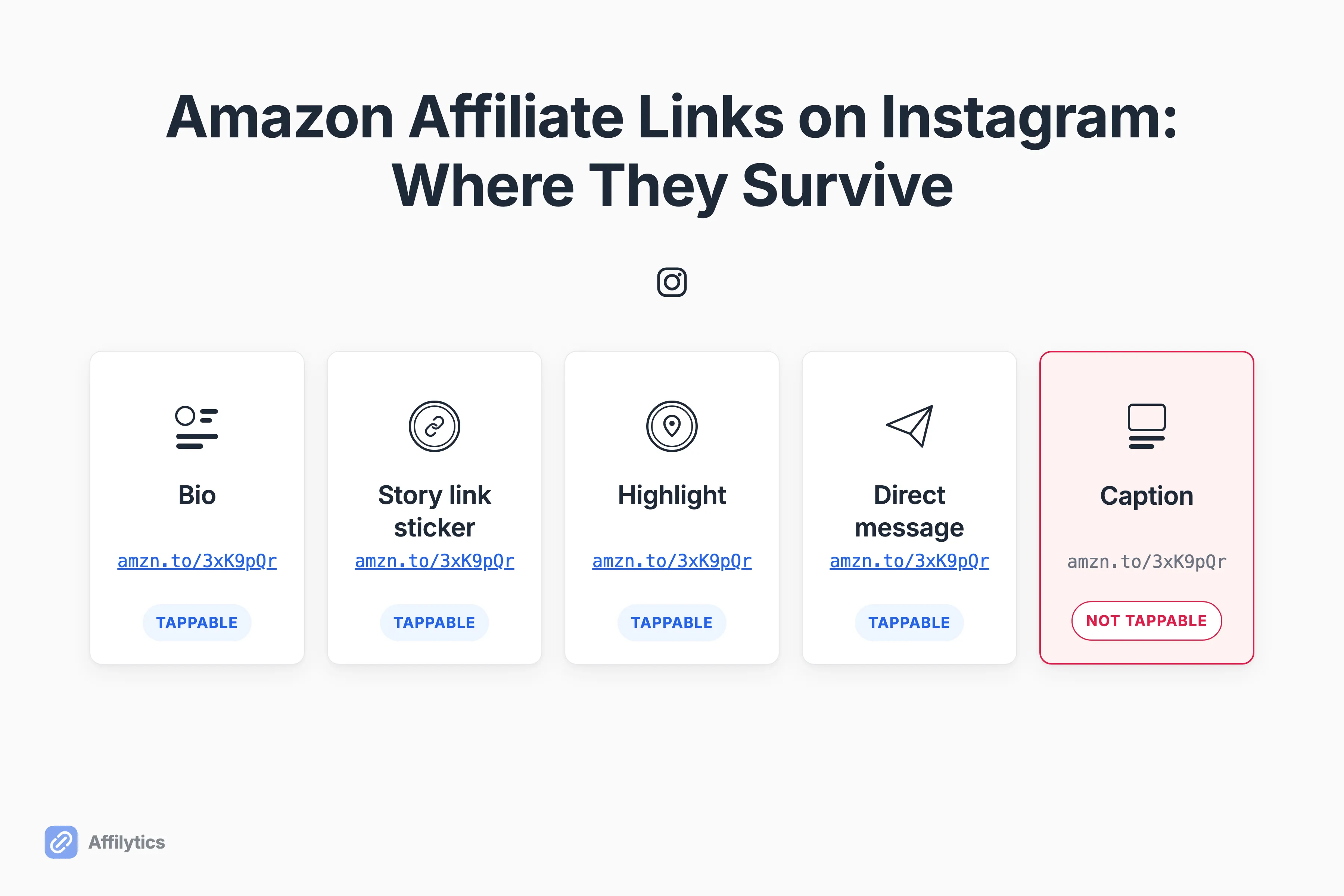
Section titled “Where a clickable Amazon link can actually live on Instagram”Instagram gives you four places where a link is genuinely tappable, and the caption is not one of them.
- Your bio. One URL, it sits there until you change it, and it never expires on its own. Most creators fill that slot with a link-in-bio page, which is its own set of trade-offs: see affiliate links on a Linktree.
- A story link sticker. Tappable while the story is live. Amazon’s own documentation notes that an Instagram story that has not been pinned has a 24-hour life span, so the link is gone tomorrow.
- A Highlight. Pin that story and the link stops expiring. It is the cheapest way to turn a one-day link into a permanent one.
- A DM. Underrated, and the only placement that is genuinely one to one. Somebody asks what blender you use, you send them the blender.
Captions and comments carry no clickable link. You can type the URL out in full, and almost nobody will retype it by hand.
Is that settled knowledge among creators? Not even close. Search this exact question and one of the top results is not a guide at all, it is a forum thread where creators contradict each other about whether a post can carry a clickable link.
Amazon itself pushes the bio-and-story pattern. In Amazon’s own creator guidance, the creator Allie P. Hunter is featured with her bio pointing at her Amazon Storefront and her Stories linking to shoppable photos or product pages. That is Amazon endorsing two of the four surfaces above, not a third party guessing.
Instagram’s affiliate tagging is not Amazon Associates
Section titled “Instagram’s affiliate tagging is not Amazon Associates”Instagram supports native affiliate product tagging inside reels. You connect an affiliate programme and tag products in a reel through Monetisation, then Affiliate programmes, then Connect. That is Instagram’s own affiliate system with its own partners, and it is not the same thing as pasting an Amazon Associates link into your bio.
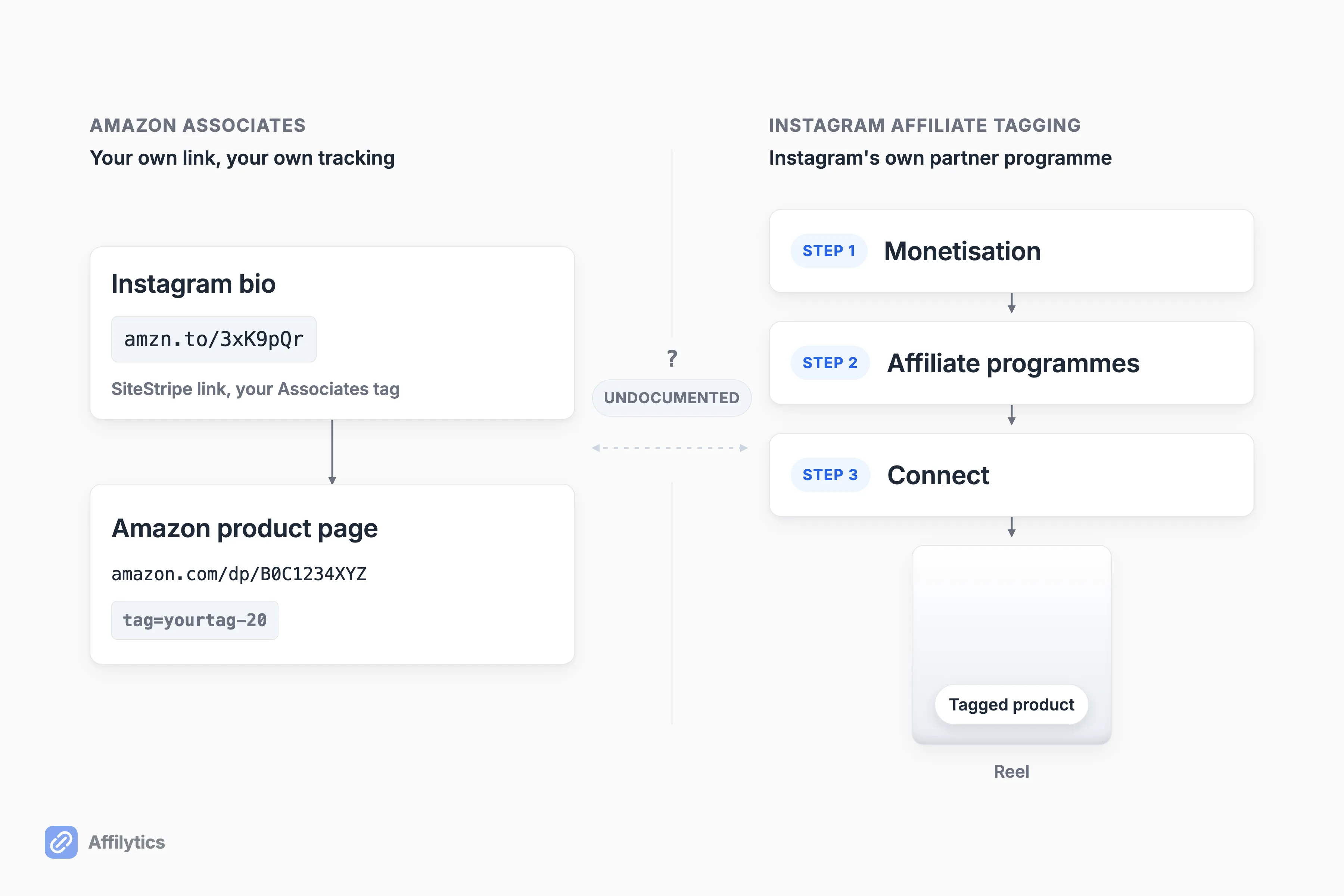
So is Amazon Associates one of those connectable partners? We could not find that documented anywhere, so we are not going to tell you either way. If a guide states it confidently, ask where they got it.
The other line creators blur is the Amazon Influencer Program versus Amazon Associates. Associates is the program for driving traffic to Amazon. The Influencer Program adds a storefront page, and Amazon states that applying with an Instagram account requires a business account. Amazon’s own guidance there: a brand that wants to drive traffic to Amazon should apply to Associates instead.
What happens after the tap, and what nobody can honestly tell you
Section titled “What happens after the tap, and what nobody can honestly tell you”Somebody taps your story sticker and the Amazon page opens, but not in Safari and not in Chrome. Felix Krause, an independent security researcher, documented that the iOS Instagram and Facebook apps render third-party links in a custom in-app browser of their own.
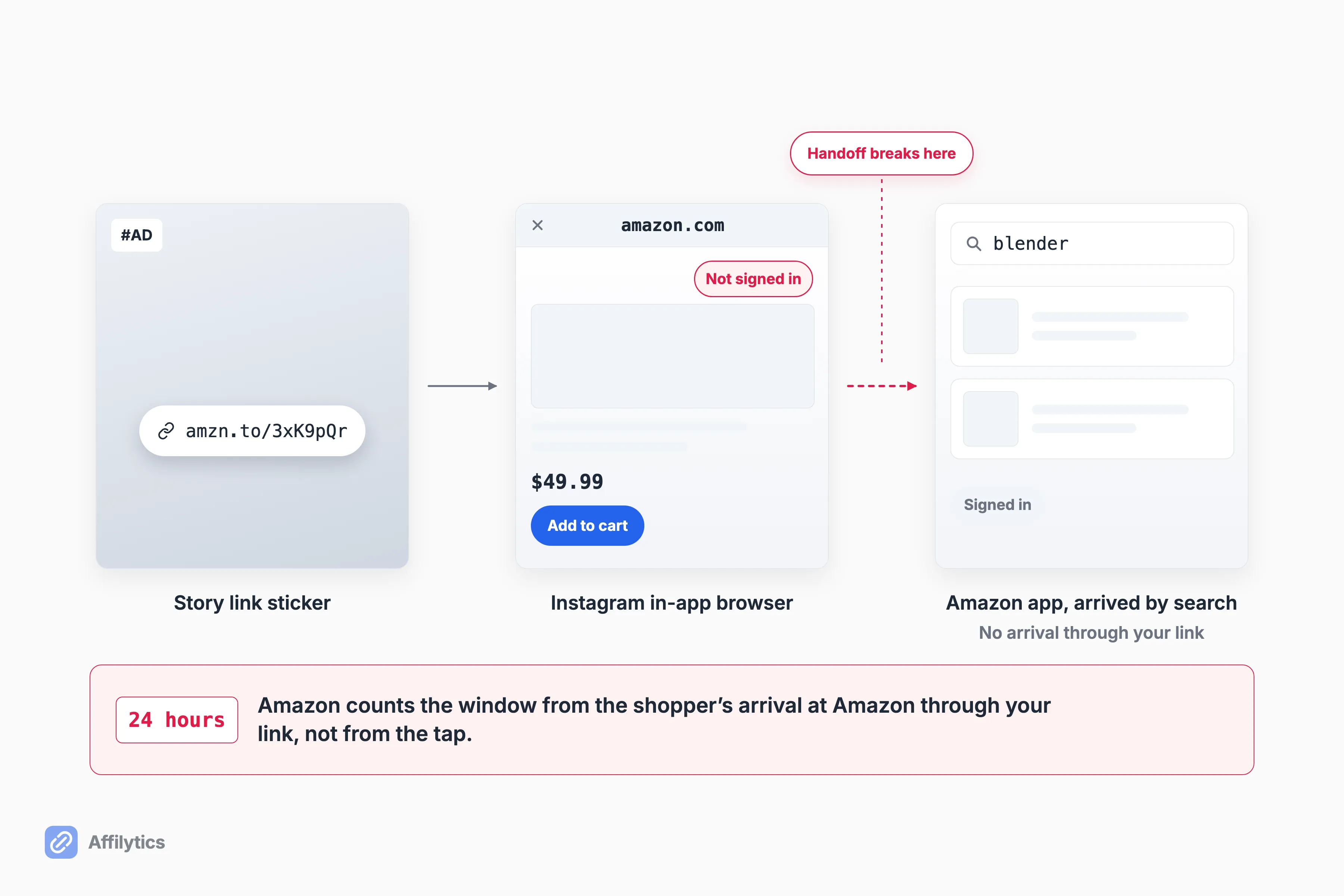
That matters because of what your follower carries into that browser: not much. Signed in to Amazon everywhere else, they land on a product page that treats them like a stranger.
Awin, an affiliate network, says cookies set in in-app browsers are usually stored separately from those in standard web browsers, so tracking may be blocked or limited, potentially leading to lost commission earnings. Awin built an In-App Browser Breakout feature specifically for this.
So how much is it costing you? Nobody can tell you, and that includes us. We went looking for a number worth repeating here and never found one. Awin describes its own breakout feature as “currently in a trial phase,” and every percentage we could trace led back to a company selling the fix.
Creators disagree about the mechanic too, and I would rather show you the argument than pick a side. On r/Amazon_Influencer, u/Sea_Somewhere_195 puts it this way: “So if you post on IG, it opens in the IG browser, which nobody logs in on… you lose it because they didn’t log into Amazon after clicking your link.” u/Old_Marzipan6085 pushes straight back in the same thread: “When links open in the app it’s a better experience for the user which leads to more conversions. And no, the cookie/tag is not lost.”
What is not in dispute is the clock. Amazon counts the 24-hour attribution window from the moment a shopper arrives at Amazon through your link, not from the moment they tap. A follower who abandons the in-app browser and searches the product inside the Amazon app may never start that clock at all.
The account rule that gets creators rejected
Section titled “The account rule that gets creators rejected”The failure that ends the conversation is not a lost click. It is losing the account, and it shows up in creators’ own posts, not in guides.
One creator, u/thatsadickmove666 on r/passive_income, was rejected for “unknown traffic source” while doing everything by the book: “…rejected because they claimed they couldn’t determine my traffic source, even though I exclusively used official SiteStripe short links directly on my Instagram page.” A different creator, u/dreamit-makeit on r/Amazon_Influencer, was shut down over the words in a bio: “I was saying ‘amazon deals’ on my posts and in my bio. Apparently this is a big no no.” Two people, two accounts, neither a general rate.
So what does Amazon actually want from you? Three things, none of them hard:
- List every Instagram profile you post from in your Associates account’s approved sources. Amazon has to guess otherwise.
- Disclose where the link is, not somewhere else. One creator in that thread, on what has worked for them for years: “#AD on the frame link sticker and small caption disclosing you earn is sufficient.” The disclosure Amazon requires is in the Operating Agreement.
- Keep Amazon’s brand out of your handle, bio and post copy. The storefront is Amazon’s; the wording around it is where accounts get burned.
A traffic source Amazon cannot identify and a link whose referrer got mangled are the same problem from two ends. That’s why an Amazon link that stops converting often has nothing to do with the product page.
Your Instagram audience is more international than your links assume
Section titled “Your Instagram audience is more international than your links assume”Instagram audiences travel. A reel that does well spreads a long way past the country you live in, and every one of those viewers taps the same amazon.com link in your bio.
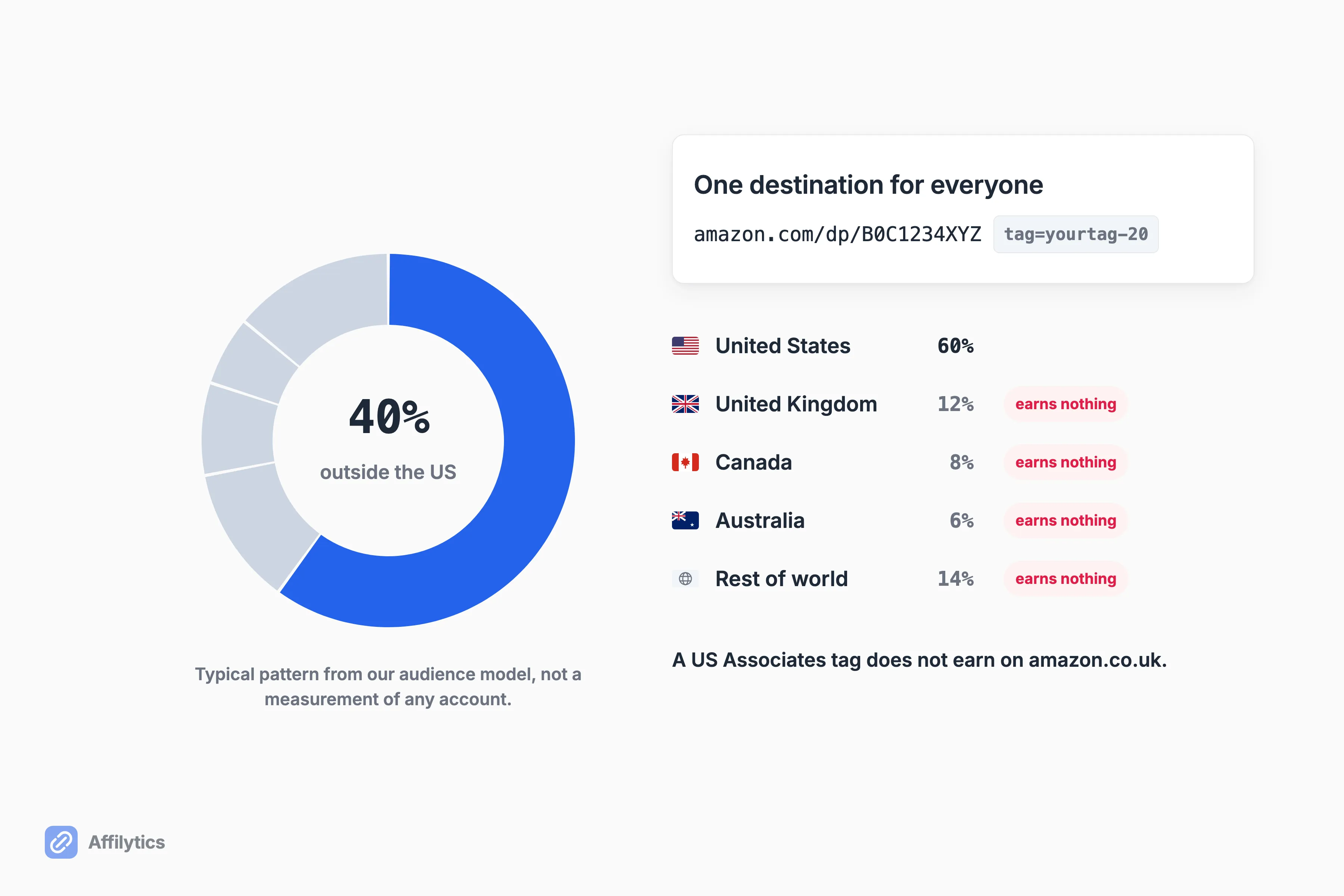
Here is the pattern we work from, and it is worth checking against your own numbers rather than taking as a measurement of your account. Most creators have a 30-50% international audience without realizing it. A typical US-based creator sees roughly 60% United States, 12% United Kingdom, 8% Canada, 6% Australia and 14% spread across everywhere else.
What does a follower in Manchester get when they tap an amazon.com link? Usually a storefront that will not ship them the item, or one that sells it to them with your tracking ID meaning nothing, because a US Associates tag does not earn on amazon.co.uk.
This is the job we built Affilytics to do first. Routing a link by country means one link with per-country rules sitting behind it: the visitor’s country is resolved from their IP address, the first matching rule wins, and anything you did not write a rule for falls back to a default destination you choose. It works for any merchant, not only Amazon.
The placement that survives: own the destination
Section titled “The placement that survives: own the destination”Every problem above has the same shape. The link you hand Instagram is the link you can never change, never diagnose and never route.
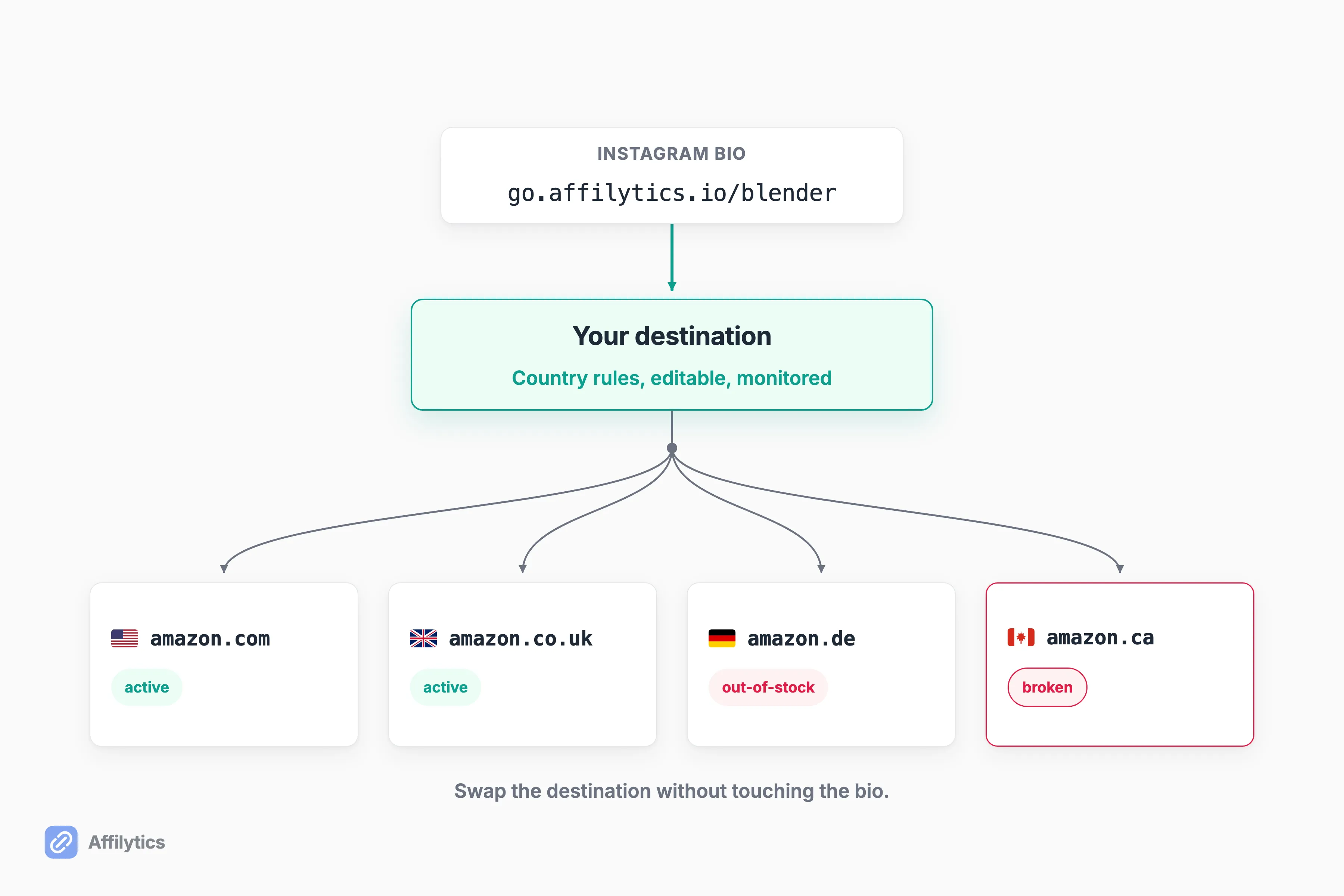
Amazon affiliate links on Instagram become fixable the moment you own the destination. Point that one slot at something you control and everything downstream inherits the fix. Swap where it goes without touching the bio. Send each country to its own storefront. Find out when the destination dies instead of watching clicks quietly stop earning.
This is not our idea, which is the best argument for it. In that same rejection thread, u/InterestingRich8905 told the poster: “Some folks route their IG traffic through a simple landing page first to preserve the source data before forwarding to the merchant link.” Creators arrive at this pattern on their own.
How to create a smart link is a manual step you do once per link: pick the slug, set the country rules, paste it into your bio or your story sticker. We register that destination for ongoing health monitoring from then on, so a dead product page reaches you as broken, out-of-stock or product-unavailable rather than as silence. We scan YouTube channels and websites for links you have already published, not Instagram, so the bio link is one you make yourself.
Does any of that fix the in-app browser? No. Nothing you install changes how Instagram renders a link, and any tool that promises otherwise is guessing at a number nobody has.
Start with the one link that matters most
Section titled “Start with the one link that matters most”If you do one thing after reading this, make it the bio link. Of every place Amazon affiliate links on Instagram can sit, it is the only slot that never expires by itself, it carries the most traffic of the four, and it is the easiest one to point at a destination you can change later.
Create your free account and route it. You get two full weeks with everything unlocked and no credit card, which is enough time to see the country split of the clicks that link is already getting.
Can you put Amazon affiliate links on Instagram?
Section titled “Can you put Amazon affiliate links on Instagram?”Yes. Your bio, story link stickers, Highlights and DMs all carry a tappable link. Captions and comments do not, so a URL typed into a caption is just text that almost nobody will retype. The account-side rules matter as much as the placement: your Instagram profile has to be listed in your Associates account’s approved sources, every post needs a clear disclosure, and Amazon’s brand name does not belong in your bio or handle.
Why are my Instagram affiliate clicks not converting?
Section titled “Why are my Instagram affiliate clicks not converting?”The likely causes are mechanical, not mysterious. Instagram opens links in its own in-app browser rather than Safari or Chrome, the shopper is usually not signed in to Amazon there, and Amazon’s 24-hour attribution window only starts once someone actually arrives at Amazon through your link. Be careful with anyone who quantifies this for you. There is no reliable public figure for how often it costs a sale, and the percentages in circulation usually come from someone selling the fix.
Is Instagram’s affiliate tagging the same as Amazon Associates?
Section titled “Is Instagram’s affiliate tagging the same as Amazon Associates?”No. Instagram has its own affiliate system that you connect through Monetisation, then Affiliate programmes, then Connect, and it lets you tag products inside a reel. Amazon Associates is a separate program with its own links and its own tracking. Whether Amazon Associates can be connected as a partner inside Instagram’s flow is not documented anywhere, so treat any confident claim in either direction with suspicion.
Do I need the Amazon Influencer Program to share links on Instagram?
Section titled “Do I need the Amazon Influencer Program to share links on Instagram?”No. An ordinary Amazon Associates account is enough to share affiliate links on Instagram. The Influencer Program adds a storefront page you can point your bio at, and Amazon requires a business account if you apply using an Instagram or Facebook account. If your goal is driving traffic to Amazon, Amazon points you at the Associates program instead.
Why was my Amazon Associates application rejected for unknown traffic source?
Section titled “Why was my Amazon Associates application rejected for unknown traffic source?”Amazon has to be able to see where your traffic comes from before it approves you, and an Instagram profile that is not listed in your account’s approved sources is invisible to that review. At least one creator has reported being rejected on those grounds despite using official SiteStripe links on Instagram. List every profile you post from, and send that traffic through a destination that keeps the source readable instead of a chain that hides it.