
Affiliate Disclosure Examples for Every Place You Link
Most affiliate disclosure examples you will find are fine. Copy one, swap in your own voice, and the writing part is finished before your coffee is. The problem was never the sentence, it is the places you forgot you put a link.
We build Affilytics, which scans a YouTube channel or a blog and returns every affiliate link already published on it, along with the video or page each one sits on. Assembling that list is a completely different job from writing the disclosure, and it is the one creators get caught out by.
Which is why the second half of this post is about the audit rather than the wording, and why it helps to build an affiliate link inventory before you start pasting disclosures anywhere. The examples come first, though, because that is probably what you came for.
Below are disclosure examples for a blog post, a YouTube description, a newsletter, podcast show notes, and a social post, what the FTC and Amazon actually require, and the three ways a disclosure you did write still fails.
What makes an affiliate disclosure actually count
Section titled “What makes an affiliate disclosure actually count”Two separate things decide whether a disclosure works, and most guides blend them into one.
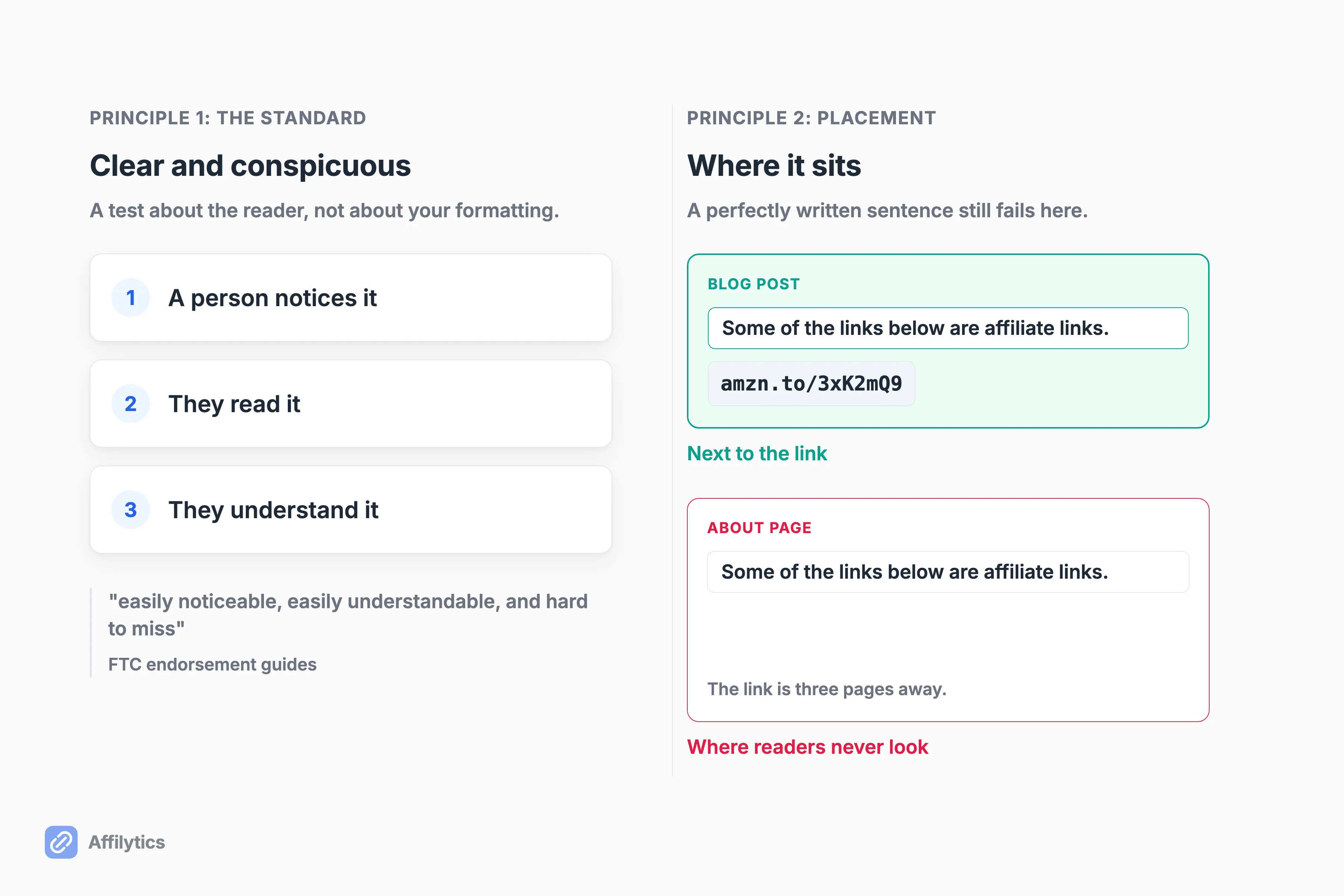
The first is the standard itself. The FTC does not hand you a word count or a minimum font size. What it asks is whether the disclosure is easily noticeable, easily understandable, and hard to miss for an ordinary reader. That is a test about the person on the other end, not about your formatting.
The second is placement, and it is a separate test that a perfectly written sentence can still fail. The FTC’s guidance for creators is specific about where a disclosure goes to die: disclosures are likely to be missed if they appear only on an ABOUT ME or profile page, at the end of posts or videos, or anywhere that requires a person to click MORE. Read that list again, because it describes where most disclosures currently sit.
So what does that leave you with in practice?
- A sentence someone can understand on the first read, without a legal dictionary
- Sitting where the reader is when they meet the link, not three scrolls below it
- Repeated on every piece of content that carries a link, not written once and filed
The creator @Naaackers put the trigger in plain English: “If you gain ANYTHING OF VALUE from sharing links to products or services, you have to disclose the business relationship based on the laws that govern you.” That is a much lower bar than “did somebody pay me.” A free product, a discount code, a commission on a sale you have not made yet: all of it counts.
One disclaimer of my own, then I will stop hedging for the rest of the post. I am not a lawyer and none of this is legal advice. I am reporting what the FTC’s published guidance and Amazon’s operating agreement say, and linking both so you can read them yourself.
This post also covers US guidance only, so if you publish from somewhere else, your own regulator runs its own regime and this post does not cover it.
The one line that is not a style choice
Section titled “The one line that is not a style choice”Every other example in this post is a judgment call about wording. This one is not.
The Amazon Associates Program Operating Agreement prescribes the exact sentence: “As an Amazon Associate, I earn from qualifying purchases.” That is why you have read that same string on page after page in the same slightly stiff register. Nobody copied it from anybody. It is a contract term, and if you are an Associate it is not a sentence you get to improve on.
Which brings up the thing creators most often collapse into one. Program terms and regulator rules are two independent obligations, and satisfying one does not satisfy the other. @podcastage said it to his own audience on Prime Day: “not disclosing that you’re sharing Affiliate links violates most program’s ToS, it may also be in violation of FTC regulation, and it’s kind of shady in my opinion. ALWAYS DISCLOSE!”
So which one actually arrives first if you get this wrong?
Almost certainly the program, not the regulator. One Reddit community assembled a case against a YouTube channel over undisclosed Amazon links. When the same subreddit came back to the subject in a later thread, the practical question they landed on was not how to file with a federal agency. It was whether Amazon takes complaints: “does amazon have a place to lodge complaints? I’ve heard they pulled affiliation from creators before because they misused the links.” Losing your Associates account is a faster and far more concrete consequence than anything else in this post.
Affiliate disclosure examples by placement
Section titled “Affiliate disclosure examples by placement”Here is the copy-paste part. Five surfaces, one example each, in the voice that surface actually uses, plus the single placement rule that makes it work.
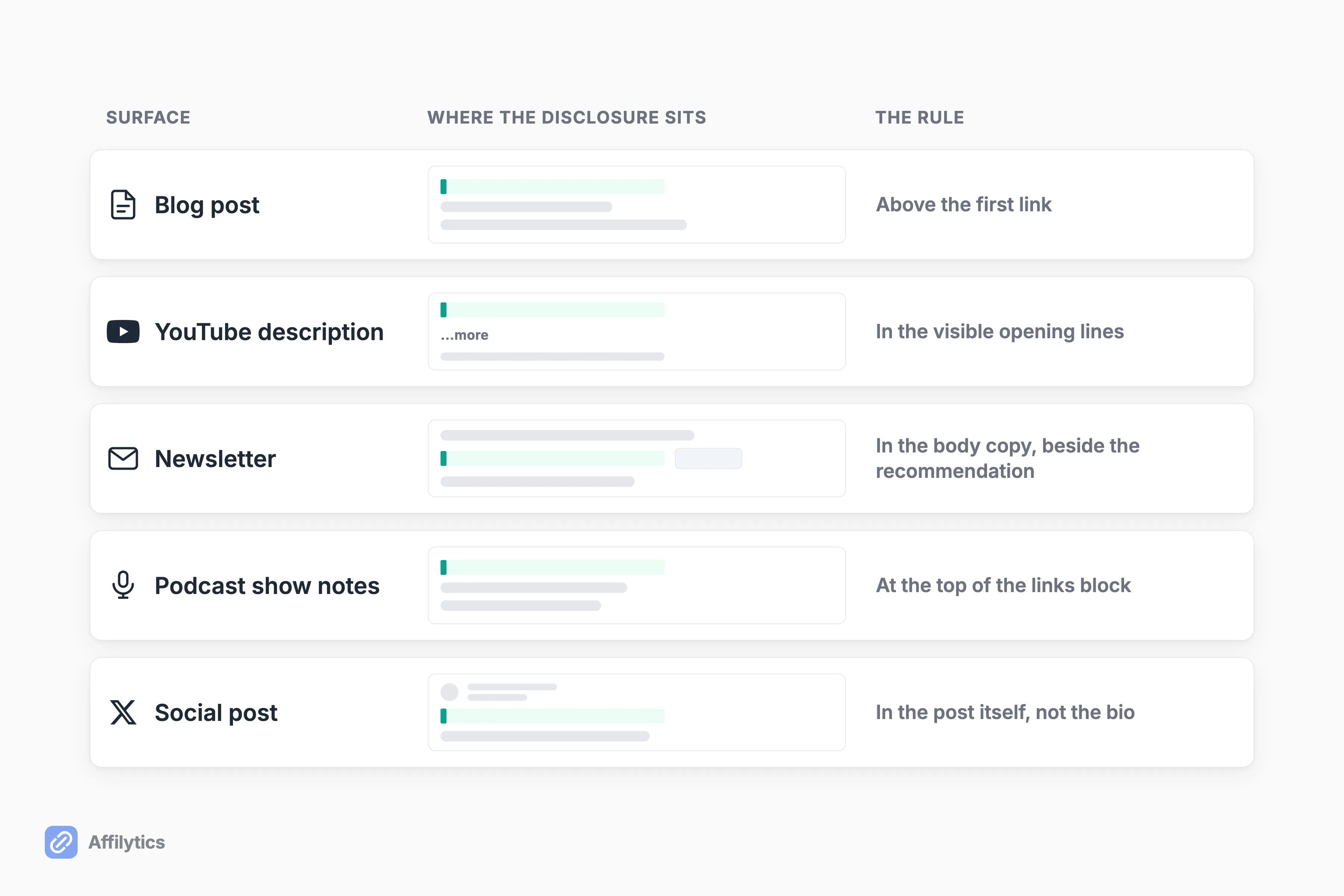
Treat all of these as drafts to edit, not legal documents to install:
- Blog post, above the first link
- YouTube description, in the visible opening lines
- Newsletter, in the body copy beside the recommendation
- Podcast show notes, at the top of the links block
- Social post, in the post itself
Why write your own instead of pasting a generator’s output?
Because a disclosure in your own voice gets read, and one in a legal vendor’s voice gets skimmed past like a cookie banner. I wrote the first four of these myself so you can rewrite them without inheriting anyone else’s tone. I quoted the fifth from a creator who published it.
Blog post
Section titled “Blog post”Some of the links in this post are affiliate links. If you buy through one, I earn a commission at no extra cost to you. Here is my full affiliate policy.
Put it above the first affiliate link, not in the footer. A reader who clicks a link in your third paragraph never reaches the bottom of the page, so a footer disclosure is a disclosure that person never saw.
If a post runs long and drops another cluster of links halfway down, say it again there. Nothing stops you from disclosing twice, and the longer policy page is still worth keeping. It just cannot be the only place the disclosure lives.
YouTube description
Section titled “YouTube description”Heads up: some of the links below are affiliate links, which means I get a small commission if you buy through them. Costs you nothing, helps me keep making these.
Write it the way you talk, and put it in the opening lines of the description where it is visible without anyone tapping to expand. A disclosure that only shows up after a viewer opens the full description is one most viewers never see.
Descriptions are also where placements pile up fastest. A back catalogue accumulates links for years, and every one of those descriptions is still live, which is why it helps to check your YouTube affiliate links in bulk rather than opening videos one at a time.
Newsletter
Section titled “Newsletter”Quick note: my link to [product] below is an affiliate link, so I earn a commission if you sign up through it. I would still be recommending it if I didn’t.
Write it into the body copy, right next to the recommendation. The footer of an email is the exact same failure as the footer of a blog post: it sits below the fold, next to the unsubscribe line, in the part of the template nobody reads.
That second sentence is doing real work, by the way. It answers the question a reader asks the moment they find out you get paid, and it costs you nothing to say when it is true.
Podcast show notes
Section titled “Podcast show notes”A few of the links below are affiliate links. If you buy through one, I earn a commission, which helps cover the cost of making the show.
Put it at the top of the show-notes block so it covers the links underneath it. Then say it out loud in the episode too, because audio is the primary surface and plenty of listeners never open the notes at all.
One line read aloud before you name a product does more than any block of text in a description field. This is also the placement the guides ranking for this keyword skip entirely, even though affiliate links in show notes are standard practice for anyone monetizing a podcast.
Social post
Section titled “Social post”Here is one from the wild rather than a template. @cryptobasenji, recommending a VPN, added this directly beside the link:
Affiliate disclosure: this link gives you 3 free months and me 1. Both sides win:
It works because it names the incentive on both sides in one sentence, in the creator’s own voice, in the same place as the link. Nobody has to interpret anything.
Do it in the post, every time, not only in your bio. That is the ABOUT ME page problem from earlier wearing a different outfit: a bio disclosure does not travel with a repost, a screenshot, or a link someone taps straight from a timeline.
Three ways a disclosure fails even when you wrote one
Section titled “Three ways a disclosure fails even when you wrote one”Every failure below involves a disclosure that exists. Written, published, technically present, and still not doing its job.
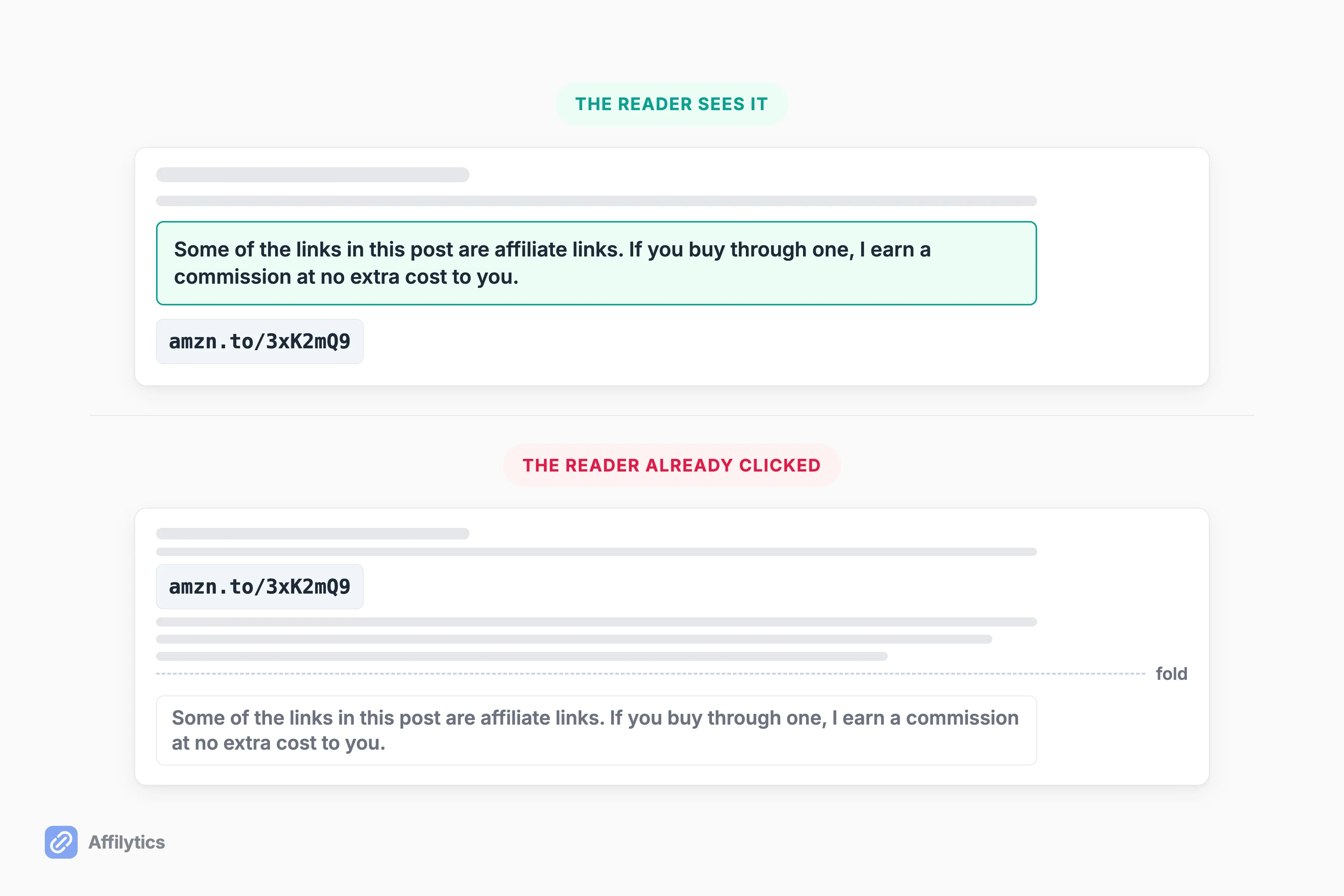
- Buried below the fold. In r/BeautyGuruChatter, the community’s read on a disclosure placed below the fold was blunt: “AD needs to be the first word in any BG’s sponsored post or GTFO.” Below the fold is not a legal term, it is just where attention stops. If someone has to scroll past the thing you are selling to learn that you are selling it, the order is backwards.
- Bio-only. A follower asked @podcastage whether having it in every bio across platforms covers you. His answer: no, “unless someone checks your profile before clicking a link they would have no idea.” This is the most sympathetic failure on the list, because it is a genuine good-faith attempt that just points at the wrong surface.
- Boilerplate bolted to the bottom. Search the phrase “affiliate disclosure” on X and watch what comes back: promotional post after promotional post with a compliance line appended at the very end, a full screen away from the link it supposedly covers. That is what a disclosure looks like when it is written for a checkbox instead of a reader.
There is a structural version of this failure too. Hiding what a link is, rather than just where the disclosure sits, is the same problem in a different form, which is worth thinking about if you are cloaking your affiliate links behind a redirect plugin.
Does everyone agree this matters?
No. At least one creator with real engagement dismisses the whole disclosure debate as overblown next to ordinary competitive pressure. I think he is wrong, mostly because the consequence that arrives first is a program closing your account, not a regulator knocking on anyone’s door.
The examples do not solve the harder problem
Section titled “The examples do not solve the harder problem”You can write a perfect disclosure and still be exposed, because a disclosure only ever covers the placement you remembered.
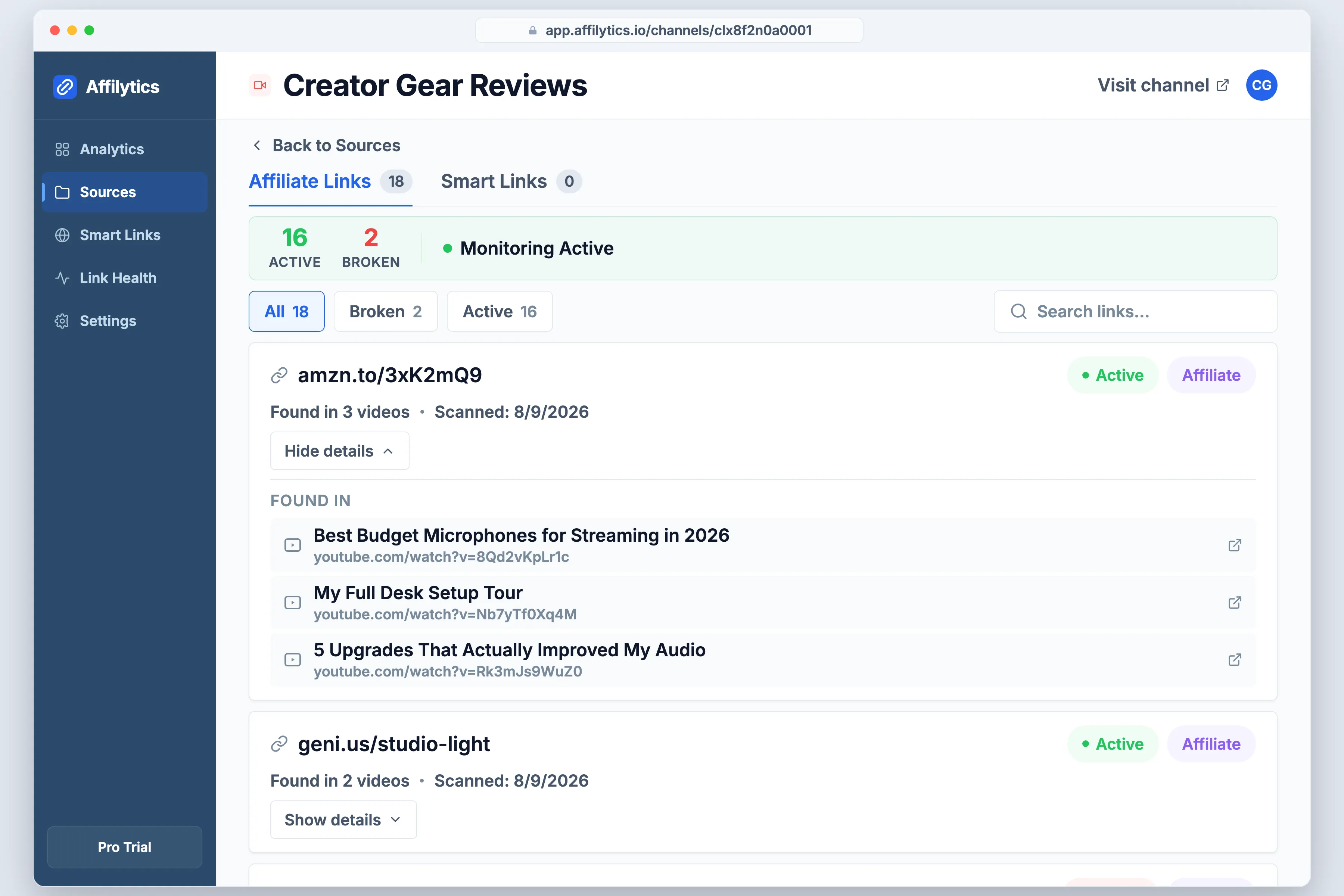
The post that went up two years ago, before you had any policy at all. The video description you edited once in 2023 and never opened again. The newsletter issue sitting in a public archive with a link still live inside it. Every one of those is a placement, and none of them are in your head.
So how do you actually check what you have already published?
The audit has two halves, and only one of them is about wording:
- List every place you have published an affiliate link
- Check each one for a disclosure
The second half is easy. The first half is the one that does not scale by memory, and it is where this quietly goes wrong for anyone with a few years of back catalogue. The consequence can also arrive from your own audience long before it arrives from a regulator. In one r/purelivingonyoutube thread, viewers compiled the evidence that a channel was using undisclosed Amazon links, quoted FTC guidance back at it, and asked each other how to report it. Nobody needed an agency’s permission to decide the channel had lost their trust.
This is the part we built for. Paste a channel URL or a site URL into Affilytics and you get back every affiliate link already published there, with the video or page each one was found on, across the major affiliate networks in one pass. It is the same list you would want to check the affiliate links on your website for anything else, from dead destinations to stripped tracking tags.
What it will not do is read your disclosures. It does not write them, generate them, check them, or tell you whether the one you have is good enough, and it does not hand you legal templates. It gives you the list of places to look, which is the half you cannot do from memory. The judgment about what belongs there stays yours.
Start with one source
Section titled “Start with one source”Pick your busiest channel or site, scan it once, and turn the disclosure audit into a checklist instead of a memory exercise. Work down the list, add the line where it is missing, done.
Create your free account and you get two full weeks with everything unlocked, no credit card. The wording is the quick part. Knowing every place it has to go is the part worth handing to something that does not forget.
Do I need a disclosure on every post, or is one on my About page enough?
Section titled “Do I need a disclosure on every post, or is one on my About page enough?”Every post, and near the link rather than at the bottom of the page. The FTC’s own endorsement guidance singles out an About page as one of the obscure places where a disclosure does not do its job, alongside a poorly labeled hyperlink and a terms of service agreement. A reader who clicks your link from the third paragraph never sees any of those. Write the disclosure into the content itself, then keep the longer explanation page as a supplement for people who want the detail.
What exactly does Amazon require me to say?
Section titled “What exactly does Amazon require me to say?”The Amazon Associates Program Operating Agreement prescribes the statement: As an Amazon Associate, I earn from qualifying purchases. That is a program requirement you agreed to when you joined, and it sits on top of the regulator’s rules rather than instead of them. Displaying Amazon’s sentence does not automatically mean your disclosure is placed where a reader will see it, and being clear and conspicuous for the FTC does not satisfy Amazon if their sentence is missing.
Is the platform’s paid-promotion toggle enough on its own?
Section titled “Is the platform’s paid-promotion toggle enough on its own?”Treat a platform toggle as a supplement, not a substitute, and keep the written disclosure in the post. Creators genuinely disagree about whether an affiliate link is the same thing as a sponsorship for toggle purposes, and you can watch it happen: an identical complaint about undisclosed TikTok reviews drew a short argument in one affiliate-marketing community and no replies at all in a creator one. When the definition itself is contested, the safe move is the one that does not depend on winning the argument: say it in your own words, next to the link, and flip the toggle too if it applies.
Does any of this apply if I am not in the US?
Section titled “Does any of this apply if I am not in the US?”This post covers US guidance and the FTC only. Other countries run their own regimes with their own regulators, and nothing here should be read as describing them. If you publish from outside the US, or you have a meaningful US audience, check your own regulator’s guidance and your affiliate programs’ terms, which apply to you wherever you are. The placement principles in this post are portable even where the legal detail is not.
What about posts I published before I started disclosing?
Section titled “What about posts I published before I started disclosing?”That backlog is the real exposure, and it is the part nobody writes about. The fix does not start with wording, it starts with listing: every page and every video that carries an affiliate link, whether or not you remember publishing it. Once you have the list, adding a disclosure to each item is mechanical work you can do in an afternoon. Trying to do it from memory is where creators quietly miss half of their own library.