Affiliate Links for Podcasters: Programs, Tools, and Fixes
Most advice on affiliate links for podcasters is a cheerful list of programs to join, and then total silence about what happens to those links six months later. One podcaster put it bluntly: in five years he made maybe 80 dollars, and almost all of it came from Amazon links on his website, not the podcast itself.
At Affilytics we build the infrastructure that geo-routes and health-monitors affiliate links, so we spend our days looking at exactly where a published link quietly stops paying.
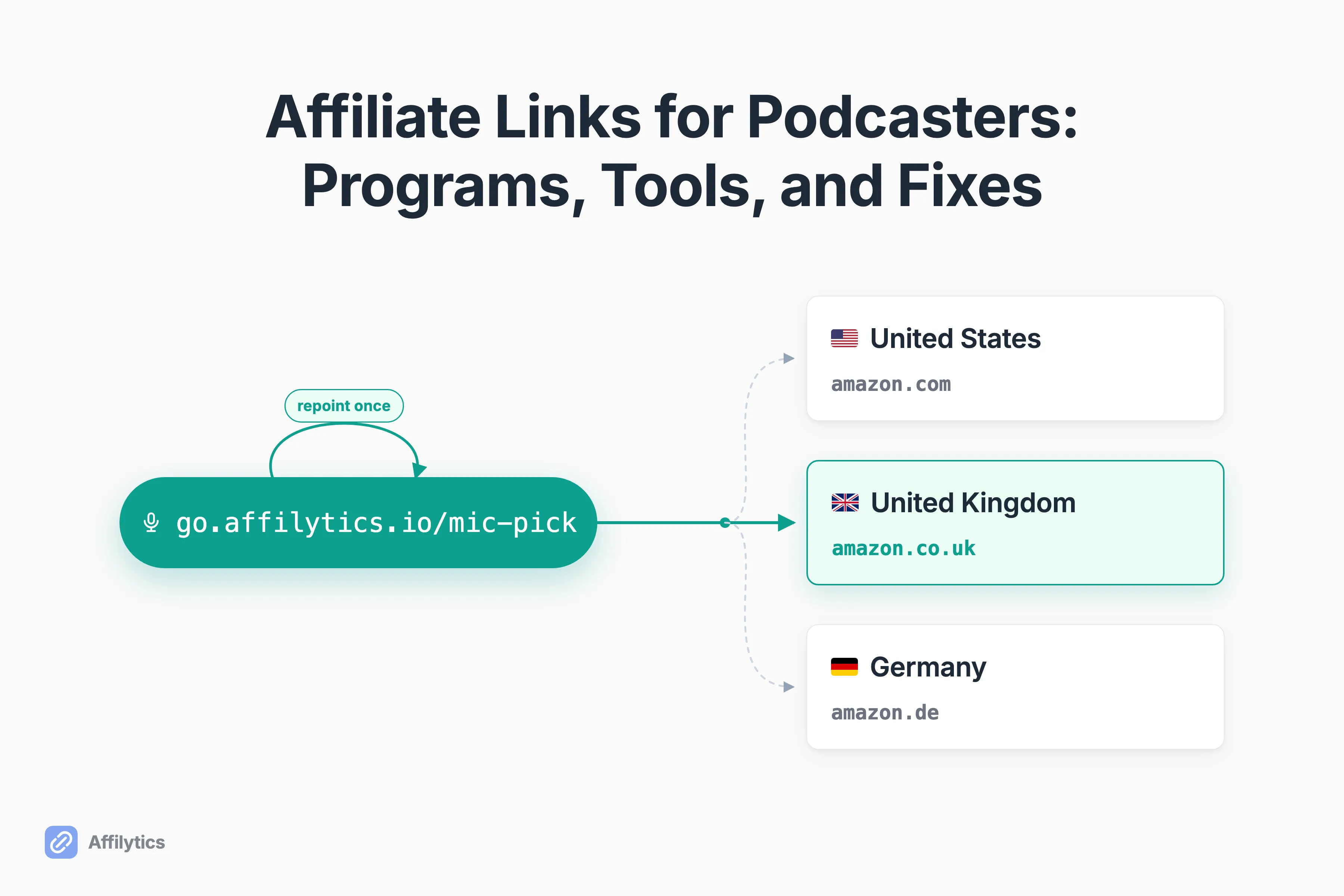
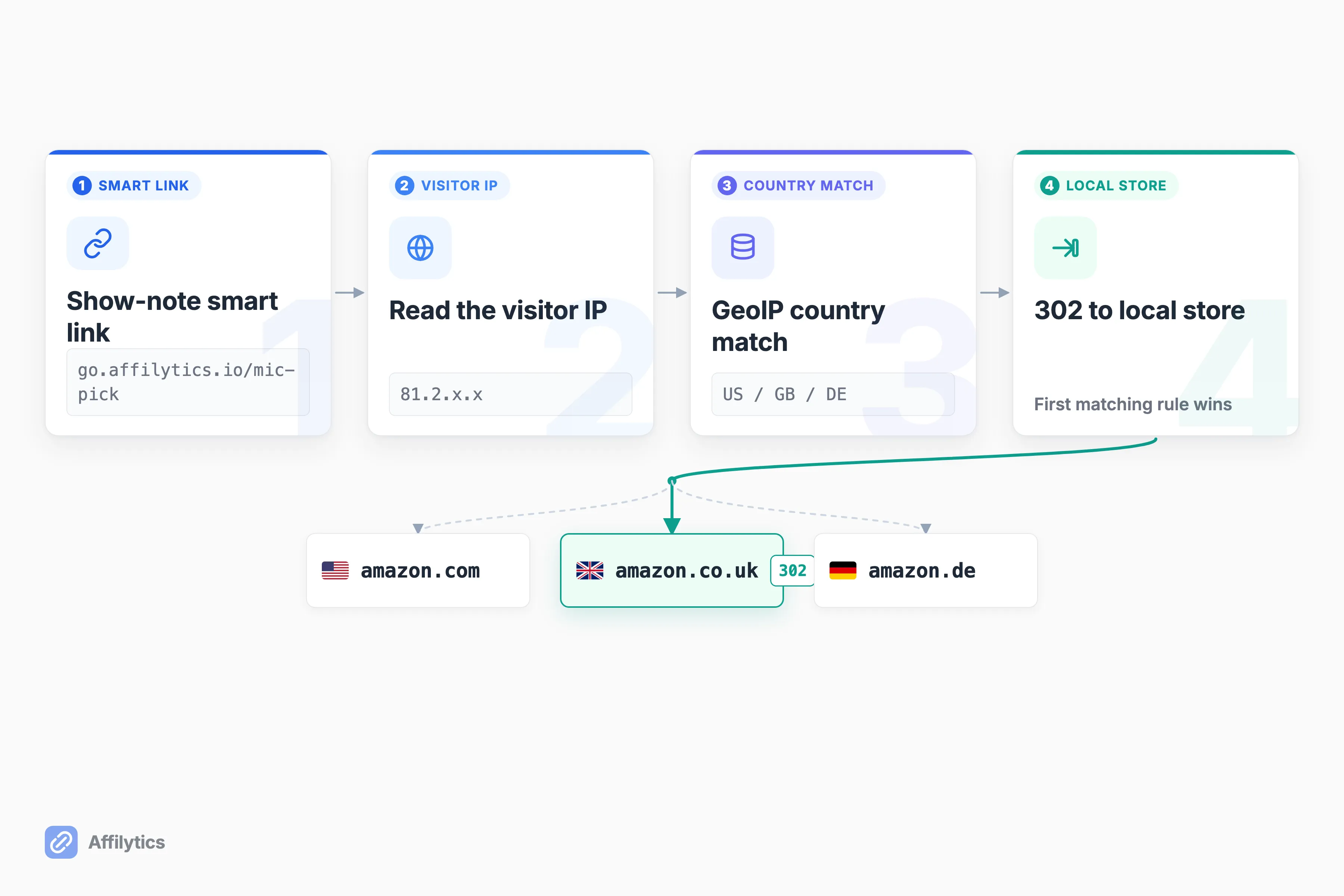
That gives me a different lens on this topic. A spoken recommendation can earn real money. But only if the link behind it still works, and still routes your international listeners to a store they can actually buy from, which is the same problem geo-routing sends each click to the right regional store solves.
This guide covers how podcasters actually earn with affiliate links, the programs worth promoting, the reason your show-note links leak money over time, and the tools (Affilytics among them) that fix it.
How Podcasters Actually Earn With Affiliate Links
Section titled “How Podcasters Actually Earn With Affiliate Links”Affiliate marketing is the pay-per-sale model. You recommend a product with a unique link, and you earn a cut when someone buys through it. No flat fee, no contract, just a commission on sales you helped create.
For a small or new show, this is the realistic entry path. Unlike sponsorship deals that need big download numbers, the affiliate model is the one monetization guides flag as best for independent and new podcasters, with no download requirement to start. You can join a program today, even if your audience is tiny.
There are three places a podcaster can put these links:
- On the show itself, where you read the recommendation out loud
- In your show notes, where the full link lives
- On your website, blog, or email newsletter
That breakdown is the standard one across podcasting monetization guides, and the order matters more than it looks. The newsletter surface also carries a condition the other two do not, so read what the rules allow in email before you put an Amazon link in a send.
So is it actually worth it? Honestly, for an indie show, the numbers are humbling. The five-years-for-80-dollars line above came from u/Trevor_Culley in r/podcasting, who added that “99% of that is traffic from Amazon links in my bibliography on my website, not the podcast directly.” Audio converts poorly to clicks. Your show notes and your website do most of the converting.
The takeaway is a reframe, not a discouragement. As u/ItinerantFella put it in the same community, “It’s not the size of your audience, it’s how much they might spend with your sponsors that matters.” A small, high-intent audience that trusts your gear picks can out-earn a big, passive one.
The Affiliate Programs Worth Promoting
Section titled “The Affiliate Programs Worth Promoting”I am not going to out-listicle the giant ranking guides here. Instead, here are the program categories that actually fit a podcaster, so you can pick by audience rather than by who advertises the biggest payout.
The podcaster-relevant programs sort into a handful of categories worth promoting:
- Podcast gear, hosting, and software programs, recurring commissions on tools you already use and talk about (Buzzsprout, Castos, Podbean, Captivate)
- Courses and learning platforms, where a single sale is worth more than a cheap impulse buy
- Amazon Associates, the default beginner program for physical products
- Email tools and affiliate marketplaces (Awin, ShareASale), which open up thousands of brands through one account
One rule beats all of them. The right product for your audience matters more than the highest commission rate. A 40% payout on something your listeners will never buy is worth zero. A modest cut on the microphone you genuinely use every episode is worth real money.
For live terms, go to each program’s own signup page. Commission rates shift quarterly, so a dollar figure you read in a 2023 article is not a number to plan around.
Why Your Podcast Affiliate Links Quietly Leak Money
Section titled “Why Your Podcast Affiliate Links Quietly Leak Money”Here is the part the program listicles skip entirely. A show-note link is the most inert affiliate surface there is. You publish an episode once, and you almost never touch it again. Newsletter operators hit the same problem in a newsletter, where a sent issue is even less editable than a show note. It sits there for years, spread across dozens of episode pages, working or quietly not working.
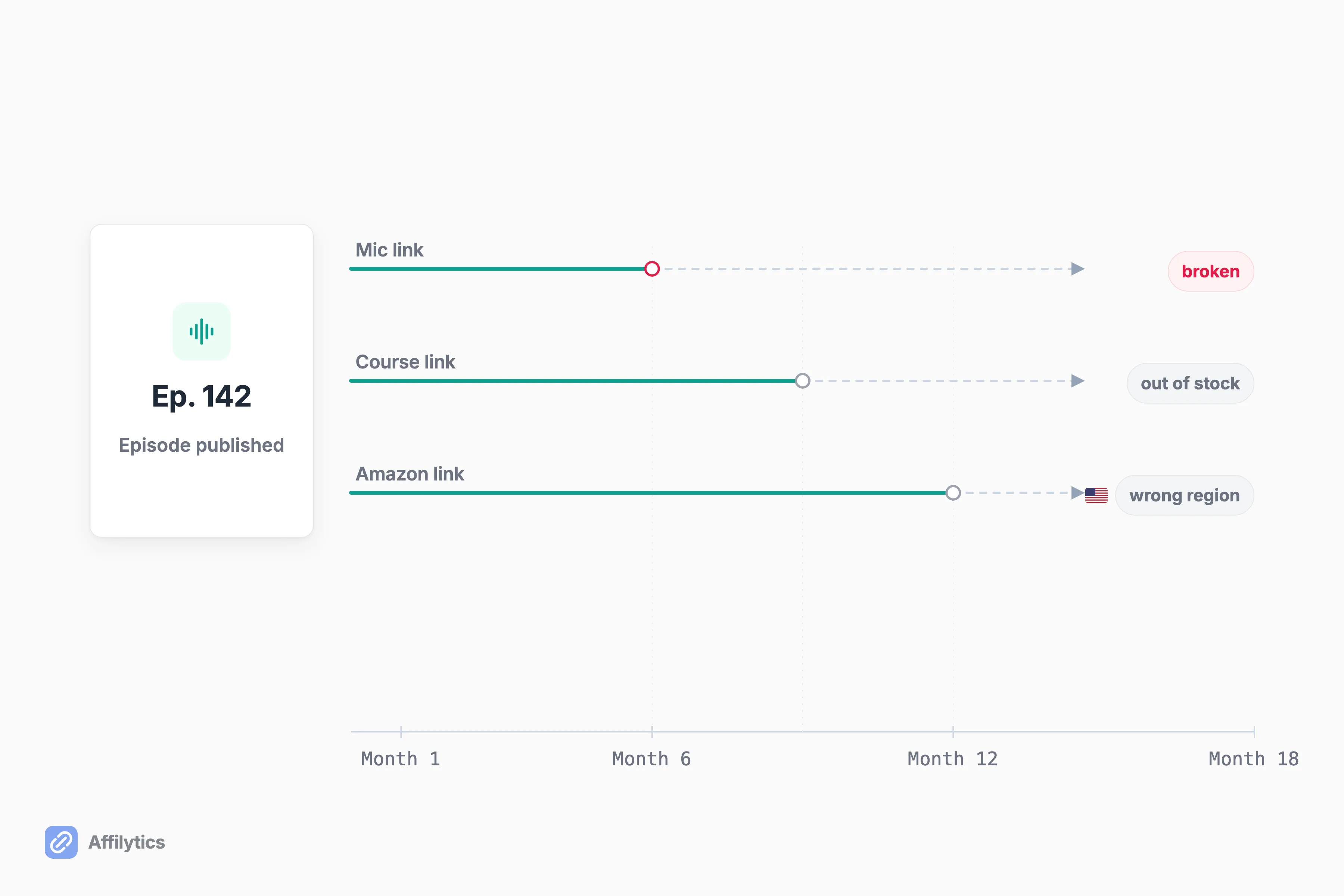
There are three ways those links leak commission, and most podcasters only notice the first one.
The first leak is that raw affiliate URLs are unsayable. They look like shareasale.com/r/long-string-of-gibberish, which nobody can read aloud and no listener can copy down. As u/NeitherOfEither asked in r/podcasting, “I can’t imagine a podcaster trying to say it or a listener managing to copy all that down.” A short, memorable link fixes this surface problem.
The second leak is the real pain, and a podcaster named it perfectly. Affiliate links change structure over time, programs get redesigned, tags get reformatted, and then every old placement points somewhere stale. As u/headph0neguy explained, “once your tagged affiliate link changes structure (they always do) you can just change the target URL page on your redirect one time … instead of trying to find every instance you used the link and swap them out.” That is the difference between editing one link and re-editing your entire back catalog by hand.
The third leak is the one almost nobody articulates: region. Podcasts reach a large, globally distributed audience, but an Amazon.com link sends a UK or German listener to a store they cannot easily buy from, and your commission evaporates. The click happened. The sale did not.
The fix for all three is one idea: a single short, repointable link per recommendation that you change in one place and that routes each click by the listener’s country. That is exactly what an Affilytics smart link does. The go.affilytics.io/{slug} link routes each click by visitor country to the right regional store first, then quietly flags itself the moment a destination breaks or goes out of stock. You change the destination once, and every show note pointing at that slug updates with it. One honest note: you create that smart link yourself and drop it into your show notes by hand. Our link discovery scans YouTube channels and crawls websites, so if your show notes live on your own site we can find those links, but we don’t read podcast RSS feeds or a host’s default episode page. The geo-routing and monitoring then run on that link wherever you publish it.
If you want to see what that international traffic is actually leaking, we wrote separately about what your international traffic is worth and how to audit your affiliate links in bulk.
What to Look For in a Podcast Affiliate-Link Tool
Section titled “What to Look For in a Podcast Affiliate-Link Tool”Before the tool list, here are the six questions to ask. Each one maps to a column in the comparison table below, so you can self-select instead of reading every review.
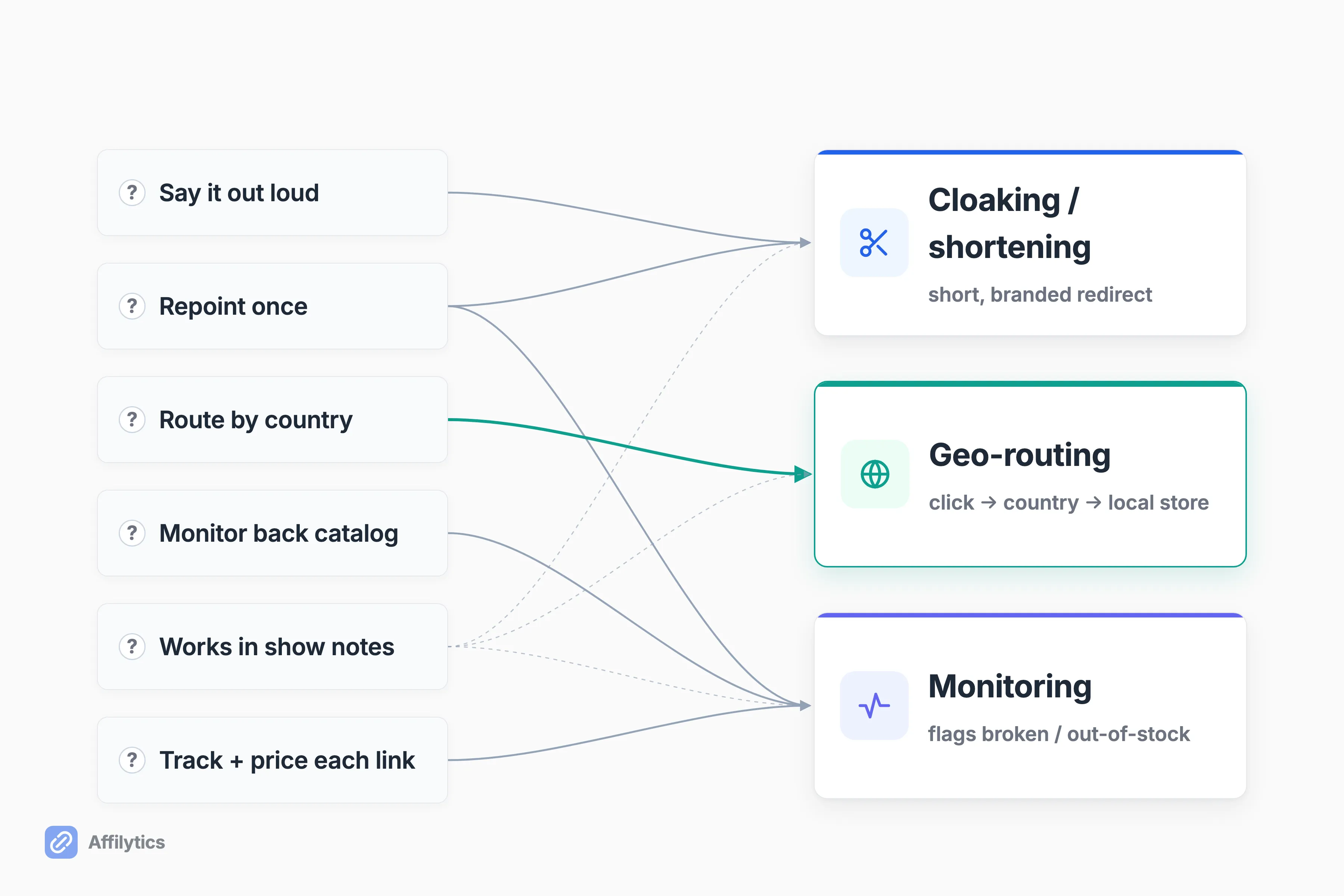
- Can I say it out loud? A short, branded redirect listeners can actually type beats a wall of tracking gibberish.
- Can I repoint it once? When the underlying link changes, you want to update the destination in one place, not across every episode.
- Does it route by country? A global listener base means an Amazon.com link is leaking commission from everyone outside the US.
- Does it monitor the back catalog? Something needs to flag a broken or out-of-stock link before your listener hits it, not after.
- Does it work where my show notes live? Plenty of tools only run inside one CMS. Your show notes may live on your host’s page instead.
- How does it price, and can I track each link? Flat pricing versus per-click changes the math at scale, and per-link tracking tells you which recommendations actually convert.
That last point is not theoretical. Podcasters in r/podcasting talk about using per-host tracking to see “which podcasts are actually driving sales versus just vanity metrics.” If you can only see clicks and not conversions, you are guessing.
The Best Tools to Manage Podcast Affiliate Links
Section titled “The Best Tools to Manage Podcast Affiliate Links”No single tool wins every row. Where your show notes live and how global your audience is decides which one fits. Here is the quick comparison, then an honest one-paragraph read on each.
| Tool | Cloaking / shortening | Geo-routing | Monitoring | Cross-platform | Pricing model | Best for |
|---|---|---|---|---|---|---|
| PrettyLinks | Yes | Yes (all tiers) | Yes (LinkHealth) | WordPress only | Flat, annual | WordPress show-notes sites |
| ThirstyAffiliates | Yes | Yes (Basic+) | Yes (404 checker) | WordPress only | Flat, annual | WordPress + Amazon shows |
| Amazon OneLink | No | Yes (Amazon only) | No | Any | Free | Amazon-only shows |
| Geniuslink | Yes | Yes (Amazon/Apple/Microsoft) | Amazon only | Any | Per-click | Global Amazon/Apple shows |
| Lasso | Yes | Yes (Pro tier) | Yes (Creator tier) | Multi-platform | Flat, monthly | Shows with a companion site |
| AMZ Watcher | No | No | Yes (Amazon only) | Website / YouTube | Flat, metered | Auditing a large Amazon site |
| Affilytics | Yes | Yes (any destination) | Yes (continuous) | Any | Flat | Cross-platform, geo + monitoring |
PrettyLinks
Section titled “PrettyLinks”Best for WordPress-hosted show-notes sites that want branded, memorable redirects. PrettyLinks gives you a free WordPress plugin for branded cloaking, Geographic Redirects in all three tiers, and LinkHealth broken-link monitoring with alerts. Pat Flynn even endorses it for “bloggers and podcasters”. The honest limit: it is WordPress-only, so it does nothing for you if your show notes live on your host’s default episode page or a non-WordPress site.
ThirstyAffiliates
Section titled “ThirstyAffiliates”Best for WordPress podcasters who lean heavily on Amazon links. It does smart uncloaking for Amazon Associates compatibility, ships an Automatic 404 Checker for broken affiliate links, and includes Geographic Redirects in the Basic tier and up. It is also a free WordPress plugin to start. Same constraint as PrettyLinks, though: it is WordPress-only, so it cannot follow your links onto a non-WordPress show-notes page.
Amazon OneLink
Section titled “Amazon OneLink”Best for podcasters who only promote Amazon and want a free geo fix. OneLink is free, official, and routes international visitors to their local Amazon storefront across 12 Amazon marketplaces. For an Amazon-only show, it is the obvious starting point. The honest limit is real, though: it is Amazon-only, it does no broken-link detection, it cannot point at a non-Amazon destination, and six markets including Mexico, Brazil, and India are not covered at all.
Geniuslink
Section titled “Geniuslink”Best for global shows promoting Amazon and Apple who accept per-click pricing. Geniuslink’s Product Localization auto-routes to local Amazon, iTunes/Apple, and Microsoft storefronts, its smart links work cleanly in show notes, and it does mobile deep linking. If you want a more flexible Geniuslink alternative, we compared the options separately. The honest limit: it prices per click, so the cost grows with your traffic and there is no free tier, and its link monitoring is Amazon-only.
Best for podcasters with a companion site or link-in-bio who want product displays plus brand-deal upside. Lasso is genuinely multi-platform across WordPress, YouTube, Instagram, and Link-in-Bio pages, with broken-link alerts at the Creator tier, geo-routing at the Pro tier, and an Affiliate+ marketplace that brokers higher commissions. The honest limit: geo-routing and the API are gated to higher tiers, and the display-box value is strongest on a website, less so for a pure audio show.
AMZ Watcher
Section titled “AMZ Watcher”Best for auditing a large companion website’s Amazon links at scale. It runs a deep Amazon-specific audit for broken links, missing tags, and out-of-stock products, crawls a full website or a YouTube channel, and sends a free monthly broken-links report. The honest limit: it is Amazon-only, and it is a checker, not a geo-router or a smart-link tool. It openly markets itself as “compatible with” Geniuslink and OneLink for the geo step, which tells you it does not do that part itself.
Affilytics
Section titled “Affilytics”Best for podcasters who want one repointable link per recommendation that geo-routes by country and auto-flags when it breaks, across any platform, without per-click fees. Our smart links (go.affilytics.io/{slug}) route each click to the right regional store, then run continuous health monitoring across the major affiliate networks, not just Amazon, on a flat plan with a free tier and a 14-day no-card trial. You create a smart link for each recommendation and paste it into your show notes. The honest limit, stated plainly: our link discovery scans YouTube channels and crawls websites, not podcast RSS feeds. If your show notes live on your own site we can crawl them; if they live only on a host’s default episode page, creating that show-note link is a manual step. The geo-routing and monitoring then work on that link anywhere you publish it.
Stay Compliant: Disclosure and the Double-Dipping Rule
Section titled “Stay Compliant: Disclosure and the Double-Dipping Rule”Two short rules keep you out of trouble, and the podcasting community polices both pretty hard.
First, disclosure. The FTC requires clear disclosure of affiliate relationships, and you owe it on-air and in the show notes. The r/podcasting community takes this seriously enough that its auto-moderator posts a required-disclosure reminder on affiliate comments. Say it when you read the recommendation, and write it near the link.
Second, the double-dipping rule. Do not run an affiliate link on a placement a sponsor already paid for. As Dennis from Castos put it in r/podcasting, “If the sponsor pays for the ad, then no, you shouldn’t use affiliate links. That’s double dipping and your sponsor won’t like it.” Use affiliate links where there is no paid sponsor, and keep the two streams separate.
Make the Dollars You Earn Stick
Section titled “Make the Dollars You Earn Stick”The money from audio is hard-won, so the worst outcome is earning a commission and then losing it to a broken link or a listener stuck on the wrong country’s store. That is the gap worth closing.
You can create your free account and try it with everything unlocked for two full weeks, no credit card. Route each recommendation by country, and get flagged the moment a link breaks.
Do podcasters actually make money with affiliate links?
Section titled “Do podcasters actually make money with affiliate links?”Yes, but modestly. Audio is a poor click medium, so most of the revenue tends to come through your show notes and a companion website rather than the spoken ad. One podcaster reported making about 80 dollars in five years, almost all of it from links on his website. The right product for your audience matters far more than the headline commission rate.
Where should I put affiliate links for a podcast?
Section titled “Where should I put affiliate links for a podcast?”There are three surfaces: a short spoken redirect you say on-air, the full link in your show notes, and your website or newsletter. Keep one short, memorable link per recommendation so listeners can actually type it and you only have one place to update later.
Do I have to disclose affiliate links on my podcast?
Section titled “Do I have to disclose affiliate links on my podcast?”Yes. The FTC requires clear and conspicuous disclosure of affiliate relationships. Say it on-air when you read the recommendation, and put it in the show notes near the link so listeners and readers both see it.
Can I use affiliate links and sponsorships at the same time?
Section titled “Can I use affiliate links and sponsorships at the same time?”Not on the same placement. If a sponsor already paid for the spot, running an affiliate link there too is double-dipping and your sponsor will not like it. Use affiliate links where there is no paid sponsor instead.
What’s the best tool to manage podcast affiliate links?
Section titled “What’s the best tool to manage podcast affiliate links?”It depends on where your show notes live and how global your audience is. WordPress sites suit PrettyLinks or ThirstyAffiliates, Amazon-only shows can start with free Amazon OneLink, and cross-platform podcasters who want one repointable, geo-routed, auto-monitored link per recommendation can use Affilytics.