
What Is a Smart Link in Affiliate Marketing (Really)?
You searched “smart link for affiliate marketing,” and about half the results are answering a question you didn’t ask. The phrase points at two different tools depending on who’s using it, and most creators land on the wrong explanation.
We build Affilytics to send each affiliate click to the right regional store and to catch the links that quietly stop paying, and we wrote the routing and checking engines ourselves, so we spend most of our week inside how these links actually behave.
If you want the wide-angle version, how geo affiliate links work covers the whole routing idea. This post zooms all the way in on one word.
Here I untangle the two meanings, give you a plain definition of a creator smart link, and hand you a four-feature test so you can spot a real one from a shortener wearing the name.
Two Different Things Get Called a “Smart Link”
Section titled “Two Different Things Get Called a “Smart Link””The confusion isn’t your fault. Type the phrase into Google and two completely different products answer, and neither page bothers to mention that the other one exists.
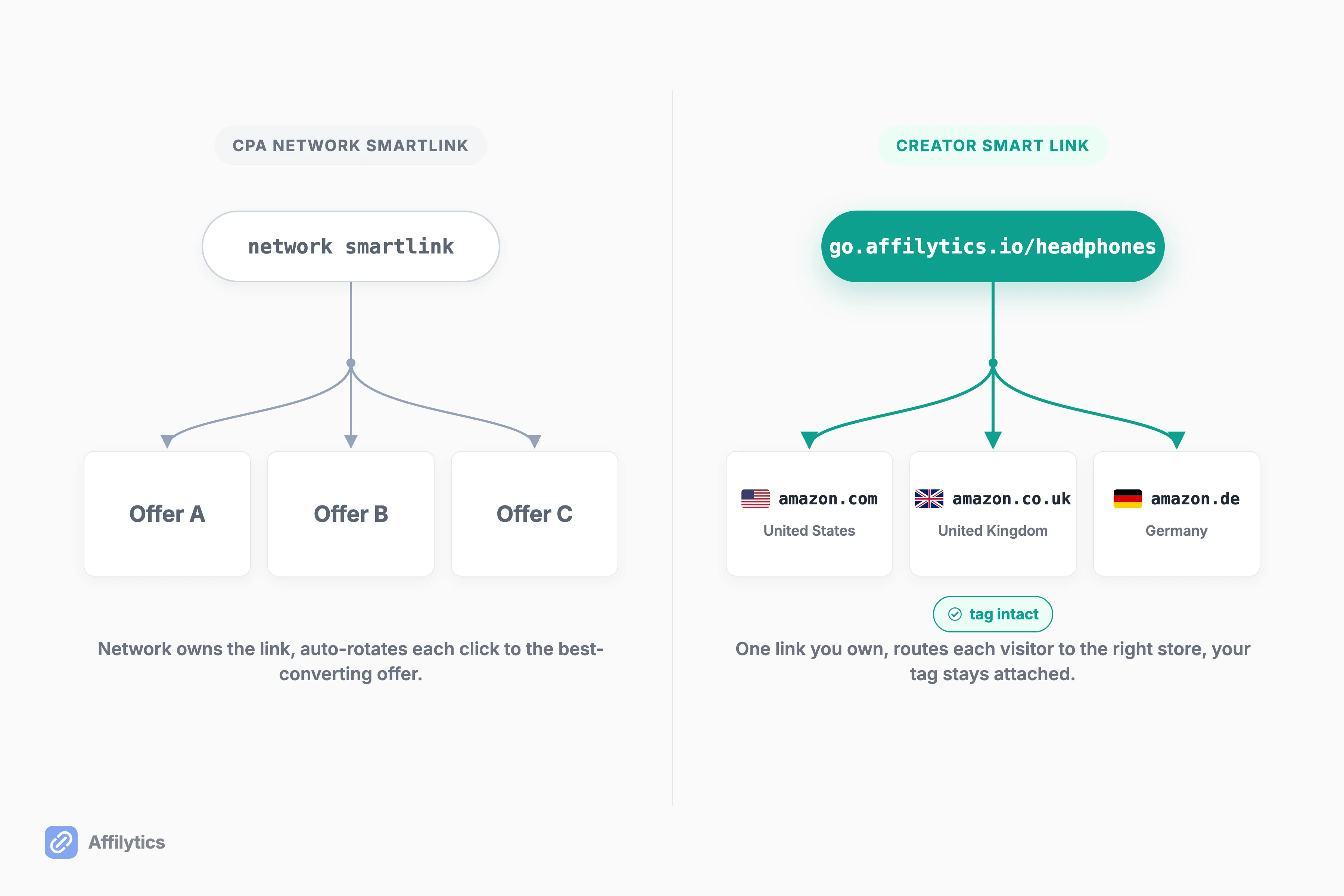
The first meaning is the CPA or ad-network “smartlink.” It’s a link an affiliate network hands a media buyer running paid traffic. It bundles many offers and auto-rotates each click to whichever offer converts best for that visitor’s country and device. The buyer doesn’t much care which product wins, as long as one of them does. The network owns the link, configures the rotation, and keeps the relationship with the merchants. Networks like RichAds and MyLead build their whole pitch around this version.
That’s the version filling the first page of Google when you search the phrase. So if you landed on a stack of explainers about “how the algorithm picks the best-converting offer,” and none of it matched what you’re doing, that’s why. You’re reading about a media buyer’s tool.
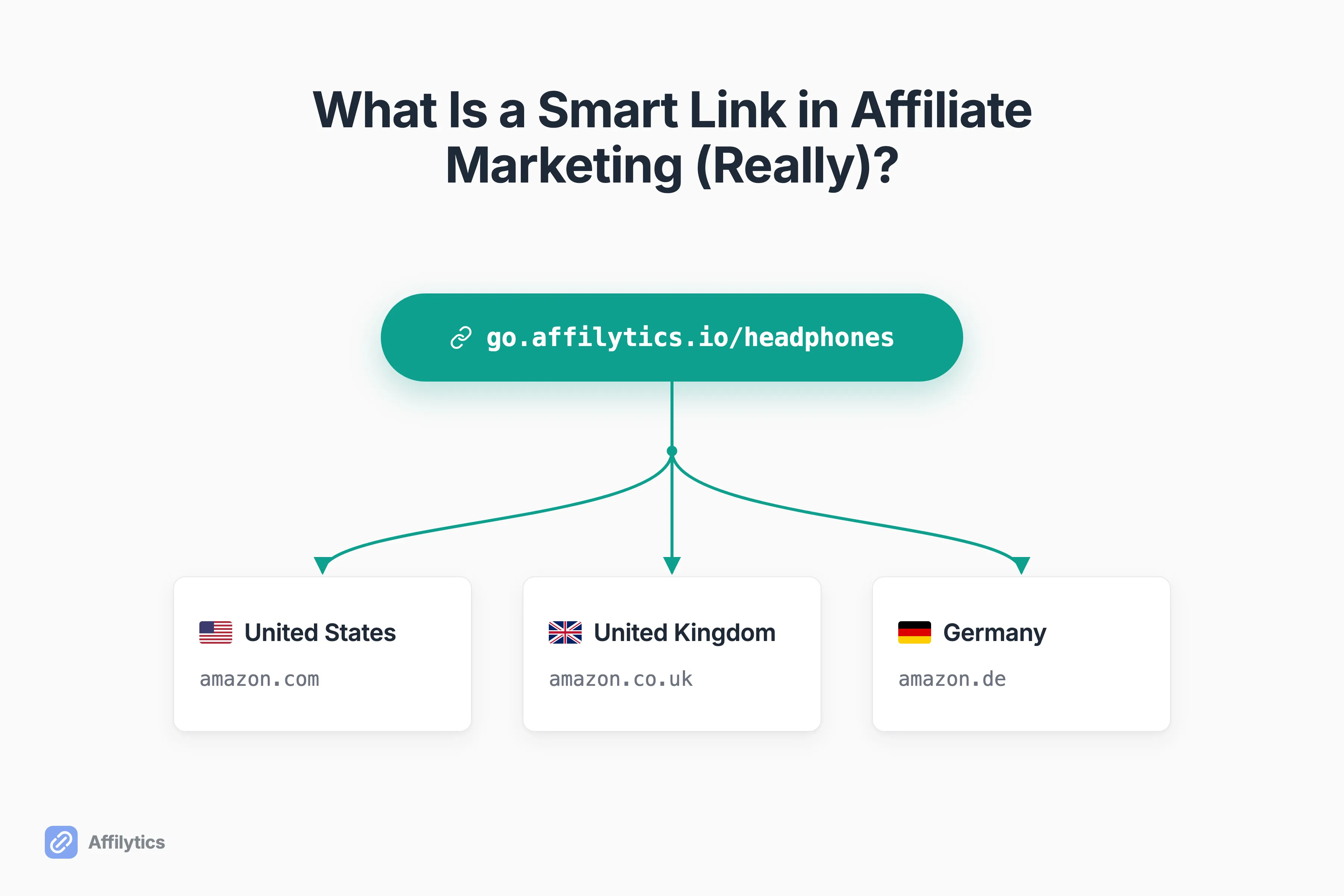
The second meaning is the creator smart link. It’s a link you own. It routes each visitor to the right destination for them, usually the right regional store, while keeping your own affiliate tag attached. You set the rules. You keep the commission.
This post is about the second one. If you’re a creator with an audience and your own affiliate links, you almost never mean the network version. You mean the one that stops your two-year-old Amazon.com link from dumping your German viewers onto a checkout they can’t use.
So What Is a Smart Link, in Plain Terms?
Section titled “So What Is a Smart Link, in Plain Terms?”A smart link is one link you own that decides where each click goes, based on rules you set, instead of pointing every visitor at the same fixed URL.
The cleanest way to say it: a single tracking link that routes each user by rules like country or device, with a default fallback when no rule matches. That fallback matters. It means nobody ever hits a dead end, even a visitor from a country you never wrote a rule for.
So what isn’t a smart link? Plenty of things carry the label without doing the work:
- A plain shortener that just relabels one destination with a prettier domain. Same page for everyone, shorter to type.
- A QR “smart link” like Billetto’s, which gives you a trackable URL and a QR code but still sends everyone to the same place, with no geo-routing at all. It counts scans; it doesn’t route them.
- A cloak that only hides an ugly affiliate string. The URL looks nicer; the routing is still dumb.
Each of those is useful for what it does. None of them is deciding anything per click. The intelligence lives in the routing and the rules, not the short domain. In our product, the link looks like go.affilytics.io/{slug}, and behind that slug sits a set of routing rules you control: one per country, each pointing wherever you want that country’s clicks to land.
The 4 Features That Separate a Real Smart Link From a Label
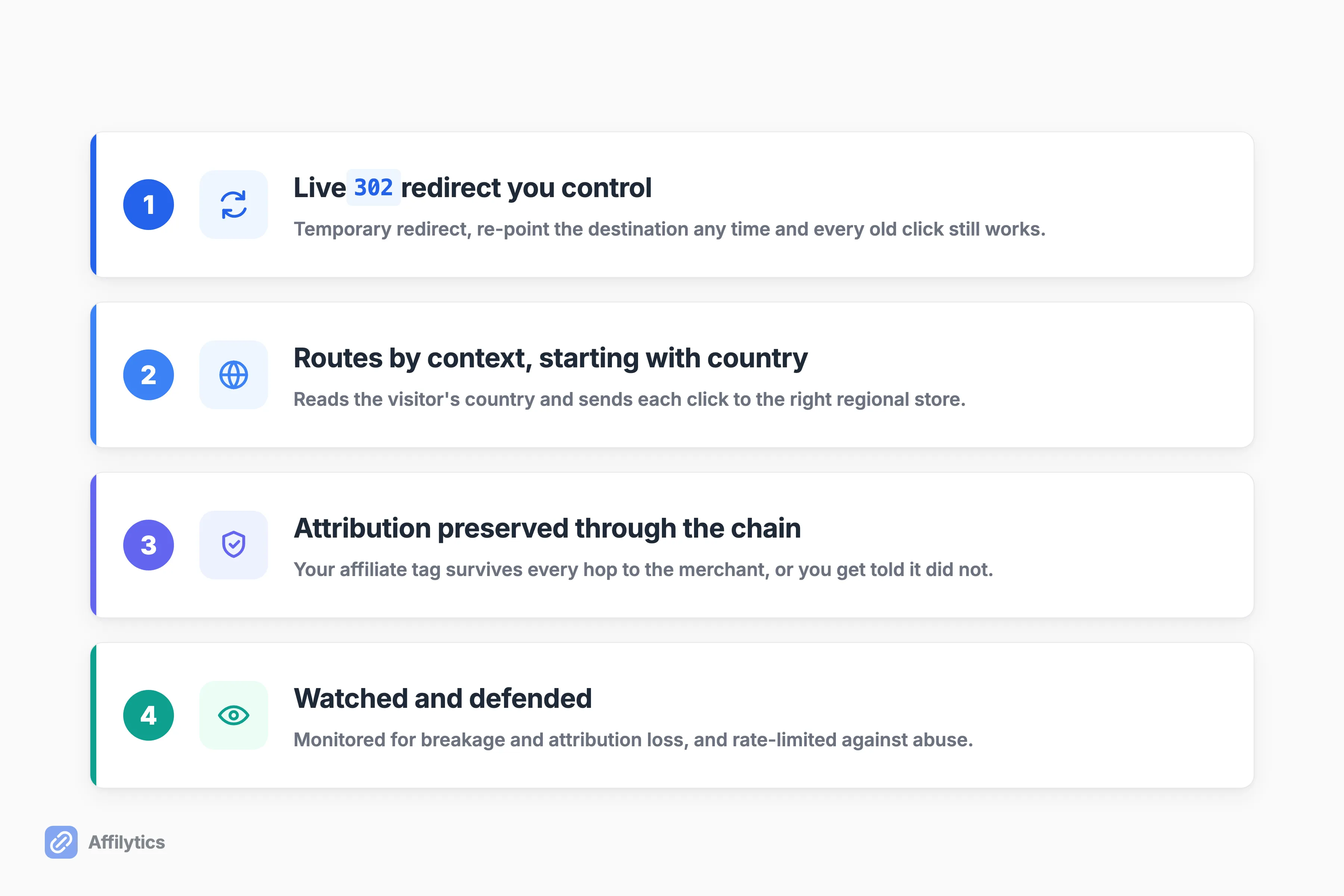
Section titled “The 4 Features That Separate a Real Smart Link From a Label”Here’s the test. If a link doesn’t do these four things, it’s a shortener with a nicer name.
1. It’s a Live 302 Redirect You Control
Section titled “1. It’s a Live 302 Redirect You Control”A real smart link is a temporary redirect, the kind a browser is told not to cache. In plain terms, a 302 is a temporary redirect where the destination can change, so you can swap where the link points any time and every old click still lands on a working page.
A permanent (301) redirect or a hardcoded cloak does the opposite. Browsers and networks cache it aggressively, the destination gets locked into people’s devices, and changing it later is a fight you rarely win. Some of your audience keeps getting sent to the old page for weeks.
Picture the everyday version of this. A merchant discontinues the exact product you linked, or redesigns the page and the old URL 404s. With a 301 or a cloak, every video and post pointing at that link is now leaking clicks, and fixing it means editing each one by hand. With a 302, you re-point the single smart link once and every old click starts resolving to the new page immediately. Affilytics smart links use a 302 for exactly this reason.
That’s the whole point of “smart.” The destination stays yours to move.
2. It Routes by Context, Starting With Country
Section titled “2. It Routes by Context, Starting With Country”This is the part that earns the word. The link reads where each visitor is and sends them to the right place, starting with their country.
When someone clicks a smart link, the router looks up their location from the visitor’s IP address, matches it against your routing rules, and sends them to the first rule that fits with a 302. No rule matches? They fall through to your default URL, so nobody is ever stranded. Country is the primary signal, and rules can factor in other context like device on top of it.
Why it matters is simple. One static Amazon.com link serves the wrong storefront to most of the planet. Your UK viewer lands on a US store with US pricing, US shipping, and no local Prime checkout. Your German viewer sees a listing they can’t buy from. In practice that click either strips your commission, converts at a fraction of the rate, or bounces entirely. As one marketer put it, a single link often can’t serve multiple markets effectively.
A smart link fixes that per click. Instead of one link for the whole world, you set a rule that sends UK traffic to amazon.co.uk, German traffic to amazon.de, and everyone else to a sensible default, all behind the same short URL. The click-to-storefront routing path is only a few steps, and it runs in the milliseconds before the page loads, so the visitor never sees the detour.
3. It Preserves Your Attribution Through the Whole Chain
Section titled “3. It Preserves Your Attribution Through the Whole Chain”In May 2026, Razr owners noticed something strange. Tapping the Amazon app opened a browser instead, bounced through a sketchy URL, and only then landed on amazon.com, now carrying someone else’s affiliate code. A preinstalled system app called “Smart Feed” was intercepting the tap and slipping a third party’s tag into the chain.
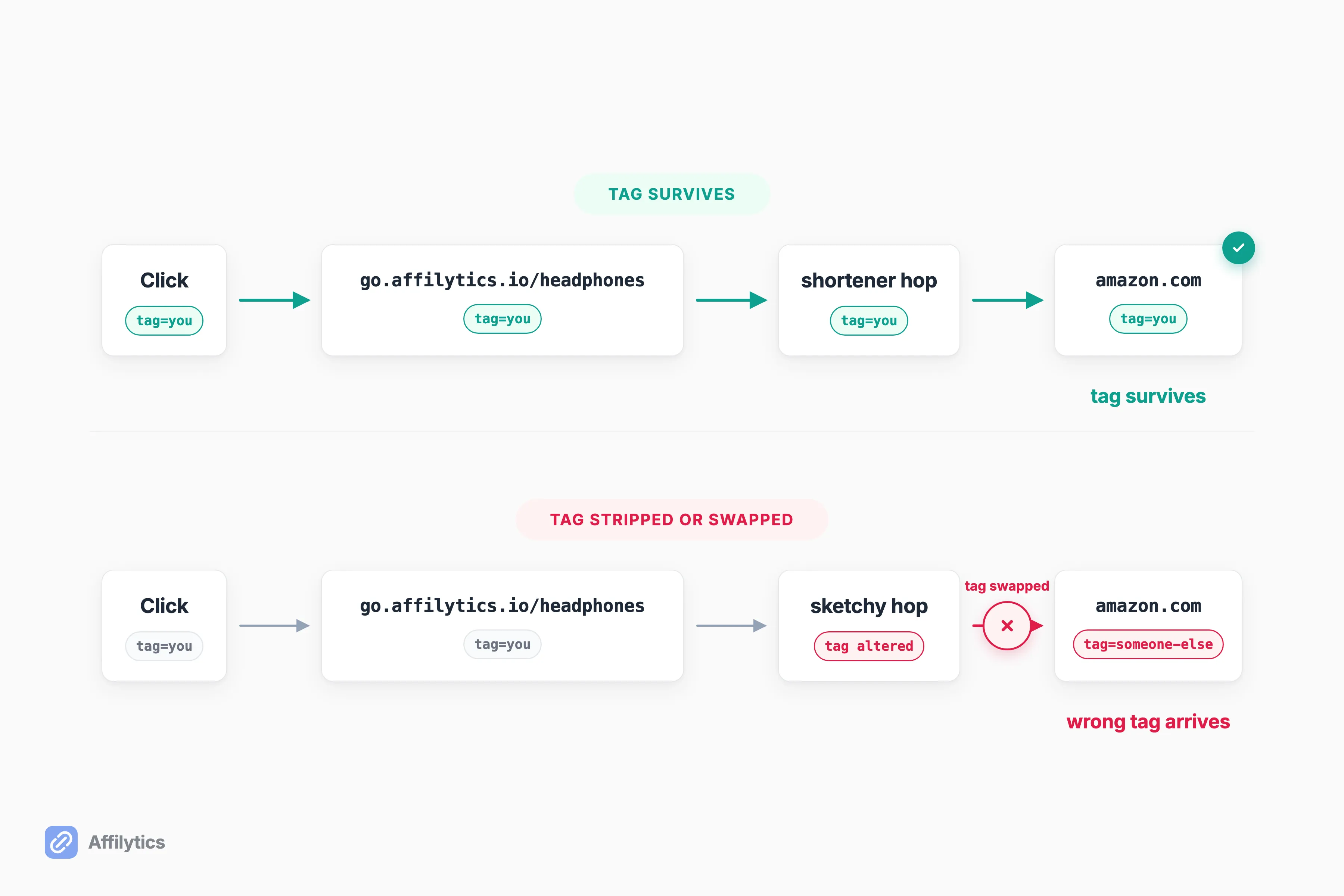
A preinstalled app hijacked Amazon-app taps to insert a third party’s affiliate code, and people only caught it by sniffing their own network traffic. The important part for you isn’t the specific app. It’s the lesson: attribution can be tampered with anywhere in the redirect chain, in either direction. A third party can insert its code, or your own tag can get quietly stripped by a hop you didn’t know was there. Either way, the commission you earned goes to someone else, or to nobody.
The creator-side version is quieter than the Motorola case but just as costly. Your link passes through a shortener, a coupon extension, or a redesigned merchant redirect, and somewhere in that chain your tag falls off. The page still loads. The sale still happens. You just don’t get paid for it, and nothing on the surface tells you.
A real smart link is a place your commission is protected, not a place it silently changes hands. Affilytics follows each redirect chain and flags when a link’s affiliate tag gets stripped along the way; that failure surfaces as an attribution-lost status, kept separate from a plain broken link, because a link that loads fine while losing your tag would otherwise look healthy. If you want the mechanics, how affiliate attribution gets stripped walks through where tags actually disappear.
4. It’s Watched and Defended
Section titled “4. It’s Watched and Defended”A smart link is a live asset, not a fire-and-forget string. Two words carry this one: watched and defended.
- Watched: the destination is monitored so you find out when it breaks, loses attribution, or goes out of stock, before your audience does. Affilytics tracks each link across eight states (active, broken, attribution-lost, out-of-stock, and a few more) and alerts you the moment a check sees a change, not once a month.
- Defended: the redirect endpoint only accepts a small burst of requests per second before it throttles, which keeps bots and abuse from hammering it.
Here’s why “watched” is not optional. When a link skims a few cents per click, nobody notices. Redditors dissecting that Motorola app joked they’d each recover about three dollars: tiny individually, systemic in total. The same math runs against your own links. A product that quietly went out of stock, a program that shut down, a tag that stopped attributing, each one costs a little per click and nothing announces itself. You find out at payout time, months later, if you find out at all.
A link you set once and never check again isn’t smart. It’s a liability with a nice domain.
Do the Popular Tools Actually Pass All Four?
Section titled “Do the Popular Tools Actually Pass All Four?”So which tools clear the bar? Most do some of it, and each one below is genuinely good at something. Read this as feature coverage, not a scoreboard.
| Tool | Live 302 routing | Geo routing | Attribution cross-network | Watched + defended | Best for |
|---|---|---|---|---|---|
| Amazon OneLink | Yes | Yes (Amazon only) | No | No | Amazon-only beginners who want free |
| Geniuslink | Yes | Yes (Amazon, iTunes, Microsoft) | Amazon, iTunes, MS focus | Monitoring, Amazon-only | Amazon-heavy affiliates wanting a mature paid tool |
| URL Genius | Yes | Yes (app-deep-link first) | Amazon Attribution Partner | No | Creators who need app deep links |
| Pretty Links / ThirstyAffiliates | Yes (WordPress) | Yes (WordPress only) | No (cloaking, not cross-network) | 404 checks (depth undisclosed), WordPress only | WordPress bloggers |
| Affilytics | Yes | Yes (any network) | Yes, cross-network | Yes, stealth monitoring + rate-limited | Creators with links across YouTube and social who want geo income plus monitoring |
If you sell only Amazon products to a mostly-Amazon audience, OneLink is free and fine. Amazon offers it as Amazon’s free geo-redirector for international traffic, and for a lot of beginners that’s enough. It sends international shoppers to their local Amazon store and costs nothing. If OneLink is where you’re starting, what Amazon OneLink can and can’t do covers its limits in depth.
Geniuslink is the mature paid option in this group. Its Product Localization routes buyers to their local storefront across Amazon, iTunes, and Microsoft, not just Amazon, and it monitors links for breakage, though that monitoring stays Amazon-only. If most of your revenue is Amazon and you want a polished tool with a track record, it earns its place.
URL Genius comes at routing from a different angle. It leads with codeless app deep linking, opening a link straight into the native app instead of the mobile web, and it’s a verified Amazon Attribution Partner. Geo-routing is there, but it’s secondary to the app-linking story. Best fit if deep links into apps are what you actually need.
Pretty Links and ThirstyAffiliates do route by country, so don’t let anyone tell you they “can’t geo-route.” Their honest limit is different. They’re WordPress-only, so they can’t touch a link living in a YouTube description or a link-in-bio. Their broken-link checking depth is undisclosed, and they cloak links rather than defend attribution across networks. For a WordPress blogger who wants clean, cloaked links inside their site, they’re a solid pick.
The gap they all share opens when your links span more than one network, or live on YouTube and social instead of a blog, or need to be watched for attribution loss and not just a dead 404. That’s the slice Affilytics is built for.
How Affilytics Builds a Real Smart Link
Section titled “How Affilytics Builds a Real Smart Link”We built Affilytics around that four-feature bar, and geo-routing comes first because it’s the part that grows your income rather than just protecting it. You create a go.affilytics.io/{slug} link, add a rule per country, and point each rule at the right regional store on any network, not just Amazon. Every click resolves through a 302, so the destination stays yours to move forever, and we log each click by country so you can see where your audience actually shops.
Behind that sits the loss-prevention half. We health-check each destination continuously with a browser-like fingerprint, so the checks don’t get bounced by the bot walls (Cloudflare and the like) that guard most retail sites. When a tag gets stripped or a product goes out of stock, the status changes and you hear about it, instead of finding out from a thin payout three months on.
Then the part no tool in that table ships:
- Paste your YouTube channel and Affilytics reads your video descriptions and finds the affiliate links you already published, then monitors them.
- Paste a blog or website instead and it crawls your pages, sitemap first, to find the links you published there. The crawl reads static HTML, so a fully JavaScript-rendered site may not scan.
- The smart links themselves work anywhere you can paste a link: blog, link-in-bio, social, wherever your audience clicks.
Make One and Watch It
Section titled “Make One and Watch It”If your audience or your links cross any borders or platforms, the move is simple: build one real smart link and watch what it does for a week. Create your free account and you get two full weeks with everything unlocked, no credit card.
When you’re ready to set one up, how to create your first smart link walks through the steps.
Is a smart link just a link shortener?
Section titled “Is a smart link just a link shortener?”No. A shortener swaps one long URL for a shorter one and sends everyone to the same place. A real smart link routes each click by rules you set, usually country first, keeps your affiliate tag attached through the redirect, and is monitored so you know when it breaks. The short domain is the least interesting part of it.
Is Amazon OneLink a smart link?
Section titled “Is Amazon OneLink a smart link?”Partly. OneLink is a genuine geo-redirect that sends international shoppers to their local Amazon store, and it’s free. But it’s Amazon-only, it doesn’t defend attribution for non-Amazon links, and it doesn’t monitor your links for breakage. It passes some of the four features, not all. If you’re Amazon-only, that can be all you need.
What makes a smart link “smart” versus a normal affiliate link?
Section titled “What makes a smart link “smart” versus a normal affiliate link?”Four things a plain affiliate URL doesn’t have: a live 302 redirect you can re-point any time, geo and conditional rules that route each click, attribution that survives the whole redirect chain, and active monitoring of the destination. A normal affiliate link is a fixed string that points at one page and never tells you when that page dies.
Do smart links violate affiliate program terms or hurt SEO?
Section titled “Do smart links violate affiliate program terms or hurt SEO?”A proper 302 redirect with clear disclosure is standard practice, and tools like OneLink and Geniuslink explicitly market their redirects as program-safe. Routing a click by country isn’t cloaking; cloaking is showing search engines something different from what users see. Always read each program’s terms, but the routing itself is normal.
Do I need a smart link if most of my audience is in one country?
Section titled “Do I need a smart link if most of my audience is in one country?”Probably still yes. Even a small international slice loses commission every time it lands on the wrong storefront, and the other three features (swappable redirects, attribution preservation, and breakage monitoring) help no matter where your audience lives. Geo-routing is the headline benefit, not the only one.