
Geniuslink Pricing: The $9.50 Cliff at 1,001 Clicks
In January, a creator opened his Geniuslink invoice, found it higher than the month before, and went to Reddit to ask whether he had imagined it. He had not. Geniuslink pricing changed in October 2025, and the way it changed lands hardest on the creators who are growing.
We build a smart-link router at Affilytics, so we price this exact decision for a living. That is also why this post runs the arithmetic on Geniuslink’s published rates instead of telling you how we feel about them.
If you are here to sanity-check a bill, you probably also want the alternatives worth considering, and maybe the prior question of whether you need a smart-link tool at all.
This post covers what Geniuslink costs today, what changed in October 2025, the bill at every click volume up to 10,000, what the per-click money actually buys, and how to tell whether the model still fits your traffic.
What Geniuslink Pricing Actually Is
Section titled “What Geniuslink Pricing Actually Is”Geniuslink runs on one tier. It is $6 a month, and that includes every feature plus the first 1,000 clicks each month. No plan ladder, no feature gate, no cheaper version that hides the good stuff behind an upsell.
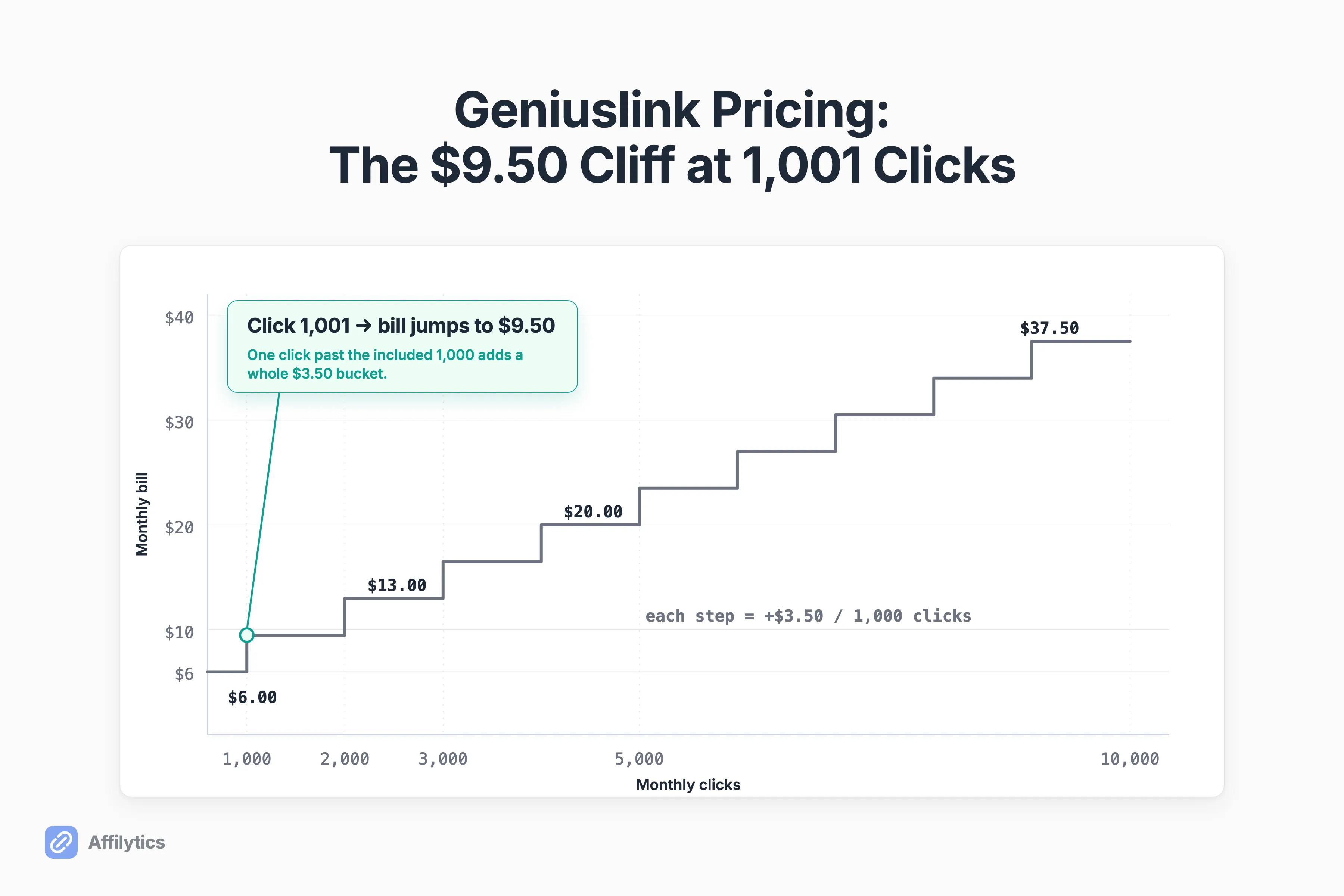
Above 1,000 clicks, you pay as you go: $3.50 for each additional bucket of 1,000 clicks. Billing runs monthly in arrears, so on the first of each month Geniuslink invoices you for the prior month’s traffic. Bot and junk clicks are not billed. There is no free tier, though there is a 14-day trial with unlimited clicks that requires a valid credit card.
Here is the one mechanic nobody puts in bold: buckets round up. Geniuslink bills a bucket whole. So the moment you cross into your second thousand, click number 1,001 costs you the full $3.50 by itself, even if the other 999 in that bucket never show up.
Stripped down, that is:
- $6/mo base, all features, first 1,000 clicks included
- $3.50 per additional 1,000-click bucket, rounded up
- billed monthly in arrears, bot clicks excluded
- no free tier, and a 14-day trial that needs a card
What Changed in October 2025
Section titled “What Changed in October 2025”For most of 2025, the same $6 got you more. Until September 2025, the base tier included up to 2,000 clicks, then charged $2.50 per additional 1,000. From October 2025, the included allowance is 1,000 clicks and the overage rate is $3.50 per 1,000.
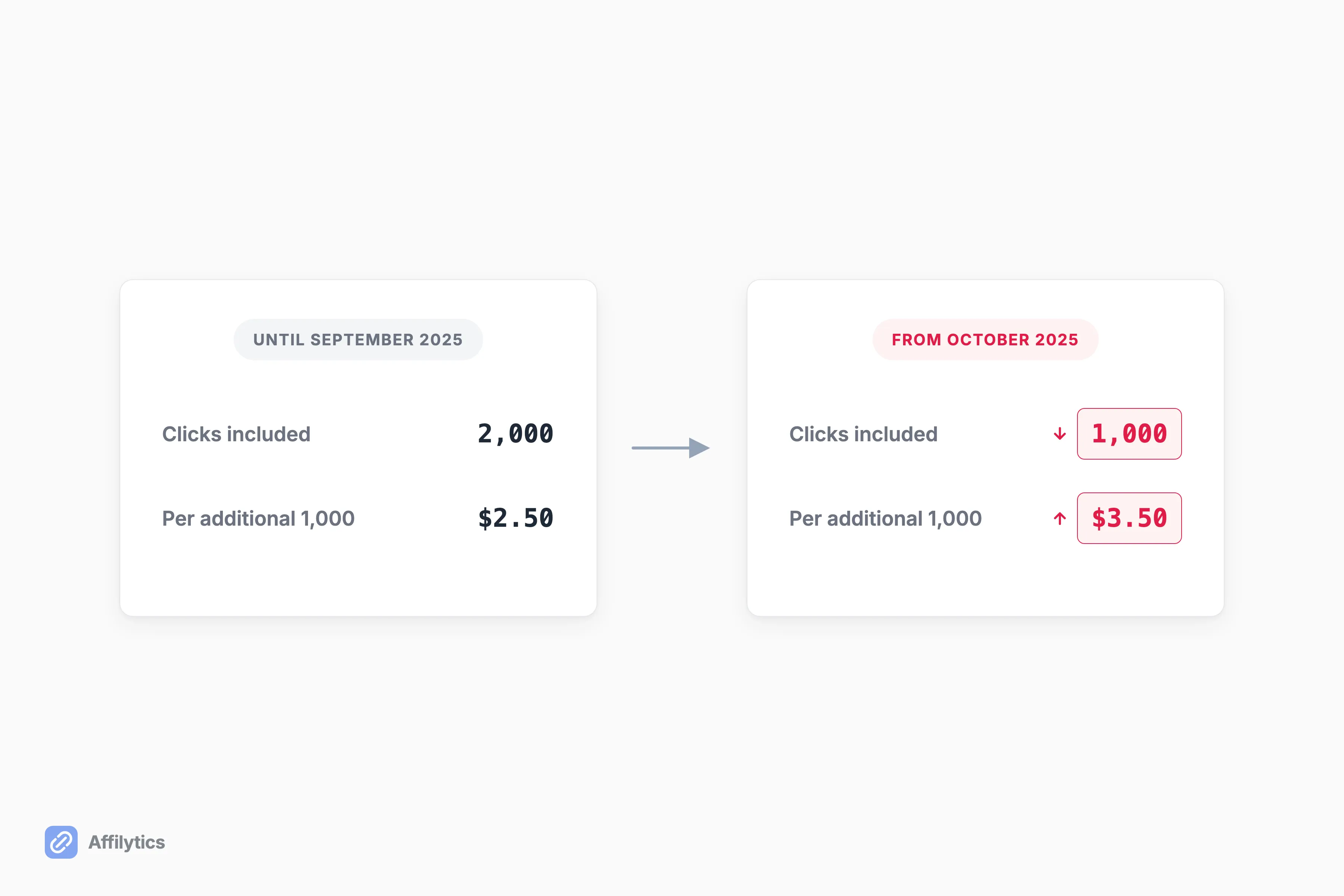
Two things moved at once, and that is the part worth slowing down on. The included-click floor halved, from 2,000 to 1,000. The per-bucket rate rose 40%, from $2.50 to $3.50. Neither change is dramatic on its own. For anyone sitting in the overage band, they compound.
The creator who kicked off the Reddit thread put it bluntly: “So it’s like a ~50% hike in my monthly bills. It would have been nice to be notified about this…” That figure is his bill at his volume, not a universal rate, but the frustration is real.
The “silent” part, though, is contested, and honesty means carrying both sides. Another paying customer in the same thread pushed back: “I got about 2 emails on their changes and it was also on the main page when you logged in. So no I would not say it was silently done.” The original poster conceded he might have missed it: “I couldn’t find any emails regarding this, maybe I missed it.” So the fair verdict is narrow. The rate changed, and at least some paying users were blindsided.
You can inspect the shift yourself in the Wayback Machine: the archived pricing page from August 2025 and the same page in December 2025. One caveat: the price figures on those pages load through JavaScript, so the snapshots prove the page existed on each date without necessarily rendering the old numbers on screen. The before-and-after figures above come from the creator who documented his own invoice.
The Bill Nobody Shows You
Section titled “The Bill Nobody Shows You”Because buckets round up, the first overage click is the most expensive click you will ever buy. Click number 1,001 costs $3.50 on its own. The bill jumps from $6.00 to $9.50, a 58% increase, and the effective cost of those 1,001 clicks spikes to $9.49 per thousand before it starts decaying again.
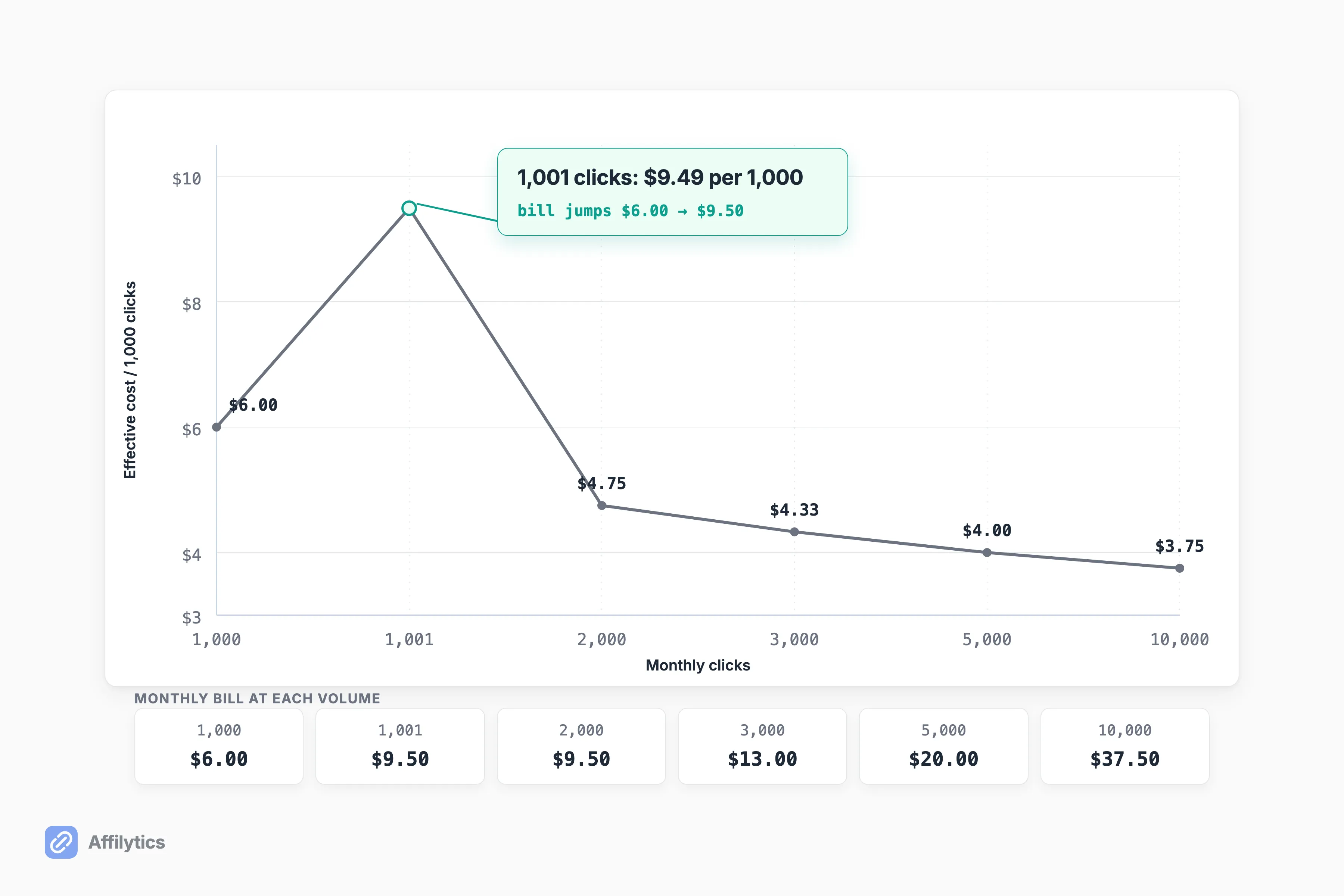
Run Geniuslink’s own published rates across a range of click volumes and the shape shows up. These are illustrative volumes against published rates, not observed customer data (Affilytics has no users’ invoices to average):
| Monthly clicks | Geniuslink bill | Effective cost per 1,000 clicks |
|---|---|---|
| 1,000 | $6.00 | $6.00 |
| 1,001 | $9.50 | $9.49 |
| 2,000 | $9.50 | $4.75 |
| 3,000 | $13.00 | $4.33 |
| 5,000 | $20.00 | $4.00 |
| 10,000 | $37.50 | $3.75 |
The curve is a sawtooth, not a smooth line. Each new bucket spikes the effective rate, then dilutes it as you fill the bucket out. The table stops at 10,000 because Geniuslink applies an escalating volume discount above that point and does not publish the schedule, so any higher number would be a guess.
You do not have to trust my arithmetic. Geniuslink’s own on-page calculator says 3,000 clicks costs $13.00, which is exactly the 3,000-click row. The method is theirs. I just ran it past the volume where their calculator conveniently stops.
There is a second line item the pricing page keeps below the fold. A custom domain is a flat +$50/mo add-on. So a branded short link at 1,000 clicks is $6 plus $50, which is $56 a month, nine times the base price for the same traffic. One Capterra reviewer flagged exactly this: the price “can be prohibitive for Associates who do not make a lot of money if they want a branded link.”
For contrast, a flat plan with unlimited clicks is one price at every row of that table, and a branded short domain is part of the plan rather than a surcharge on top of it. That does not make it the right tool for everyone, which is the rest of this post.
What the Per-Click Money Actually Buys
Section titled “What the Per-Click Money Actually Buys”It would be easy to stop there and call per-click a bad deal. That would be dishonest, because the money buys something specific, and the free floor does not do it.
Amazon’s own OneLink is free with an Associates account, and it does one job: it redirects an international visitor to their local Amazon store so the sale still counts. OneLink is free and covers a fixed set of Amazon marketplaces: Canada, the UK, Spain, Germany, France, Italy, Japan, Singapore, the Netherlands, Saudi Arabia, Poland, Sweden, and Australia.
Here is the gap. OneLink does not cover Mexico, Brazil, India, China, Türkiye, or the UAE, even though Amazon runs Associates programs in those countries. If your audience clicks from there, OneLink drops them, and the commission with them. That coverage gap is the concrete thing the per-click money buys back.
Geniuslink’s localization also reaches past Amazon. Its Product Localization covers Amazon, iTunes and Apple, and Microsoft storefronts, so it is not an Amazon-only tool, though its link-health monitoring is Amazon-only. A creator on r/juststart summed the trade-off up: “OneLink is limited to a few international programs where GeniusLink will let you use all of them.”
And when it works, it pays for itself. The most honest line in all the research came from a creator who had done the math the emotional way: “no tool is expensive if it’s making you money. My first month with Geniuslink, I started earning $180/month from my site’s international traffic.”
So what are you actually paying for? Not a link shortener. What happens after the click. As another creator put it, “Where Geniuslink comes in is everything after the click, so geo-routing, A/B testing, broken link monitoring, advanced analytics.” That after-the-click layer, how geo-routing actually works and what international traffic is worth, is the axis every smart-link tool competes on, ours included.
The Flat-Rate Alternatives, Honestly Compared
Section titled “The Flat-Rate Alternatives, Honestly Compared”If the per-click curve has turned on you, there are three real places to go. Each has a genuine limit, and pretending otherwise would just be a different kind of sales pitch.
Amazon OneLink ($0). Free, official, and enough for a lot of people. It is Amazon-only and redirect-only: no analytics, no broken-link alerts, no non-Amazon destinations, no public API. Best for creators whose traffic is small, or whose audience sits inside OneLink’s marketplace list. If that is you, there is a $0 path and you should take it.
Lasso (flat, but gated). Lasso is flat-tiered: Free, then Creator at $19/mo, Pro at $29/mo, and Studio at $59/mo, with annual billing running roughly 16 to 22% cheaper. It is multi-platform, WordPress, YouTube, Instagram, Link-in-Bio, and HTML embed, not a WordPress-only plugin. The catch is where the features live. Lasso gates geo-routing (international link localization) to Pro and above, broken-link alerts to Creator and above, and API access to Studio only. Flat is not automatically cheaper, and a flat plan that gates the exact feature you came for is a per-click plan with extra steps.
Flat and ungated. The third option is a flat plan where the routing is not held back for a higher tier: unlimited clicks, unlimited smart links, no per-click charge, a branded short domain included, and continuous link-health monitoring across the major affiliate networks. This is the lane Affilytics is in, and the honest limits belong in the same breath. Link discovery scans YouTube video descriptions only today (blog and site scanning is planned, not built), and creating a smart link is a manual step: discovery finds your published links, it does not convert them into smart links for you. If you want the feature-by-feature comparison, that is its own post.
One more thing, and it cuts toward this post too. Some of the “Geniuslink is expensive, switch to X” threads on Reddit are written by the people who make X. Read every tool recommendation in a pricing argument, including this one, with that in mind, and check the numbers yourself.
Which Model Fits Your Traffic
Section titled “Which Model Fits Your Traffic”Strip out the branding and it comes down to your own numbers.
Stay on per-click if:
- you reliably sit at or under 1,000 clicks a month, where Geniuslink is genuinely the cheaper tool at $6.00
- you want Amazon plus iTunes and Microsoft localization managed in one place
Leave per-click if:
- your click volume is growing, because the bill grows with the exact metric you are trying to increase
- you want a branded link, since the +$50/mo add-on dwarfs the base price
- your traffic is overwhelmingly domestic, in which case you are paying for localization you never trigger. One creator said it plainly: “Bro I have 150k monthly traffic from USA. Random traffic what can genius link provide me.”
The subreddit itself proposed the only test that matters, answering a complaint that the pricing was too steep with: “How much traffic are you driving? What is your average EPC?” Multiply your monthly clicks by your earnings per click, then weigh the tool’s bill against the commission it actually recovers. A tool that recovers more than it costs is cheap at any sticker price. The per-click question is only whether the sticker keeps moving while you are not looking.
Run Your Own Numbers
Section titled “Run Your Own Numbers”If your per-click bill has started climbing faster than your traffic, the fix is not a feeling, it is two weeks of your own numbers. Create your free account and run your real click volume against a flat plan: no credit card, everything unlocked for the full trial. Even after it ends, you keep the country breakdown of every click, so you can see how much international commission is on the table either way.
Wherever you land, keep the arithmetic honest, and if you are still weighing tools, a wider look at the alternatives goes deeper than pricing alone.
How much does Geniuslink cost?
Section titled “How much does Geniuslink cost?”Geniuslink is $6 a month, which includes every feature and the first 1,000 clicks. Above that you pay $3.50 for each additional 1,000-click bucket, rounded up and billed monthly in arrears. A custom domain is a separate flat +$50/mo add-on, so a plain link at 1,000 clicks is $6 and the same link branded is $56.
Did Geniuslink raise its prices?
Section titled “Did Geniuslink raise its prices?”Yes. In October 2025 the included-click allowance dropped from 2,000 to 1,000, and the per-bucket rate rose from $2.50 to $3.50. Whether it was announced is disputed: at least one paying customer received emails and saw a login banner, while another missed every notice, so it is fairer to say the rate changed and some users were blindsided than to call it silent.
Is Geniuslink worth it?
Section titled “Is Geniuslink worth it?”At or under 1,000 clicks a month, yes: it is the cheaper tool there, and its Amazon, iTunes, and Microsoft localization is real. Above 1,000 clicks the bill scales with your traffic, so it depends on whether the international commission it recovers outruns the overage. Multiply your monthly clicks by your average earnings per click and compare that to the bill.
What is the cheapest Geniuslink alternative?
Section titled “What is the cheapest Geniuslink alternative?”Amazon OneLink at $0, if your audience’s countries sit inside its fixed marketplace list and you can live without analytics or broken-link alerts. If you need more coverage or monitoring, a flat plan with unlimited clicks avoids the per-click curve entirely.